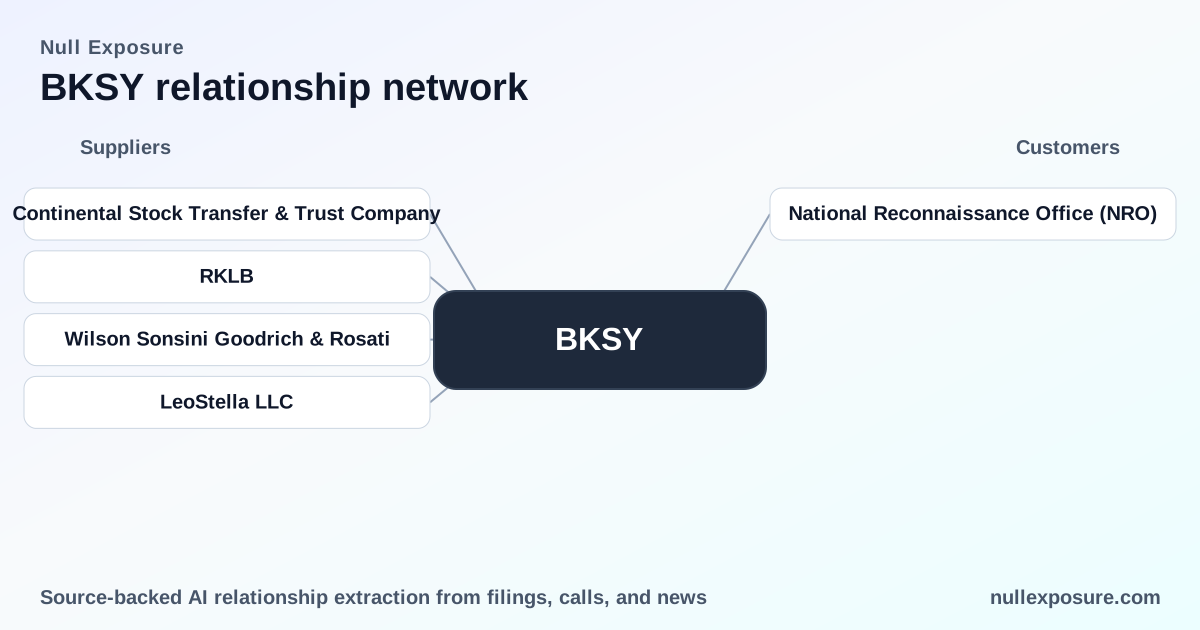
BlackSky (BKSY) — Gov‑centric space intelligence with subscription economics and lumpy contract upside
BlackSky operates a constellation of small satellites and a commercial analytics platform (BlackSky Spectra) that converts imagery into actionable intelligence. The company monetizes primarily through subscription-based imagery and software services (On‑Demand and Assured access), supplemented by professional and engineering services and multi‑year government contracts that deliver large, lumpy revenue events and recurring capacity payments.
Interested in tracking customer signals and contract flow? Visit https://nullexposure.com/ for a continual readout of commercial relationships and public notices.
Business model and how customers pay
BlackSky’s operating model is subscription-first: customers buy capacity and analytics access on either on‑demand or assured (priority) terms, with imagery and software revenue recognized ratably over the subscription period. The company also executes firm‑fixed price and time‑and‑materials professional services that are billed separately and often accompany larger government programs.
- Government concentration is high. FY2024 revenue split shows the U.S. federal government is the single largest end market and international governments also represent a material share. According to company filings for the year ended December 31, 2024, U.S. federal customers accounted for roughly $61.3 million, international governments about $38.0 million, and commercial customers approximately $2.9 million.
- Geographic profile is global but skewed. North America produced roughly $63.8 million of the company’s 2024 revenue and Asia Pacific about $22.8 million, highlighting both domestic defense reliance and meaningful APAC exposure.
- Contracting posture blends recurring subscriptions and long‑term fixed contracts. The firm sells multi‑year assured access programs (take‑or‑pay style) and longer engineering contracts; imagery and analytics revenue is recognized over the subscription term to reflect continuous capacity delivery.
- Economics are early and lumpy. Gross margins are solid, but the company is not profitable on the bottom line — fiscal metrics show negative EPS and operating losses while the market prices a premium multiple to revenue.
Customer relationships that matter right now
Below I cover the explicit customer relationships found in public reporting and press coverage. Each relationship is summarized in plain English with a source citation.
National Reconnaissance Office (NRO)
BlackSky is one of three vendors awarded into the NRO’s Electro‑Optical Commercial Layer (EOCL) program, a historic multi‑billion‑dollar effort to procure commercial electro‑optical imagery capacity; BlackSky also received a one‑year extension to continue delivering Gen‑2 imagery services into mid‑2026 under that EOCL arrangement. (Geospatial World, March 2026; company disclosure noting NRO contract extension, 2024–2026.)
National Geospatial‑Intelligence Agency (NGA)
Company announcements and market coverage highlight a multi‑year Gen‑3 defense contract referenced in connection with an NGA award framework worth up to approximately $290 million, underscoring BlackSky’s momentum in securing sizable government tasking for next‑generation services. (SahmCapital coverage, November 2025.)
What constraints and disclosures tell investors about operating risk and durability
Company‑level signals from filings and public statements provide a consistent picture of how BlackSky wins and retains business:
- Subscription and ratable recognition are the core of revenue permanence. Filings describe On‑Demand and Assured subscription offerings and state that imagery and analytics revenue is recognized ratably over the subscription term as BlackSky provides continuous satellite capacity and software services.
- Large, multi‑year contracts exist alongside smaller professional services engagements. Management discloses a mix of firm‑fixed price long‑term engineering contracts, time‑and‑materials work, and multi‑year assured access programs — a model that creates recurring revenue but also lumpier program receipts tied to contract awards.
- Government counterparties dominate the book. The company explicitly classifies its end markets as U.S. federal agencies, international governments and commercial customers, with the largest revenue shares from government customers in FY2024.
- Geographic diversification is real but limited. Filings show material North American exposure and meaningful APAC revenue; the company claims a global footprint of government and commercial customers.
- Materiality and mission criticality are documented. Public statements describe certain agreements as supporting mission‑critical operations and validate the company’s role in national security workflows.
- Renewals are proven on core programs. Filings note a one‑year NRO contract extension and a broader set of multi‑year renewals and awards in 2024 that point to contract durability for core capabilities.
- Scale and spend: large contract pool exists. Management disclosed new and renewed agreements up to $870 million in aggregate potential value in 2024, signaling the potential for high‑value bookings when programs are won.
Note: the renewal reference above explicitly names the NRO and is therefore tied to that relationship; all other constraints are presented as company‑level signals drawn from corporate disclosures.
Investment positives and the primary risk checklist
Key positives:
- Deep government relationships and inclusion in core programs like EOCL position BlackSky as a preferred commercial imagery supplier for U.S. and allied agencies.
- Subscription economics with assured capacity produce predictable, ratable revenue when programs are contracted and funded.
- Product differentiation through AI/analytics on BlackSky Spectra gives the company higher capture rates for value‑added services beyond raw pixels.
Primary risks:
- Customer concentration and funding risk: heavy dependence on U.S. and international government budgets makes revenue exposed to program re‑scopes and appropriations cycles.
- Lumpy contract timing: revenue and cash flow hinge on winning and executing multi‑year awards; timing mismatches can produce volatility in quarterly results.
- Valuation vs. profitability mismatch: the market values BKSY at a premium to revenue (Price‑to‑Sales ~12.65) while the business remains unprofitable on an EPS basis and produces negative operating margin.
Valuation and operational takeaways for active investors
BlackSky is a growth‑at‑a‑premium story that trades on the convergence of sovereign demand for persistent ISR and scalable commercial analytics. Market capitalization is roughly $1.35 billion with Price‑to‑Sales and Price‑to‑Book ratios that reflect a market expectation of substantial scale and margin expansion. Operationally, the company must demonstrate repeatable contract capture and steady conversion of asserted pipeline into ratable subscription revenue to justify current multiples.
If you track contract flow and customer renewals closely, BlackSky’s future profitability hinges on expanding software margins, increasing recurring assured revenue, and sustaining a high win rate on large government frameworks.
Need continuous signals on customer contract wins and program changes? Check ongoing monitoring at https://nullexposure.com/.
Bottom line
BlackSky is a government‑centric geospatial intelligence company with subscription economics, proven placements on major government programs (including NRO EOCL), and a growing pipeline of multi‑hundred‑million‑dollar opportunities. The investment case is straightforward: execution on contract wins and a shift from lumpy program receipts to durable, higher‑margin subscription revenue will unlock valuation; conversely, customer concentration and funding cycles remain the primary catalysts for near‑term volatility.