BK Technologies (BKTI): Customer Relationships that Drive Public-Safety Revenue
BK Technologies designs, manufactures and sells two-way land mobile radios and companion public-safety software, monetizing through hardware sales to government and commercial end‑users and through reseller agreements and software services. The company’s revenue engine is high‑margin radio hardware (BKR/KNG lines) sold primarily to North American public‑safety agencies, supported by targeted SaaS/mobile offerings and reseller channels. For investors, the customer base is both a growth lever and a concentration risk: federal and state procurement cycles generate lumpy, material awards, while lifecycle replacement demand in local agencies supports recurring product cycles. Learn more about how BKTI’s customer signals translate into credit and revenue exposure at https://nullexposure.com/.
Why customers matter for the valuation narrative
BKTI’s P&L and working capital profile are driven by a relatively small set of big public‑sector orders and a long tail of municipal and county purchases. Government procurement accounts for a substantial portion of revenue (roughly 38% of sales in 2024), creating both high‑visibility order windows and revenue volatility around grant and budget timing. At the same time, BKTI’s product focus on mission‑critical radio hardware means customer retention and technical interoperability are commercial advantages that support pricing and margin stability.
- Key commercial drivers: hardware margins, federal order cadence, strategic reseller agreements.
- Key risks: concentration in U.S. public customers, order lumpiness, and accounts‑receivable concentration identified in filings.
If you want a concise customer exposure map for underwriting or M&A diligence, BKTI’s profile is available at https://nullexposure.com/.
Company-level operating constraints and business model signals
- Contracting posture and criticality: BKTI sells mission‑critical communications equipment into public‑safety and defense channels; the business benefits from high switching costs on account of interoperability and lifecycle replacements. This is a company‑level signal drawn from product positioning and sector focus in filings.
- Customer concentration: Filings show government sales represented approximately 38% of revenue in 2024 and 49% in 2023, and one commercial customer accounted for ~13% of 2024 sales and ~24% of accounts receivable at year‑end 2024 — a signal of meaningful customer concentration risk when large orders occur.
- Geographic concentration: The business derives the majority of revenue in North America, with U.S. sales dwarfing international receipts, indicating regional policy and budget cycles materially affect revenue.
- Business maturity and segmentation: BKTI operates a single reportable segment focused on designing, manufacturing and marketing LMR hardware, supplemented by a SaaS/mobile unit (BKRplay) — implying capital intensity in manufacturing alongside higher margin, lower‑capex software initiatives.
- Materiality contrasts: While no commercial customer exceeded 10% of net sales in 2023, 2024 shows at least one commercial customer crossing the 10% threshold, highlighting an evolving concentration profile that investors must monitor.
Customer relationships — what the record shows
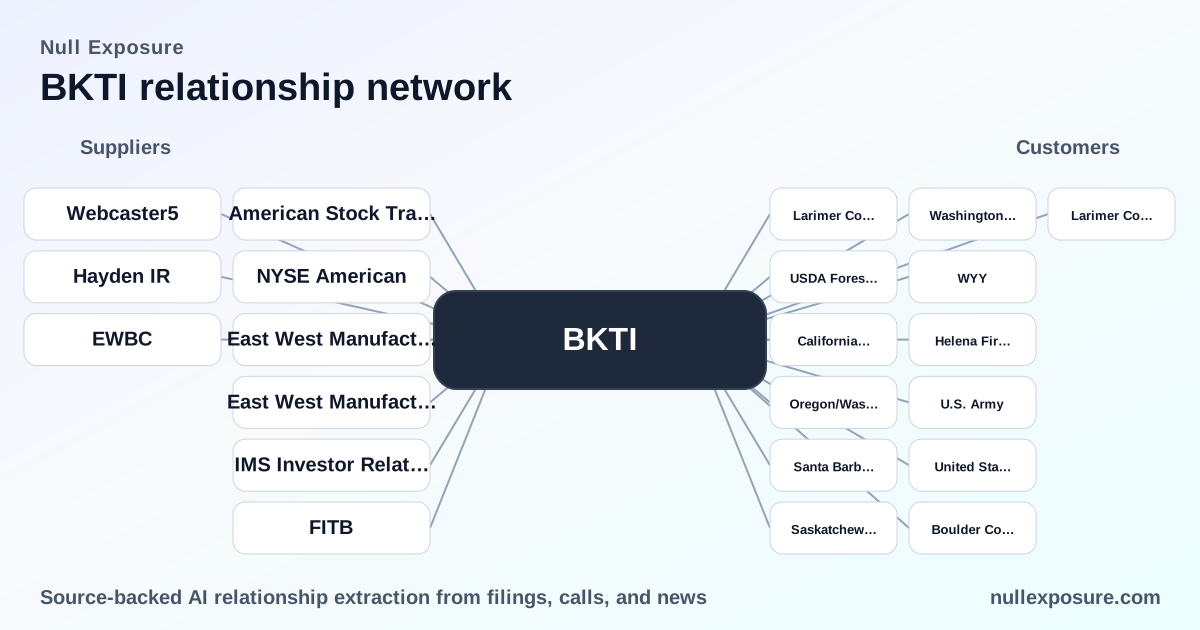
Below are the customer and partner names captured in company calls and press coverage, each with a short plain‑English summary and the cited source.
USDA Forest Service (USFS)
BKTI reported multiple purchase orders totaling $12.9 million from the USDA Forest Service received in July, which management said were a primary driver of sequential revenue strength. This is documented on both the company’s Q2 and Q3 2025 earnings commentary and in subsequent press releases. (Sources: BK Technologies Q2/Q3 2025 earnings calls; company press release, FY2025–FY2026.)
Larimer County Sheriff’s Office (Fort Collins, CO)
Larimer County placed an initial purchase order for RelayONE portable repeater kits to support search and rescue operations, representing early municipal adoption of BK ONE product extensions. (Sources: BK Technologies Q2 2025 earnings call; company press release and coverage in The Globe and Mail, FY2025.)
Santa Barbara County Fire Department
BKTI received a $500,000 purchase order for BKR 5000 radios from Santa Barbara County Fire, illustrating municipal fire departments’ procurement of the company’s portable units. (Source: ACCESSWIRE press release reported via FinancialContent, December 2022; cited in FY2026 results set.)
Saskatchewan Public Safety Agency
BK Technologies was awarded an approximately $2.0 million standing offer agreement by the Saskatchewan Public Safety Agency, expanding the company’s Canadian public‑safety footprint. (Source: ACCESSWIRE press release reported via FinancialContent, December 2022; FY2026.)
Washington State Department of Natural Resources
The company reported a $1.4 million follow‑on purchase order for BKR 5000 radios from Washington State DNR, signaling repeat state‑level procurement for wildfire and land‑management communications. (Source: ACCESSWIRE press release reported via FinancialContent, March 2023; FY2026.)
WidePoint Corporation (WYY)
BKTI signed a reseller agreement with WidePoint Corporation for the InteropONE PTToC service, signaling a channel strategy to bundle BK hardware with third‑party interoperability services. (Source: ACCESSWIRE press release via FinancialContent, March 2023; FY2026.)
California Department of Forestry and Fire Protection (Cal Fire)
BKTI received a $781,000 order for KNG series mobile radios from Cal Fire, reinforcing demand from major state wildfire‑response agencies. (Source: ACCESSWIRE press release via FinancialContent, March 29, 2023; FY2026.)
Oregon/Washington Bureau of Land Management
The company reported a $970,000 order for BKR 5000 radios from the Oregon/Washington BLM, adding to a pattern of regional land‑management agencies standardizing on BK equipment. (Source: ACCESSWIRE press release via FinancialContent, April 25, 2023; FY2026.)
Boulder County, Colorado
Boulder County is described as a longstanding and valued customer, consistent with BKTI’s municipal customer base and typical lifecycle replacement programs for county fleets. (Source: Critical Communications Review coverage, FY2024.)
Helena Fire Department (Helena, MT)
Helena Fire selected the BKR 5000 in a lifecycle replacement program for its wildland fire fleet, reflecting grassroots municipal upgrades that aggregate into meaningful order flow. (Source: Critical Communications Review press coverage, FY2021.)
U.S. Army (Camp Arifjan, Kuwait)
BKTI announced that the U.S. Army chose the BKR 5000 for deployment at Camp Arifjan, evidencing defense channel wins and exportable military use cases. (Source: Critical Communications Review press coverage, FY2021.)
What investors should take away
- Revenue concentration is real and measurable. Government customers drove a large portion of sales in recent years (38% in 2024; 49% in 2023), and discrete awards such as the USDA Forest Service orders can materially move quarterly receipts and backlog.
- North America is the primary market, so policy and wildfire budgets in U.S. states are direct demand levers.
- Product mix skews toward hardware manufacturing, but reseller agreements and the BKRplay smartphone offering provide optionality to capture service ecosystem value and stickier revenue streams.
- Counterparty and AR concentration requires monitoring, as filings flag one commercial customer representing ~13% of sales in 2024 and a large share of receivables, which could affect working capital if orders shift.
For a structured customer‑exposure report and model inputs you can use in investment or credit analysis, visit https://nullexposure.com/ for our BKTI coverage and downloadable summaries.
Bold, verifiable customer wins are underpinning BKTI’s recent performance, but investors must balance the upside of federal and state programs against the downside of order lumpiness and concentration in a largely North American public‑safety market.