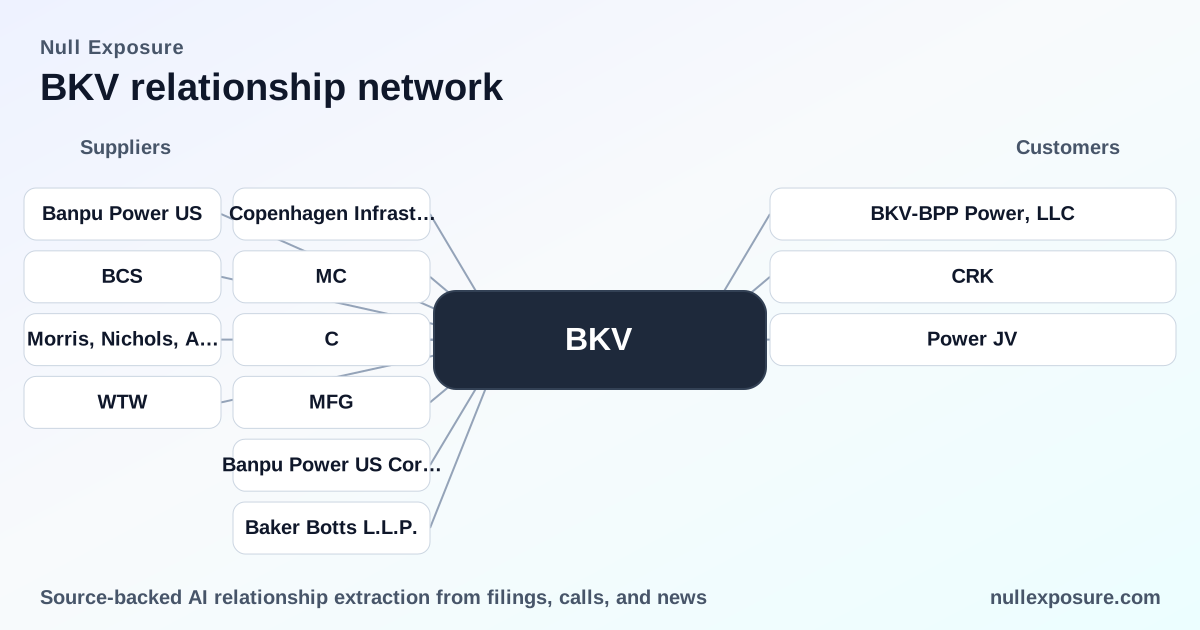
BKV Corporation: Customer relationships that anchor CCUS and downstream growth
BKV Corporation operates as an upstream and midstream energy company that monetizes through the sale of natural gas, NGLs and oil, fee-based midstream services, power generation, and a growing CCUS (carbon capture, utilization and storage) business. Revenue derives primarily from commodity sales and midstream/service fees, with CCUS contracts positioned as strategic, higher-margin, multi-year revenue streams beginning commercial operations in 2028. For further investor research and relationship intelligence, see https://nullexposure.com/.
How to read BKV’s customer links: commercial wins, service contracts and capital markets flows
BKV’s recent public disclosures and media coverage reveal three customer/partner clusters that matter to investors: (1) CCUS offtake and sequestration agreements with producers, (2) intra-group power joint-venture services and fee income, and (3) capital markets underwriting relationships that affect dilution and balance sheet capacity. These relationships collectively explain where growth, recurring fees, and financing risk converge in BKV’s model.
Material customer and partner relationships
Below are the relationships identified in the public record and press coverage. Each entry is a concise plain-English summary with the source cited.
Comstock Resources (CRK) — CCUS sequestration partner
BKV has signed definitive agreements to sequester CO2 from Comstock Resources’ Bethel and Marquet facilities in the Western Haynesville play, positioning those facilities as anchor feed for BKV’s CCUS commercialization scheduled to begin operations in 2028. According to BKV’s Q4 2025 earnings call transcript (March 2026) and corroborating coverage in The Globe and Mail and Futunn, these agreements are presented as foundational commercial CCUS contracts that link upstream emitters to BKV’s sequestration assets (BKV Q4 2025 earnings call; The Globe and Mail press release, March 2026; Futunn earnings summary, March 2026).
Key takeaway: CCUS contracts with a named producer like Comstock represent an operational shift from commodity-only revenue to fee-based, long-duration CCUS income.
Sources: BKV Q4 2025 earnings call transcript (March 2026); The Globe and Mail press release (March 2026) — https://www.theglobeandmail.com/investing/markets/stocks/BKV-N/pressreleases/420908/bkv-bkv-q4-2025-earnings-call-transcript/; Futunn earnings summary (March 2026) — https://news.futunn.com/en/post/69241822/earnings-call-summary-bkv-corp-bkvus-q4-2025-earnings-conference
CRK / Comstock mention in industry press — context for Haynesville hub
Independent industry commentary links BKV and Comstock in broader Haynesville CCUS narratives, citing Comstock’s April 2025 carbon capture agreement with BKV at Western Haynesville processing plants as a market-shaping development. A Sahm Capital industry note (March 2026) references this prior announcement as a catalyst for regional hub discussions.
Key takeaway: Third‑party industry coverage reinforces the strategic significance of the Comstock-BKV CCUS arrangement to regional gas and carbon infrastructure planning.
Source: Sahm Capital industry note (March 27, 2026) — https://www.sahmcapital.com/news/content/will-hosting-the-texas-gas-power-hub-with-nextera-reshape-comstock-resources-crk-western-haynesville-narrative-2026-03-27
BKV-BPP Power, LLC / Power JV — internal services and fee expansions
BKV provides administrative and services support to the Power JV (BKV-BPP Power, LLC) under an Administrative Services Agreement that was amended to expand the scope of services and increase fees payable to BKV. The merger information statement and Form PREM14C describe the Amended ASA and the enlarged fee structure, reflecting BKV’s role as a services provider to its power joint venture (PREM14C filing, March 2026).
Key takeaway: The Power JV is a revenue and fee source for BKV, converting internal group activities into externally visible service income and cash flows.
Source: PREM14C / preliminary merger information statement (March 2026) — https://www.stocktitan.net/sec-filings/BKV/prem14c-bkv-corp-preliminary-merger-information-statement-dfa96bd7b0a5.html
Power JV (separately noted) — additional filing context
The same PREM14C filing also references the Power JV in a separate entry; the substance reiterates that BKV expanded administrative and services support to the JV and negotiated higher fees under the amended agreement (stock filing, March 2026). This duplicate appearance in the results underscores the Power JV’s prominence in BKV’s internal contracting footprint.
Source: PREM14C / preliminary merger information statement (March 2026) — https://www.stocktitan.net/sec-filings/BKV/prem14c-bkv-corp-preliminary-merger-information-statement-dfa96bd7b0a5.html
RBC Capital Markets, LLC — equity underwriting and near-term capital flows
RBC Capital Markets is named as an underwriter in the Form 424B5 registration, agreeing to purchase common stock at $26.58 per share in a financing that generated approximately $147.5 million to BKV and $110.1 million to a selling stockholder (Form 424B5 / SEC filing, May 2026). This underwriting relationship directly affects BKV’s capital structure and available cash for capex, CCUS buildout, and balance sheet management.
Key takeaway: Underwriting activity through RBC influences dilution, liquidity, and the pace of project funding for BKV’s growth initiatives.
Source: Form 424B5 (May 2026) — https://www.streetinsider.com/SEC+Filings/Form+424B5+BKV+Corp/26148623.html
For a deeper dive into these counterparty dynamics and how they affect valuation drivers, visit https://nullexposure.com/.
Operational constraints and what they signal about BKV’s business model
BKV’s public disclosures and evidentiary excerpts produce clear company-level signals about how it contracts, where revenues are concentrated, and how critical certain relationships are to operations.
-
Counterparty mix: BKV transacts across a spectrum — from retail electricity customers served by its BKV Energy retail arm (the BKV-BPP Power JV launched a retail marketing business in February 2023, building >55,000 customers in deregulated Texas) to large and very large enterprise counterparties for gas marketing (utilities, LNG producers, majors). This implies diversified buyer types but mixed margin profiles (retail vs. wholesale).
- The excerpt explicitly naming the BKV-BPP Power Joint Venture supports attributing retail customer activity to that JV.
-
Geography and concentration: All revenues are generated in Pennsylvania and Texas, and BKV Energy’s licensed footprint is in deregulated Texas. Geographic exposure is concentrated in two states, which amplifies regulatory and regional commodity risk.
-
Materiality posture: Management states that loss of specific customers would be immaterial to consolidated financials because alternative purchasers are available; this signals low counterparty concentration risk for commodity sales but higher project concentration for CCUS, where individual offtake contracts (e.g., Comstock) carry strategic importance.
-
Contracting posture and revenue recognition: BKV recognizes revenue from commodity sales and fee-based midstream/service contracts; the company functions as both seller (commodity sales) and service provider (midstream and power JV services), implying a hybrid commercial model with both spot/term commodity exposure and recurring service fees.
-
Relationship maturity and stage: Public filings and earnings commentary classify many of these relationships as active, with CCUS contracts moving toward commercial operations in 2028 rather than being purely developmental.
Investment implications: what investors should watch
- CCUS commercialization is a value inflection. Definitive contracts with Comstock signal transition to fee-based CCUS revenue starting in 2028; investors should monitor execution timelines and producer delivery volumes.
- Power JV fee income de-risks operations but links cash flows to in-group arrangements. The Amended ASA increases fees to BKV and should be modeled as recurring service income.
- Financing and dilution matter. The RBC-led offering supplied substantial proceeds; watch future capital raises for project funding versus shareholder dilution.
Risk checklist:
- Execution risk on CCUS buildout and regulatory permitting
- Geographic concentration in PA and TX
- Timing mismatch between capital deployment and commercial CCUS revenue
Bottom line
BKV is evolving from a commodity-centric producer to a diversified energy services company where CCUS and intra-group service agreements materially affect revenue composition. Investors should price in successful CCUS commercialization by 2028, the revenue uplift from Power JV fees, and the capital markets activity that funds those ambitions. For ongoing coverage and relationship tracking, visit https://nullexposure.com/.