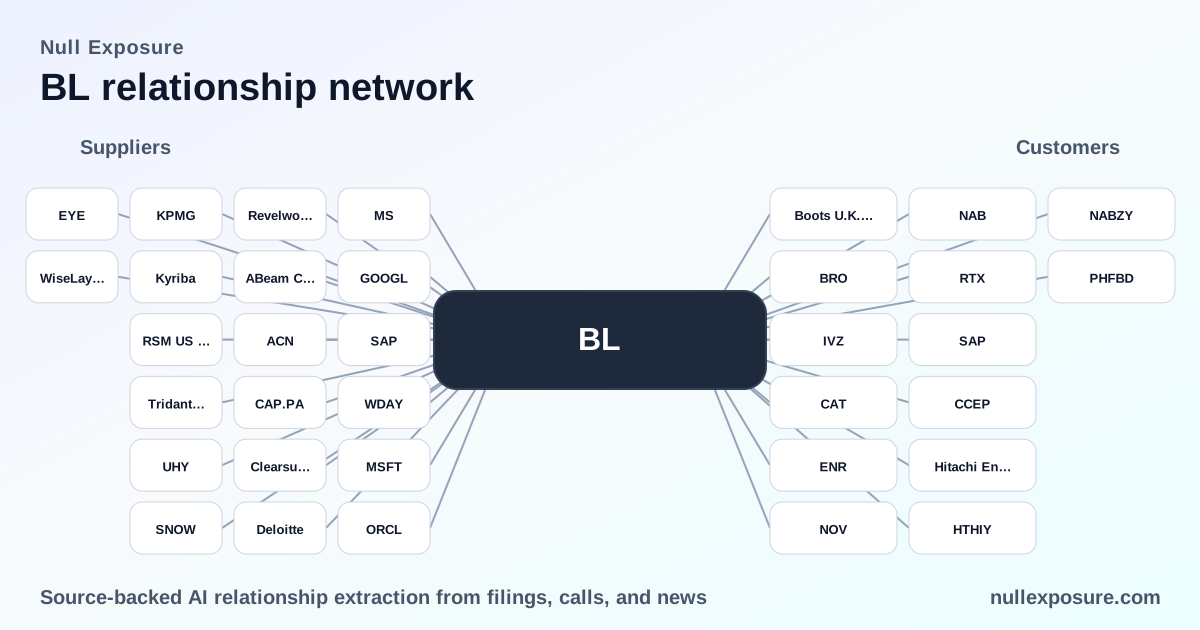
BlackLine’s customer map: enterprise wins, platform leverage, and what investors should price in
BlackLine sells cloud-native financial close and invoice-to-cash software on a subscription basis and monetizes primarily through recurring SaaS contracts plus a small services component. Approximately 95% of revenue is subscription-based, sold through a direct sales force and reseller partnerships (notably with SAP), with customers spanning large enterprises to mid-market and non-profit organizations across global markets. For investors, the customer signals in recent calls and releases point to continued enterprise validation, strategic partner leverage, and a low single-customer concentration risk—all supportive of predictable recurring revenue and margin expansion. Learn more about the coverage behind this note at https://nullexposure.com/.
Why the customer roster matters now
BlackLine is executing a two-part commercial playbook: land large strategic enterprise customers (mega deals with global brands) and embed platform capabilities—including Studio 360 and Verity AI—so expansions follow. Recent disclosures show new enterprise logos and significant expansions with existing customers across industries from CPG to oil & gas and pharmaceuticals. The mix of large enterprise and mid-market customers, together with international office footprint and roughly 30% of revenue generated outside the U.S., positions BlackLine as a globally distributed SaaS vendor whose growth relies on scale and renewals rather than lumpy professional services.
- Contracting posture: subscription-first with active subscription definitions, which supports predictable ARR and retention-led growth.
- Concentration: no single customer >10% of revenue historically, so customer concentration risk is immaterial at the company level.
- Service mix: professional services account for roughly 5% of revenue—BlackLine is primarily a software/recurring-revenue business.
- Sales channels: direct sales augmented by technology partners (SAP resell agreement) and professional services alliances.
Relationship-by-relationship: the wins, expansions and partners that matter
Below are every customer and partner referenced in recent BlackLine calls and releases, with a concise plain-English description and the cited source.
-
Boots U.K. Limited — BlackLine announced a “mega company” deal with Boots as part of the 2025Q3 results, highlighting integration with SAP as a differentiator. Source: BlackLine 2025Q3 earnings call.
-
Coca‑Cola Europe Pacific Partners (CCEP) — CCEP was named as a closed mega-company deal in 2025Q3, reinforcing BlackLine’s traction in large consumer goods finance organizations. Source: BlackLine 2025Q3 earnings call.
-
Brown and Brown (BRO) — Brown and Brown expanded from financial close into a full Invoice-to-Cash suite, illustrating typical land-and-expand behavior for long-standing customers. Source: Q4 2025 earnings call transcript reported by InsiderMonkey (FY2026).
-
BRO (ticker reference) — The transcript also references Brown and Brown by its ticker (BRO) when describing the same expansion into invoice-to-cash. Source: InsiderMonkey coverage of the Q4 2025 call (FY2026).
-
Invesco (IVZ) — BlackLine reported it re‑signed Invesco after the client had previously migrated to a lower-cost ERP competitor, signalling successful recapture and competitive displacement in financial services. Source: Q4 2025 earnings call (reported in InsiderMonkey, FY2026).
-
IVZ (ticker reference) — Invesco was referenced by ticker IVZ in company remarks about resigns and competitive dynamics in FY2026 commentary. Source: InsiderMonkey (FY2026).
-
Siemens Energy (ENR) — Siemens Energy was cited as a new win contributing to strong bookings, representing energy-sector demand for BlackLine’s finance transformation capabilities. Source: Q4 2025 earnings call (FY2026 commentary).
-
ENR (ticker reference) — Siemens Energy also appears referenced under the ENR ticker in call coverage describing select bookings. Source: Q4 2025 earnings call.
-
Caterpillar (CAT) — Caterpillar was listed among new enterprise wins that underscore penetration into industrial and manufacturing finance functions. Source: Q4 2025 earnings call.
-
CAT (ticker reference) — Caterpillar is also referenced by ticker in the company’s bookings commentary. Source: Q4 2025 earnings call.
-
National Oilwell Varco (NOV) — BlackLine secured a large enterprise win with NOV in oil & gas, highlighting verticalized expertise and platform approach driving digital finance transformation. Source: Q4 2025 earnings call.
-
NOV (ticker reference) — The NOV ticker appears alongside the National Oilwell Varco mention in earnings commentary on enterprise wins. Source: Q4 2025 earnings call.
-
National Australia Bank (NAB) — NAB was cited as a major win tied to the evangelism around Studio 360 and Verity AI, demonstrating traction with large financial institutions in APAC. Source: Q4 2025 earnings call.
-
Raytheon / RTX — Raytheon (RTX) was named among companies secured via strategic product evangelism, signaling defense and aerospace adoption of BlackLine’s AI-enabled offerings. Source: Q4 2025 earnings call.
-
RTX (ticker reference) — The RTX ticker was used in earnings remarks when describing partners evangelizing Studio 360. Source: Q4 2025 earnings call.
-
Bristol Myers Squibb (BMY) — Senior controllership leadership at Bristol Myers Squibb publicly committed to adopting AI capabilities embedded within BlackLine to reduce manual tasks and improve compliance and insight. Source: GlobeNewswire press release (April 14, 2026) and CPAPracticeAdvisor coverage (April 15, 2026).
-
Hitachi Energy — Hitachi Energy was described as having executed a large expansion, illustrating BlackLine’s capacity to drive upsell within established enterprise accounts. Source: Q4 2025 earnings call and FY2026 transcript coverage.
-
Accelerate (PHFBD) — BlackLine won a multi-solution deal with Accelerate, a middle-market specialty insurance exchange, reflecting success in mid-market insurance verticals seeking scalable finance platforms. Source: Q3 2025 earnings call.
-
PHFBD (ticker reference) — Accelerate was also listed with the PHFBD ticker in the Q3 2025 commentary. Source: Q3 2025 earnings call.
-
SAP — BlackLine maintains a partnership that allows SAP to resell BlackLine solutions as SAP SolEx, which materially expands GTM reach into SAP’s installed base. Source: trading commentary on BlackLine’s SEC 10‑K (reported via TradingView, FY2026).
What this cluster of relationships implies for investors
The customer list demonstrates a clear pattern: enterprise logos (CPG, industrial, energy, financial services, pharma) plus targeted mid-market insurance wins. That mix supports durable ARR growth through renewals and expansions rather than one‑off professional services.
- Growth levers: enterprise deals, partner resell motion with SAP, and product-led expansions (Invoice-to-Cash suite, Studio 360, Verity AI).
- Risk profile: customer concentration is low at the company level and services are a small portion of revenue, which reduces project-related margin volatility.
- Operational posture: subscription-driven revenue, direct sales emphasis, and active global footprint position BlackLine to scale across regions with predictable monetization.
For more investor-focused coverage and to track customer signals across filings and calls, visit https://nullexposure.com/.
Bottom line
BlackLine’s recent disclosures show continued success landing large, cross-industry enterprise customers while expanding usage with existing accounts, underpinned by a subscription-heavy revenue model and strategic channel relationships such as SAP. These dynamics support recurring revenue predictability and expansion-driven growth, while low single-customer concentration keeps downside customer risk limited.