Bausch + Lomb: Customer Concentration, Distribution Reach, and What It Means for BLCO Investors
Bausch + Lomb operates as a global eye‑health manufacturer that sells contact lenses, lens care, OTC eye products, surgical devices and select contract manufacturing services, monetizing primarily through spot product sales to large distributors, retail chains and professional channels and secondarily through contract manufacturing revenue. For investors, the key commercial dynamics are high reseller concentration in 2024, point‑in‑time revenue recognition on shipped goods, and a global go‑to‑market built around major wholesalers and retail partners. For primary research and sourcing on counterparties, visit https://nullexposure.com/ for direct access to the underlying filings and signals.
Major customers that move the top line
Below I summarize each customer relationship disclosed in public materials and how it factors into BLCO’s revenue base.
-
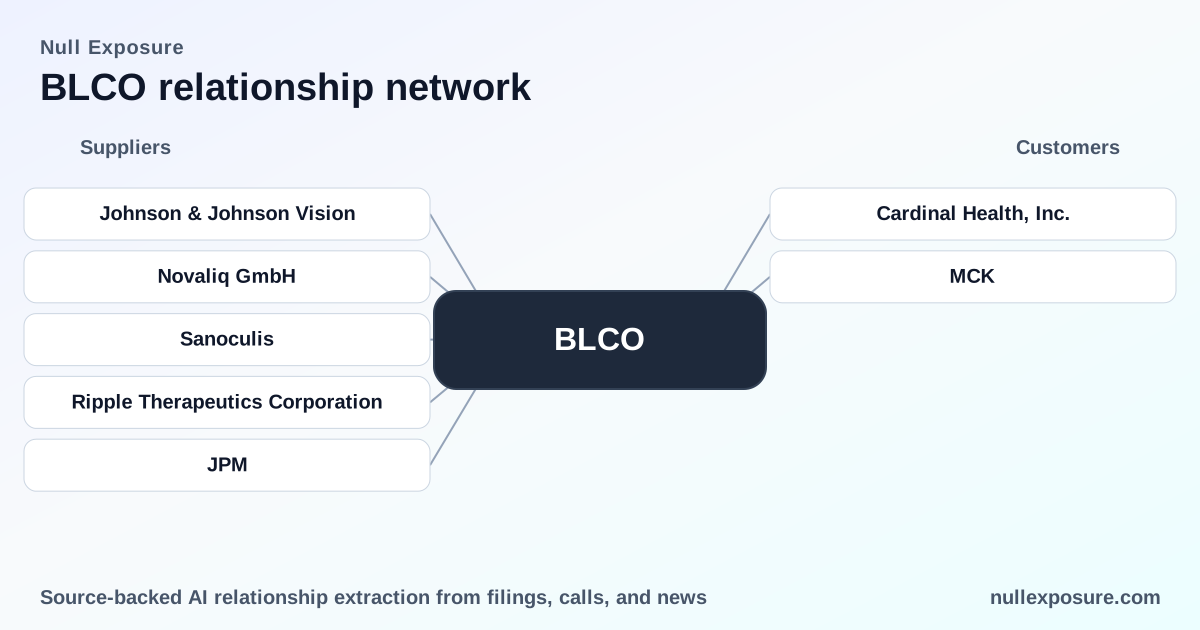
McKesson Corporation — large, material wholesaler. According to Bausch + Lomb’s FY2024 Form 10‑K, McKesson accounted for 10% of total revenues in 2024, categorizing it as a material customer that drives working capital and receivable exposures. (Company Form 10‑K, FY2024)
-
Cardinal Health, Inc. — another top‑tier distributor with material share. The FY2024 Form 10‑K lists Cardinal Health as accounting for 10% of total revenues in 2024, reinforcing a concentrated wholesaler channel for BLCO. (Company Form 10‑K, FY2024)
-
CVS Health — strategic retail/customer relationship in consumer channels. In a Q4 2025 earnings transcript reported by The Globe and Mail, management described CVS as “a really important customer” for coverage and consumer portfolio distribution, highlighting BLCO’s effort to partner with large retail payors and chains that manage Medicare lives. (Earnings transcript, Q4 2025; The Globe and Mail, May 2026)
How the customer mix defines the business model
Bausch + Lomb is fundamentally a manufacturer‑seller with a distribution‑heavy go‑to‑market. Several company signals explain the operating posture:
-
Spot, point‑in‑time revenue recognition. The company recognizes product revenue when customers obtain control of goods—generally upon shipment or receipt—indicating predominantly transactional, non‑subscription commerce rather than long‑dated contracted revenue. (Revenue recognition policy, FY2024 filing)
-
Large enterprise counterparties dominate. Filings state that a significant portion of sales flow through major healthcare distributors and retail chains across the United States, Canada and abroad; the company also disclosed its two largest U.S./Canada wholesalers accounted for roughly 17% of net trade receivables as of December 31, 2024. This underlines counterparty scale and credit concentration as central commercial characteristics. (FY2024 filing)
-
Global footprint with regional regulatory complexity. BLCO sells in approximately 100 countries and derives the majority of its sales from North America ($2,413 million attributed to U.S. and Puerto Rico in 2024 on a $4,791 million total), while EEA regulatory changes affect a meaningful portion of revenue where BLCO is the legal manufacturer or distributor. Geographic scale increases regulatory and registration complexity, particularly in EMEA. (FY2024 geographic disclosure; regulatory commentary, FY2024 filing)
-
Distribution and reseller roles are core. The company markets through direct sales forces and wholesalers and sells through retailers and eye‑care professionals, positioning BLCO as both manufacturer/seller and supplier to independent distributors. Contract manufacturing exists but is explicitly described as not material. (Commercial channels disclosure, FY2024 filing)
Operational constraints and governance signals investors should note
BLCO’s filings and disclosures generate clear signals on maturity, criticality and concentration:
-
Material counterparty concentration is present and quantifiable. McKesson and Cardinal each represented 10% of revenues in 2024, placing them in the company’s defined “major customers” grouping; this creates measurable downside risk to revenue and collections if either relationship changes. (FY2024 Form 10‑K)
-
High spend bands and receivable exposure. The FY2024 disclosure supporting the major‑customer listing sits alongside a note that the company’s two largest wholesalers account for ~17% of net trade receivables, consistent with a >$100 million per‑counterparty economic scale for top customers. (FY2024 filing)
-
Point‑in‑time contracts reduce revenue visibility but simplify backlog. Because sales are recognized on shipment, BLCO has lower contractual revenue visibility quarter‑to‑quarter versus firms with long‑term supply contracts; the trade‑off is operational simplicity in order fulfillment and inventory turnover. (Revenue recognition policy, FY2024 filing)
-
Regulatory concentration in EMEA raises product registration risk. New EEA medical device regulations affect products for which BLCO is legal manufacturer, importer or distributor and support registrations in other markets, placing a regulatory dependency on EEA approvals for parts of global sales. (EEA regulatory disclosure, FY2024 filing)
-
Rebate and Medicaid exposure affects gross margins and working capital. The company disclosed accrued variable consideration (rebates) of $497 million as of December 31, 2024, which is large relative to total revenues and highlights payer/pricing complexity in certain product categories. (Audit/financial disclosures, FY2024 filing)
What investors and operators should do next
-
For portfolio managers: treat BLCO as a manufacturing franchise with concentrated wholesale customers; monitor contract renewal dynamics and credit risk at McKesson and Cardinal, and watch incremental retail expansion via partners such as CVS for margin and volume upside.
-
For operators evaluating counterparty risk: prioritize credit monitoring and contingency sourcing for top distributor channels, and accelerate regulatory compliance programs for EMEA product registrations to protect cross‑border registrations.
-
For deeper primary materials, legal filings and customer signal monitoring, consult our research hub at https://nullexposure.com/ to access the filings and relationship snapshots referenced here.
Bottom line — concentrated distribution is BLCO’s commercial engine and risk focal point
Bausch + Lomb’s model of manufacturing and selling through large enterprise distributors and retail partners produces efficient scale and broad geographic reach but concentrates revenue and receivables in a few counterparties. McKesson and Cardinal are explicitly material customers (10% each in 2024) and CVS is a strategically important retail partner in the consumer portfolio, per management commentary. Investors should weigh the benefits of scale and diversified product lines against concentration, rebate liabilities, and regulatory execution risk in EMEA when sizing exposure to BLCO.