TopBuild (BLD): How customer relationships and a small M&A bolt-on reshape growth
TopBuild operates two related but distinct businesses — a high-volume installation services platform and a specialty distribution network that sells insulation and building products — and monetizes through short-duration installation contracts and product sales to builders, contractors and homeowners. Revenue is driven by volume, territorial scale and bolt-on acquisitions, with the company leveraging national branch coverage to cross-sell distribution and installation services. For a deeper look at the firm’s customer exposure and recent deal flow, visit NullExposure.
Business model in plain terms: transactional scale plus roll-up economics
TopBuild’s operating model is fundamentally transactional. The Installation segment performs insulation and building-product installs for single-family, multi-family and commercial customers, while the Specialty Distribution arm sells and distributes insulation, rain gutters and related accessories. Company disclosures make two points central to revenue quality:
- Contracts are short-term and transaction-focused — customer arrangements are generally less than 90 days, so there is limited embedded financing and revenue recognition follows discrete performance obligations.
- Customer mix is broad and fragmented — the firm sells to national and regional homebuilders, commercial contractors, remodelers and individual homeowners, implying low counterparty concentration but strong sensitivity to construction cycles.
Those characteristics produce a business that scales by adding branches and tuck-in acquisitions, increasing density in local markets where cross-selling between distribution and installation lifts margins. TopBuild’s scale is material: the company reported roughly $5.41 billion in trailing twelve‑month revenue and an EBITDA margin profile consistent with specialty contracting and distribution economics.
What the record shows: Johnson Roofing added as a commercial bolt-on
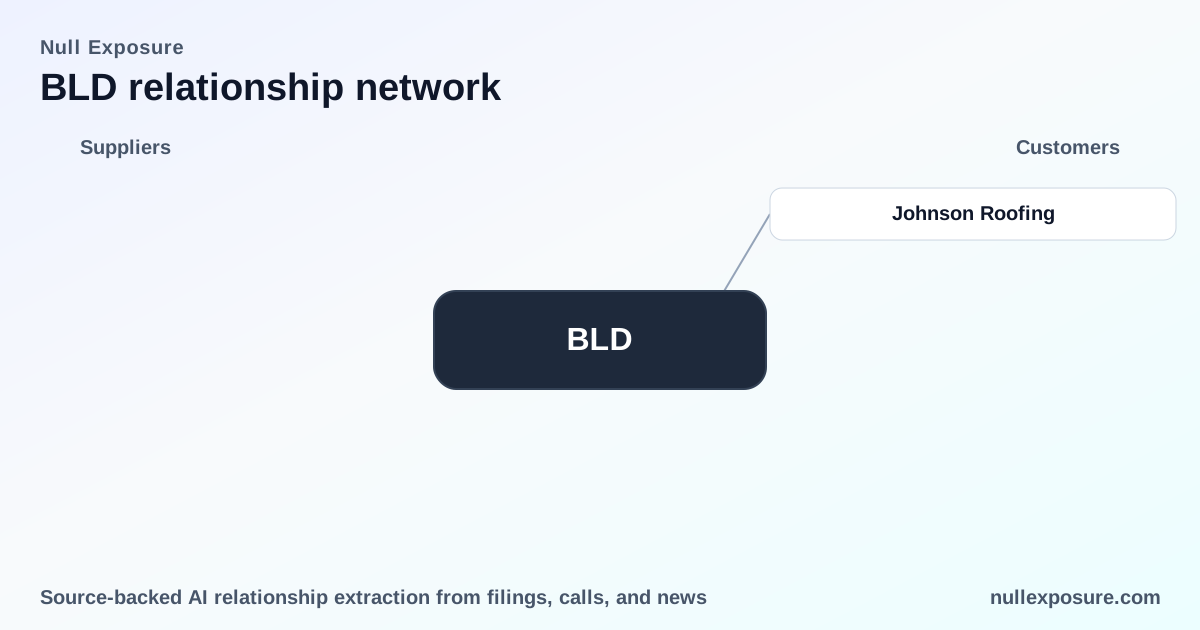
TopBuild announced an acquisition in its Q4 2025 earnings call: Johnson Roofing, described as a commercial roofing addition. According to TopBuild’s 2025 Q4 earnings call (first reported March 8, 2026), the company stated, “We also announced our second commercial roofing acquisition earlier this week, Johnson Roofing.” This is a deliberate expansion into complementary commercial exterior services that aligns with the company’s roll-up playbook. (Source: TopBuild 2025 Q4 earnings call, March 8, 2026.)
Every customer/partner mention in the record
Johnson Roofing — The company announced the acquisition of Johnson Roofing during its 2025 Q4 earnings call, positioning this as a second commercial roofing bolt-on to expand service offerings in the commercial exterior space. (TopBuild 2025 Q4 earnings call, reported March 8, 2026.)
Constraints that define topline durability and margin behavior
TopBuild’s public disclosures and segment descriptions create several actionable signals for investors evaluating customer risk and revenue quality. These are company-level characteristics—none is attached to a specific counterparty unless the disclosure explicitly names that counterparty.
- Contracting posture: short-term and transactional. The company states contracts generally run under 90 days, which reduces financing risk but increases volatility tied to project starts and local construction activity. This makes revenue cadence lumpy but simplifies receivables financing.
- Counterparty profile: mixed residential, commercial and individual end-users. TopBuild’s Installation customers include national and regional single-family builders, custom builders, multi-family projects, commercial general contractors, remodelers and homeowners — a broad set that reduces single-client concentration but raises cyclicality exposure to housing and commercial construction trends.
- Geography: North America-focused. Operations are primarily in the U.S. with a lesser presence in Canada, concentrating macroeconomic and housing-cycle risk in North American markets.
- Role duality: seller/distributor and service provider. The Specialty Distribution business acts as a seller and distributor of building materials, while Installation functions as a direct service provider; both segments are complementary but face distinct margin drivers and working capital profiles.
- Segment maturity and scale: established national footprint with roll-up dynamics. Installation operates across roughly 250 branches; distribution feeds local installers and contractors — a mature, scalable footprint that supports bolt-on acquisitions and local market density gains.
Together, these constraints indicate a business optimized for scale and local market dominance, with predictable margin expansion when acquisitions and cross-selling increase utilization and branch throughput.
Investment implications and a focused risk checklist
TopBuild’s structural profile yields a set of investment trade-offs investors should weigh:
- Growth vector: Acquisition-led expansion into adjacent service lines (commercial roofing, for example) is a clear growth lever and a method to deepen customer relationships and increase lifetime value per territory.
- Revenue predictability: Short-term contracts mean revenue is highly correlated with construction starts and seasonal patterns; macro and housing-cycle risk are primary drivers of near-term performance.
- Working capital dynamics: Distribution sales and installation jobs imply inventory and receivables variability; the less-than-90-day contract horizon reduces long-term financing risk but keeps cash conversion tied to project timing.
- Customer concentration: The broad counterparty mix signals low single-customer concentration, which improves downside protection relative to firms dependent on a few large accounts.
- Valuation context: With a market capitalization in the neighborhood of $12.1 billion and an EV/EBITDA multiple that reflects the company’s earnings power, TopBuild trades as a growth-and-scale business rather than a defensive contractor.
For investors tracking customer-level signals or competitive moves, TopBuild’s continued tuck-in activity — exemplified by Johnson Roofing — is the operational lever to watch. If you want a consolidated feed of customer and relationship signals for due diligence, see more on NullExposure.
Bottom line: roll-ups, local scale and construction cyclicality
TopBuild’s revenue engine is transactional, branch-scale and acquisition-amplified. Short contract durations and a diffuse customer base lower financing risk and concentration risk but elevate sensitivity to building activity and seasonality. The Johnson Roofing acquisition is a microcosm of TopBuild’s strategy: expand service depth in existing markets to capture more of the exterior/building lifecycle and lift revenue density per branch. For investors and operators, the critical lens is not whether the company can find targets, but whether those targets sustainably increase utilization and margins across the installation and distribution footprint.