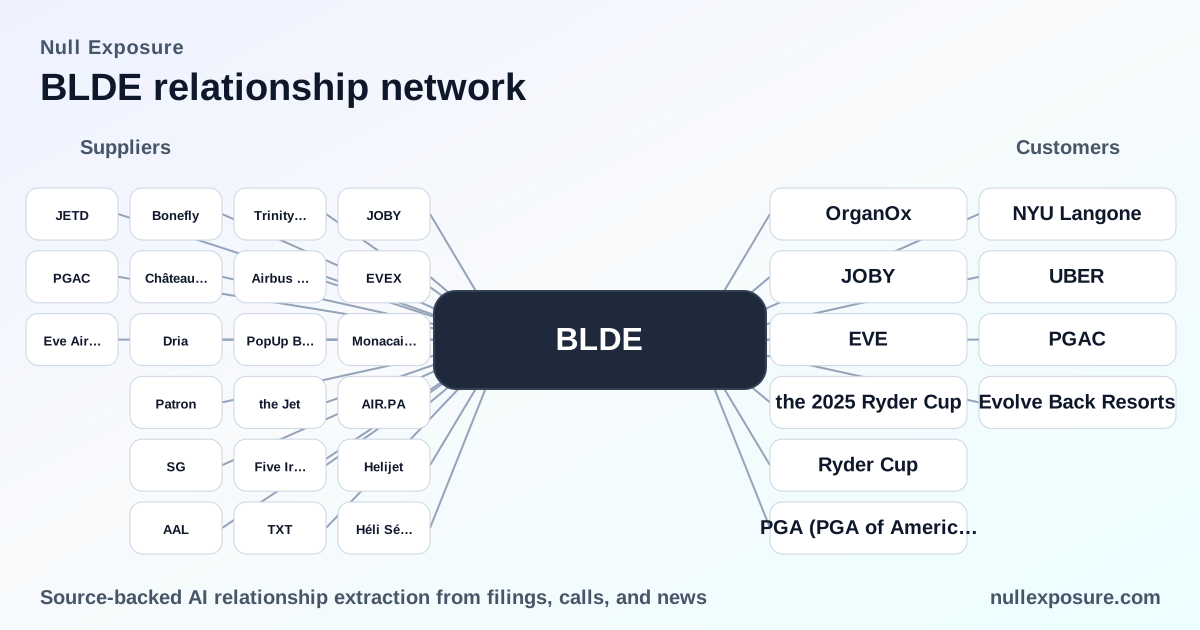
BLDE Customer Relationships: Who Fuels Blade’s Next Act and What Investors Should Know
Blade Air Mobility historically monetizes an urban air-mobility platform by selling premium point-to-point rotorcraft and specialized air-transport services to consumers, hospitality partners, and institutional clients; since 2025 it has materially reshaped that revenue mix through a strategic sale of its passenger business while retaining and growing specialized verticals such as organ transport and event partnerships. Investors should view Blade less as a standalone helicopter-ride operator today and more as a portfolio of commercial partnerships and mission-critical medical services whose value is being redeployed via strategic exits and integrations. Learn more about our coverage at https://nullexposure.com/.
Executive thesis — what changed and why it matters
Blade sold its core passenger mobility business to Joby Aviation in 2025 for up to $125 million, a transaction that transfers routes, customers and infrastructure into Joby’s eVTOL commercialization plan while leaving Blade positioned around differentiated, higher-margin services (notably organ transport) and white‑label partnerships. That transaction converts operating exposure into partnership and cash optionality, while increasing reliance on third parties and strategic licensing for revenue growth.
The relationships roster: every partner and what they mean for BLDE
Below I cover each relationship flagged in the records and state what it signals for Blade’s business and near-term strategy.
OrganOx
Blade management described the OrganOx engagement as an example of going “to lengths” to accommodate new technology in a 2025 Q2 earnings call, signaling a deliberate operational commitment to organ-transport services. According to Blade’s 2025 Q2 earnings commentary, the OrganOx partnership underscores Blade’s continued emphasis on medical logistics and bespoke flight support (earnings call, FY2025Q2).
Eve / EVE (Embraer spin‑out)
Blade supplied helicopters for an eVTOL operational simulation run by Eve in Chicago in 2022, providing a testbed for passenger flow, ground services and operator needs that feeds the broader urban air mobility ecosystem. AeroTime’s coverage of the Chicago simulation (FY2022) documents Blade’s role as on‑the‑ground operator for Eve’s early operational studies (AeroTime, FY2022).
Joby Aviation / JOBY
Joby entered a definitive agreement in 2025 to acquire Blade’s passenger business for up to $125 million in stock or cash, creating direct operational integration between Joby’s eVTOL rollout and Blade’s existing routes and terminals. Joby’s press release and contemporaneous reporting note the deal structure, the inclusion of routes and infrastructure, and $35 million of holdbacks tied to milestones and retention (Joby press release and TravelAgentCentral, FY2025).
Joby-related press and market commentary
Multiple outlets framed Joby’s acquisition as an accelerant for air‑taxi commercialization and market access to Blade’s customers and terminals; analysts have highlighted this as a strategic shortcut for Joby’s go‑to‑market. MarketBeat and LA Times coverage (FY2025) emphasize Joby’s strategic rationale—buying a ready-made passenger network to jumpstart eVTOL deployment (LA Times, MarketBeat, FY2025).
Ryder Cup (the 2025 Ryder Cup)
Blade Urban Air Mobility, now a division aligned with Joby, served as the Official Air Mobility Partner for the 2025 Ryder Cup, demonstrating how event partnerships are monetized via premium last‑mile aviation and branded experiences. The partnership was announced in Joby’s and VerticalMag’s communications outlining Blade’s role at Bethpage Black (press release, FY2025).
PGA / PGA of America (PGAC)
The PGA partnered with Blade/Joby to provide VIP access and an on‑course lounge for Ryder Cup passengers, illustrating high‑margin event and hospitality integrations that monetize premium attendee travel. VerticalMag quotes PGA partnership comments tied to the Ryder Cup experience (VerticalMag, FY2025).
Ocean Casino Resort
Blade had a commercial partnership enabling nonstop helicopter service from NYC to Ocean Casino Resort’s rooftop helipad, a classic hospitality distribution arrangement that drives ticketed premium travel and cross‑sell with resort stays. ROI‑NJ reported the resort’s partnership with Blade to offer this direct link (ROI‑NJ, FY2024).
NYU Langone
Blade’s MediMobility unit originated in collaboration with NYU Langone and other hospitals to facilitate organ transportation up to 400 miles from NYC, establishing Blade’s reputation in time‑critical medical logistics. Coverage of MediMobility’s launch cites NYU Langone as an early partner (Sherwood.news, reporting on FY2024 historical activity).
Evolve Back Resorts
Blade established a tie-up with Evolve Back Resorts to let customers book flight and stay packages, landing guests directly at resort helipads—an indication of Blade’s distribution partnerships with luxury hospitality and tour operators in international markets. Indian Express documented this partnership and the integrated booking approach (Indian Express, FY2021).
Uber / UBER
Uber announced plans to integrate Blade helicopter rides into its app in 2026 through a new phase of its partnership with Joby, positioning Blade services inside a multimodal mobility super‑app and expanding distribution channels for premium air travel. The Jerusalem Post summarized Uber’s plan to add Blade services as part of a broader mobility strategy (JPost, FY2025).
What these relationships collectively reveal about Blade’s operating model
Blade’s partner list shows a deliberate move from standalone ride‑share operator toward an asset‑light, partnership‑driven model that monetizes routes, brand, and specialized services. Consider these structural signals:
- Contracting posture: Blade historically executed direct operator contracts (ticket sales, charters) but the Joby transaction shifts the company toward transactional divestiture and partnership licensing, increasing reliance on counterparties for core customer access.
- Concentration: The sale of the passenger business reduces single‑asset operational concentration but concentrates Blade’s value in differentiated verticals (medical logistics, branded event services) and in cash or equity proceeds from divestitures.
- Criticality: Medical services like MediMobility represent high criticality—time‑sensitive contracts with hospitals are less fungible than leisure routes and support a premium margin profile.
- Maturity and market position: Blade’s partnerships with major hospitality brands, event franchises, and emerging eVTOL OEMs position it as a commercial bridge to new air‑taxi entrants; the company’s maturity is now reflected in monetizing infrastructure and relationships rather than scaling a legacy passenger fleet.
Risk and upside — an investor’s checklist
- Upside: The Joby sale crystallizes value from Blade’s passenger operations and gives Blade cash/stock optionality to scale high‑value niches (medical logistics, branded partnerships). Event and hospitality integrations offer recurring premium revenue with limited marginal asset investment.
- Risk: Business model now relies on counterparties (Joby, Uber, large venues), so integration and revenue share terms drive future upside; loss of direct passenger operations reduces control over customer experience and data monetization.
Closing guidance
Blade’s business is now about proprietary services and platform value rather than helicopter seat‑sales. Investors should track milestone payments and holdbacks from the Joby deal, the commercial traction of MediMobility contracts, and the company’s strategy for redeploying proceeds into scalable, mission‑critical services. For a deeper look at relationship‑level exposure and contract signals, see our platform at https://nullexposure.com/.
Continued monitoring of partner milestones and event deployments will determine whether Blade converts strategic exits into sustainable, higher‑margin revenue streams.