Blade (BLDEW) — Sale to Joby Reframes the Business; What investors need to know
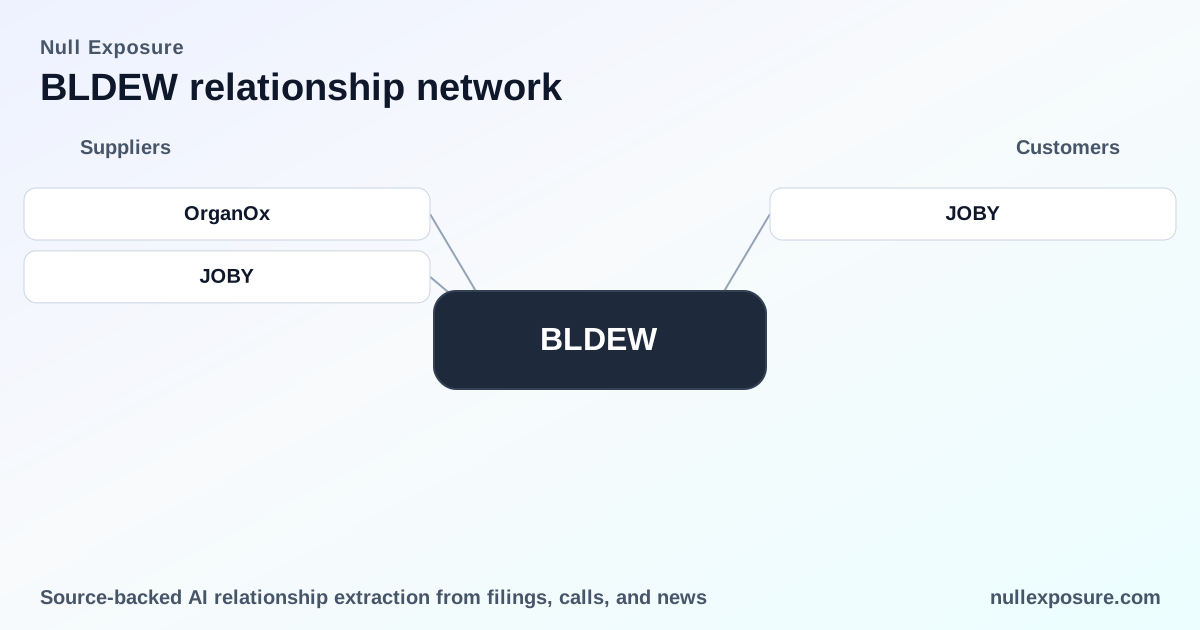
BLDEW operates the Blade Passenger business and monetizes through passenger transportation operations and discrete asset monetizations; the company executed a strategic divestiture in 2025 that converts operating exposure into near-term cash proceeds and contingent consideration. The sale of Blade Passenger to Joby Aviation for up to $125 million is a decisive liquidity event that changes revenue mix, counterparty concentration, and the company’s contract posture. Learn more at https://nullexposure.com/.
The headline: a clear, cash-focused transaction
BLDEW announced in its 2025 Q2 earnings call that it sold the Blade Passenger business to Joby Aviation for up to $125 million. The deal converts an operating segment into a measurable, capped payout and removes a line-item of recurring passenger revenue from Blade’s P&L going forward. According to the company’s 2025 Q2 earnings remarks (reported March 7, 2026), “Yesterday, we announced the sale of the Blade Passenger business to Joby Aviation for up to $125 million.”
This transaction changes the company’s risk and return profile in several concrete ways:
- Immediate liquidity: a capped cash consideration that strengthens the balance sheet in the near term.
- Operational de-risking: divestiture removes operating obligations tied to passenger services and shifts future upside to contingent payments rather than continued operational cash flow.
- Counterparty concentration: Joby becomes a primary counterparty to the sale, increasing BLDEW’s exposure to a single acquirer for this material transaction.
How the operating and business model shifts after the sale
The sale signals a transition from a service operator to an entity that can monetize assets and reallocate capital. From an investor standpoint, key characteristics of BLDEW’s new posture are clear:
- Contracting posture: The company has moved from running passenger operations to a seller role with defined purchaser terms and contingent consideration; future economics are more contract-driven than operationally variable.
- Concentration: With the passenger unit disposed, revenue concentration will depend on remaining assets and businesses; the Joby transaction concentrates near-term value realization in a single buyer-driven arrangement.
- Criticality: The passenger business was a visible customer-facing asset; its sale reduces BLDEW’s operational criticality in urban air mobility operations while increasing reliance on the performance of the sale agreement for value capture.
- Maturity: Executing a sale for up to $125 million suggests the business reached a monetizable stage where an exit generated meaningful proceeds rather than incremental operating investment.
These are company-level signals derived from the disclosed transaction and are useful when benchmarking BLDEW against peers in mobility and asset-heavy services.
Relationship details — every disclosed relationship in the record
JOBY
BLDEW disclosed the sale of its Blade Passenger business to JOBY in its 2025 Q2 earnings call, with the transaction valued at up to $125 million. According to BLDEW’s 2025 Q2 earnings remarks (first reported March 7, 2026), the sale was announced “yesterday,” confirming JOBY as the purchaser in this material divestiture.
Joby Aviation
Joby Aviation is identified by name as the acquirer of Blade Passenger; the company will pay up to $125 million as disclosed on BLDEW’s 2025 Q2 earnings call. The same earnings call text states plainly that the Blade Passenger business was sold to Joby Aviation for the capped consideration announced on March 7, 2026.
(Note: Both entries in the public record reference the same event and the same source text from BLDEW’s 2025 Q2 earnings call, which is the primary disclosure for this relationship.)
What this means for valuation and risk
Investors should treat the Joby transaction as a liquidity and strategy inflection point rather than merely a one-off cash receipt. Key implications:
- Valuation mechanics: The capped consideration of $125 million provides a discrete uplift to enterprise value if collected in full, but contingent elements of the deal (timing and performance triggers) will determine realized value and should be modeled explicitly.
- Earnings profile: Removing the passenger business reduces operating revenue but eliminates operating cost and capital demands associated with that segment; EBIT volatility is likely to decrease while non-operating income from the sale replaces recurring cash flow.
- Counterparty risk: Joby’s ability and incentive to fulfill contingent payments are material to BLDEW’s realized proceeds; investors should monitor subsequent filings or communications for payment schedules and any escrow arrangements.
- Strategic optionality: Proceeds can be redeployed to higher-return uses, used to shore up the balance sheet, or returned to shareholders — management’s stated capital allocation plan post-sale will be a decisive driver of shareholder value.
Near-term watchlist for investors
- Payment realization: Track subsequent company disclosures for timing and certainty of the up to $125 million consideration and any earnout mechanics.
- Capital allocation: Watch how BLDEW deploys sale proceeds — deleveraging, buybacks, or reinvestment will materially affect returns.
- Residual business transparency: Demand clarity on what parts of the business remain, their revenue contribution, and how management will replace lost passenger-revenue capacity.
- Counterparty monitoring: Follow Joby’s disclosures and financial health, since the acquirer’s performance directly affects BLDEW’s realized value from the deal.
For a concise, ongoing view of BLDEW’s customer relationships and related transaction risk, visit https://nullexposure.com/ for detailed tracking and alerts.
Bottom line
BLDEW has executed a material strategic divestiture by selling the Blade Passenger business to Joby Aviation for up to $125 million, converting operating exposure into contracted consideration. This is a liquidity-focused move that reshapes revenue composition, concentrates near-term value capture with Joby, and requires active investor monitoring of payment realization and management’s capital allocation decisions.