Ballard Power Systems (BLDP): Customer Map and Commercial Signals for investors
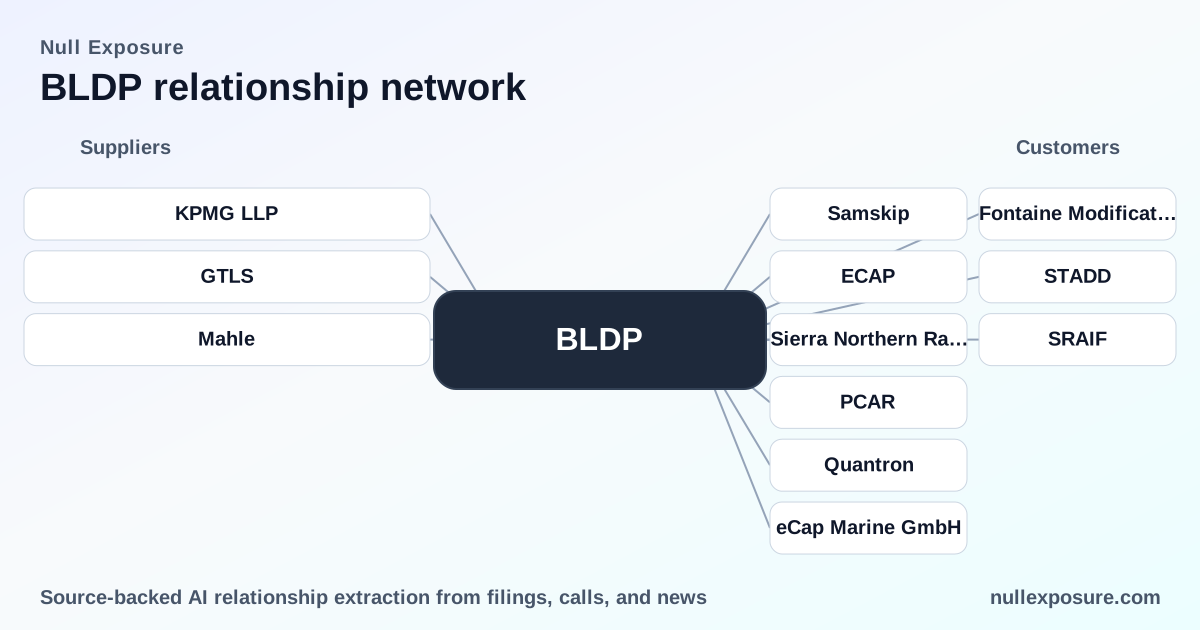
Ballard Power Systems designs, manufactures and services proton exchange membrane fuel-cell engines and sells them to OEMs and fleet operators across bus, rail, marine and heavy-duty trucking markets. The company monetizes through engine module sales, multi-unit supply agreements and follow-on service relationships, with recent order flow concentrated in a handful of large commercial and marine awards that drive near-term revenue recognition. For a focused view of Ballard’s customer dependencies and contracting posture, review the relationship breakdown below.
For strategic monitoring and ongoing customer-intel coverage, visit the NullExposure homepage: https://nullexposure.com/
What the customer roster signals about Ballard’s go-to-market
Ballard’s customer list in recent filings and press coverage shows a clear industrialization path: OEM partnerships for buses and trucks, targeted marine deployments, and rail system integrations. The commercial pattern is dominated by large, explicit purchase commitments and framework agreements rather than spot, one-off sales — evidence of a supplier posture oriented toward multi-year OEM programs. Ballard’s TTM revenue (~$99.4M) and negative operating margins reflect a company still scaling manufacturing while converting engineering wins into repeatable production volume. Key commercial characteristics: concentrated large-ticket orders, high product criticality for customers, and early-commercial maturity of market adoption.
For more context around Ballard’s customer coverage and to set alerts on new customer events, check NullExposure: https://nullexposure.com/
Operating model and business-model constraints (company-level signals)
- Contracting posture: Ballard transacts through commercial agreements, framework arrangements, and purchase orders — indicating multi-stage program commitments rather than spot supply.
- Concentration: Recent large awards (notably a 50 MW New Flyer commitment) create short-term revenue concentration risk tied to a limited number of large OEM customers.
- Criticality: The fuel-cell engine is a system-critical component for customers’ hydrogen propulsion platforms, which places Ballard in a strategic, high-dependency supplier role for those programs.
- Maturity: The business is in early commercialization: orders are growing and follow-on volume is visible, but profitability and scale are not yet settled, as reflected in negative margins and modest revenue base.
The customer-by-customer read (every relationship in the dataset)
-
Samskip — Ballard recorded a 6.4 MW marine order tied to vessels operated by Samskip, under a joint customer arrangement with eCap Marine; the order was disclosed in a Q3 2025 earnings call and company press material. (Ballard Q3 2025 earnings call / FY2025 press release, March 2026)
-
ECAP — Ballard described a 6.4 MW award to ECAP and Samskip as its largest marine order to date, reflecting engagement with marine system integrators for vessel deployments. (Q3 2025 earnings call transcript and FY2025 press materials, March 2026)
-
eCap — Company statements repeat the same marine award language using the eCap name, confirming Ballard’s contract with an emissions-free marine power integrator for two vessels. (Ballard press release and Q2/Q3 2025 results commentary, March 2026)
-
eCap Marine GmbH — A Ballard press release formalized a purchase order for 6.4 MW to eCap Marine GmbH for deployment on two Samskip vessels, documenting the commercial purchase order and expected program deployment. (Ballard press release, March 2026)
-
New Flyer — Ballard announced a commercial agreement for 500 FCmove®-HD+ fuel cell engines (50 MW), identified as the largest single New Flyer commitment since the partnership began; deliveries begin in 2026 under the announced framework. (Ballard press release and multiple news outlets, May 2026)
-
NFI (parent of New Flyer) — Coverage notes the current relationship rests on a framework agreement dating to January 2024 between Ballard and NFI, the New Flyer parent, which underpins follow-on commercial commitments. (Electrive report and related media coverage, March–May 2026)
-
Sierra Northern Railway — Ballard signed a supply agreement to deliver 1.5 MW of fuel cell engines to Sierra Northern Railway with deliveries expected in 2025, signaling progress in rail applications. (Ballard press release, FY2025 results)
-
PCAR — Ballard contributed technology to the Kenworth zero-emissions cargo truck program, with media noting Ballard’s role in developing the PEM fuel cell system used in the vehicle platform. (TruckingInfo coverage of the Kenworth program, March 2026)
-
Kenworth — As cited in industry press, Ballard helped develop the proton exchange membrane fuel-cell system for the Kenworth Zero Emissions Cargo Transport vehicle, establishing Ballard’s presence in heavy-duty truck OEM collaborations. (TruckingInfo, March 2026)
-
Quantron — Ballard entered a partnership to integrate its FCmove heavy-duty modules into Quantron’s electric drivetrains and vehicles, marking additional OEM channel penetration in Europe for heavy-duty segments. (TruckingInfo/global news roundup, March 2026)
-
Fontaine Modification — Fontaine Modification integrates chassis and systems for a class‑6 FCEV program in Charlotte, with Ballard supplying the fuel-cell system for the vehicle conversion. (FleetEquipmentMag program coverage, 2025/2026)
-
Stadler — Ballard referenced Stadler’s FLIRT H2 hydrogen train entering service in San Bernardino and identified itself as the power supplier for the system, underscoring traction in hydrogen rail deployments. (Q3 2025 earnings call and supporting press mentions)
-
STADD — The STADD/‘STADD’ ticker appears alongside Stadler references in the earnings transcript coverage, capturing the same rail-program relationship where Ballard supplies hydrogen traction power. (Q3 2025 earnings call transcript)
-
SRAIF — Ballard’s earnings commentary and third‑party transcript coverage referenced SRAIF in connection with the Stadler FLIRT H2 train deployment, reinforcing Ballard’s role in that rail integration. (Earnings materials and post-call transcripts, FY2025)
What investors should take from the map
- Large, programmatic orders are driving the narrative: the New Flyer 50 MW commitment and the 6.4 MW marine order are signature commercial events that convert engineering wins into sizeable manufacturing runs.
- Concentration risk is real but commercially validating: large commitments imply dependency on a small number of OEMs for near-term revenue, yet they provide evidence of product-market fit with fleet OEMs and integrators.
- Product criticality gives Ballard negotiating leverage but also execution risk: customers rely on Ballard modules as core propulsion components, so on-time delivery and manufacturing scale become gating items for revenue realization.
- Early-commercial economics remain the gating factor for valuation upside: orders and partnerships validate demand, but the company’s negative margins and modest revenue base mean investors should track volume ramp, gross margin improvement and contract cadence.
Bold takeaway: Ballard is transitioning from engineering wins to commercial program deliveries; investor focus should be on delivery execution, margin trends and customer concentration metrics over the next 12–24 months.
If you want continuous tracking of Ballard customer events and supplier relationships, NullExposure provides structured monitoring and alerting at scale: https://nullexposure.com/