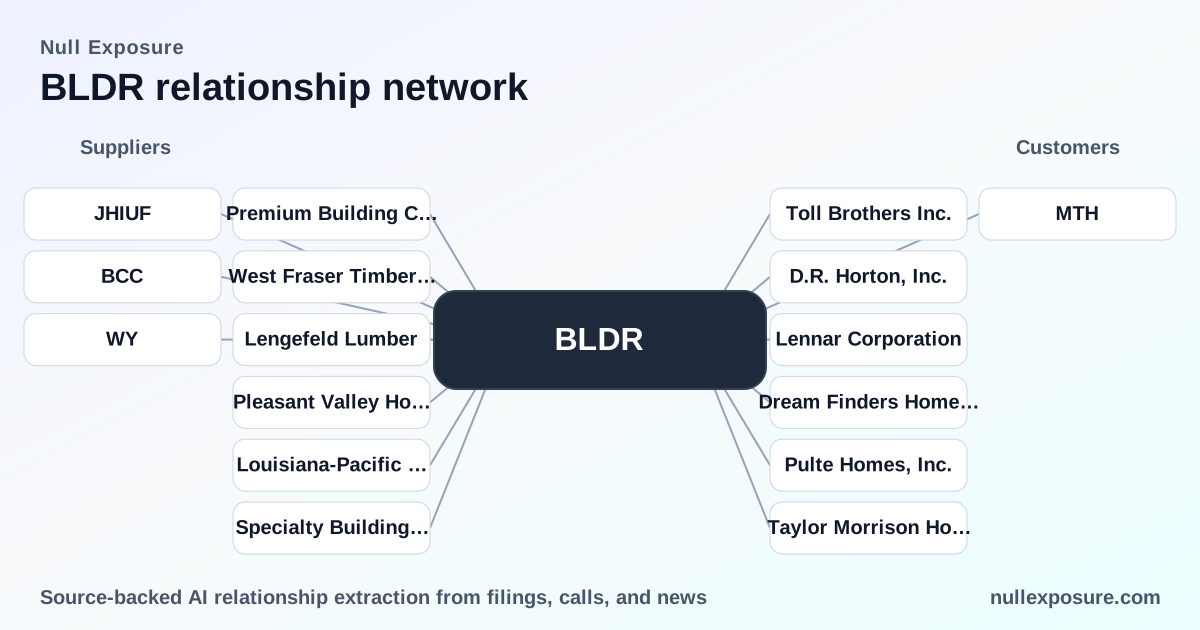
Builders FirstSource (BLDR): customer footprint and relationship risk profile
Thesis: Builders FirstSource monetizes a vertically integrated building-products and services platform by selling distribution goods, manufactured components, and construction services to professional homebuilders across the U.S.; the company captures margin through scale in distribution and component manufacturing while locking in recurring demand via multi-year framework supply relationships and integrated installation services. For investors, the revenue mix — distribution-dominant, services adjunctive, and manufacturing/software additive — drives predictable top-line exposure to a concentrated set of large national builders while retaining broad small-contractor depth. Learn more at https://nullexposure.com/.
How BLDR sells and where the dollars come from
Builders FirstSource operates three commercial levers: large-scale distribution of building materials (the clear revenue engine), in-house manufacturing of components (trusses, wall panels, millwork), and construction/installation services that increase stickiness. Distribution accounted for the majority of 2024 net sales ($16.4bn consolidated), while installation and construction services represented under 10% of revenue, per the company’s FY2024 reporting. The firm also offers software through its Paradigm subsidiary to improve builder workflows and lock in enterprise customers.
Key operating characteristics investors should note:
- Contracting posture: BLDR uses a mix of framework agreements that establish supply relationships and short-term transactional delivery terms for distribution sales.
- Customer concentration: Top-10 customers represented 15% of net sales in 2024, with the single largest customer at 4%, indicating material but not single-counterparty criticality.
- Geography and scale: Operations cover ~590 locations across 43 U.S. states, creating national reach balanced by regional divisions.
- Business maturity and role: BLDR is both a seller of materials and service provider with mature, long-term relationships with professional builders, underpinned by trade credit and integrated service packages.
These structural features create recurring demand from national builders while limiting outsized counterparty risk—useful when modelling revenue volatility and credit exposure.
The national builders that drive demand (what the filing says)
The company explicitly lists its largest national production homebuilder customers in its FY2024 Form 10-K. Below I cover each named relationship in the filing; each bullet is sourced to BLDR’s FY2024 10-K disclosure.
D.R. Horton, Inc.
Builders FirstSource identifies D.R. Horton as one of its largest national production homebuilder customers, reflecting the company's role as a preferred supplier to high-volume builders that drive steady distribution demand. According to BLDR’s FY2024 Form 10-K, D.R. Horton is part of the “top customers” cohort noted by the company.
Dream Finders Homes, Inc.
Dream Finders Homes is listed among the national production builders that comprise BLDR’s top customer set, highlighting BLDR’s reach into both large and growth-oriented regional production builders. This relationship is referenced in the FY2024 10-K.
Lennar Corporation
Lennar appears in BLDR’s 2024 disclosure as a top national homebuilder customer, signaling recurring procurement of materials and manufactured components from BLDR across multiple markets. The FY2024 Form 10-K lists Lennar alongside other national builders.
Pulte Homes, Inc.
Pulte Homes is included in the company’s top customer list in the FY2024 10-K, reinforcing BLDR’s exposure to large, publicly traded production builders that source distribution goods and components at scale.
Meritage Homes (MTH)
Meritage Homes is explicitly listed among BLDR’s top customers in the FY2024 Form 10-K; the filing records Meritage (inferred symbol MTH) as part of the national builder cohort that contributes to the company’s material customer base.
MTH (duplicate entry)
The dataset includes a duplicate entry for MTH (Meritage Homes) with the same FY2024 10-K excerpt and inferred symbol. The repetition in the results reflects the same 10-K mention of Meritage as a top customer.
Taylor Morrison Home Corporation
Taylor Morrison is identified in the FY2024 Form 10-K as a member of BLDR’s top-customer group, confirming the company’s supply relationships with builders that operate across multiple U.S. regions.
Toll Brothers Inc.
Toll Brothers is listed by BLDR in its FY2024 10-K as one of the national production homebuilders that make up the company’s top customers, indicating BLDR’s penetration into the luxury and higher-end new-home segments as well as volume channels.
What the customer list implies about risk and revenue durability
The group of named customers shows BLDR’s strategic focus on large national production builders alongside a broad base of regional and local contractors. Top-10 customers representing 15% of net sales in 2024 and the largest customer at 4% imply material concentration without single-customer dependency. The mix of framework supply arrangements and short-term point-of-sale distribution contracts means revenue is both recurring and transaction-linked—stable from scale but sensitive to volume swings in new-home starts.
How contracts, segments and spend profile shape modeling choices
- Contracting: The firm uses framework contracts that set supply parameters and allow orders “when and if” placed, while many distribution sales settle at delivery with short payment cycles. This hybrid contracting posture supports working-capital predictability but requires modelling of order volatility.
- Segment mix: Because distribution dominates revenue and services are under 10%, forecasting should prioritize commodity price and volume drivers for materials, while treating services and manufacturing margins as incremental margin enhancers. Paradigm software is a strategic stickiness play, not a primary revenue driver.
- Spend scale: BLDR’s top-10 customers contributing 15% of sales implies several counterparties are in the >$100m annual spend band, which supports volume discounts and negotiated program terms that benefit BLDR’s margins.
Bottom line for investors and operators
Builders FirstSource is a distribution-led, vertically integrated supplier with material but diversified exposure to national production builders; the FY2024 10-K names D.R. Horton, Dream Finders Homes, Lennar, Pulte, Meritage (MTH), Taylor Morrison, and Toll Brothers among the top customers. Model BLDR with distribution volumes as the primary driver, account for moderate customer concentration, and incorporate framework ordering behavior and regional housing cycles into scenario analysis.
For a deeper read on how these customer relationships feed into credit and revenue risk, visit Null Exposure’s research hub at https://nullexposure.com/.
H2/H3 Appendix: data provenance and document references
- Primary source for all relationship mentions: Builders FirstSource 2024 Form 10-K (filed covering FY2024, referenced in BLDR’s public disclosures).
- Operational and constraint excerpts referenced are drawn from the same FY2024 filing, including statements on top-10 customer contribution (15% of net sales), operating footprint (~590 locations in 43 states), segment revenue splits, and contract language describing framework and point-in-time distribution sales.
If you want a downloadable table of the named counterparts and the precise 10‑K excerpts used for modeling, I can prepare that next.