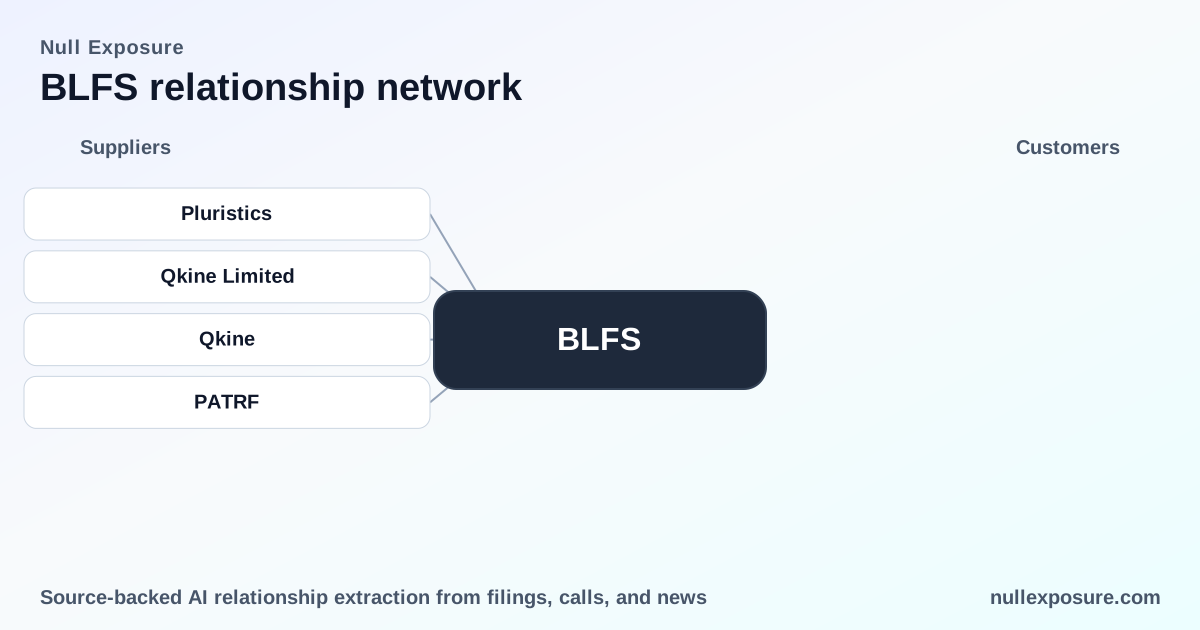
How BioLife Solutions’ customer footprint shapes its growth and risk profile
BioLife Solutions (BLFS) manufactures and sells biopreservation media, modular thawing and handling products, and refrigerated/rental logistics to the gene and cell therapy (CGT) market, monetizing through point-of-sale product revenue, short-term equipment rentals, and channel distribution agreements. Revenue is driven by core product sales plus a meaningful distributor channel and a rental fleet that operates on sub‑one‑year terms, creating a hybrid transactional/recurring cashflow profile that investors should evaluate alongside customer concentration and geographic exposure. For a structured look at counterparty relationships and how they influence credit and commercial risk, visit https://nullexposure.com/.
Quick investor takeaways — what moves the needle for BLFS
- Business model: Product sales recognized at shipment deliver high gross margins on biopreservation products; rental agreements for shipping/temperature-control units provide recurring, asset-backed revenue.
- Channel concentration: Third‑party distributors historically account for a material share of revenue (mid‑30s to mid‑40s percent annually), creating dependency on partner buy patterns.
- Geographic mix: The U.S. represents the dominant revenue base (roughly three quarters of total sales in cited periods), with EMEA a secondary but visible market and ongoing global commercial expansion.
- Contracting posture and maturity: Leasing is short‑term, which limits customer lock‑in but supports faster fleet redeployment; product sales remain predominantly point‑in‑time, signaling a mature transactional revenue stream rather than long-term contracted sales.
Relationships in the news: Merit Medical (MMSI) mentions
Merit Medical cited BioLife as an operational contributor in third‑party coverage (Mar 10, 2026)
An article summarizing Merit Medical activity noted that recent deals included assets from Cook Medical and BioLife, describing those transactions as strategically aligned and expanding Merit’s portfolio depth. Source: Finviz coverage quoting recent deal activity (March 10, 2026) — https://finviz.com/news/261307/heres-why-you-should-retain-merit-medical-stock-in-your-portfolio-now.
Merit’s Q1 2026 earnings discussion referenced contribution from an acquisition labeled “BioLife” (May 3, 2026)
In its Q1 2026 remarks, Merit Medical stated that organic growth and contributions from acquisitions — specifically naming BioLife alongside the C2 CryoBalloon device — exceeded expectations and supported constant‑currency growth. Source: InsiderMonkey transcript of Merit Medical Q1 2026 earnings call (May 3, 2026) — https://www.insidermonkey.com/blog/merit-medical-systems-inc-nasdaqmmsi-q1-2026-earnings-call-transcript-1752201/.
What the documented signals tell investors about BLFS’s operating model
The public relationship mentions above are limited but consequential; they sit alongside several company‑level signals that define BLFS’s commercial dynamics.
-
Contracting posture — short‑term rentals: All customers leasing shippers do so under rental arrangements of one year or less, with month‑to‑month continuation options thereafter. This structure reduces contractual stickiness but increases asset redeployment flexibility and cadence of recurring billing; fleet utilization and maintenance economics become key operational levers. (Company disclosure language.)
-
Geographic concentration and expansion: The company reports a heavy U.S. bias — roughly 75–82% of revenues in cited periods — with EMEA representing a material minority (around 12–19% in the excerpts) and an explicit push to broaden global coverage. High U.S. concentration concentrates regulatory, reimbursement, and demand risk domestically while incremental growth will depend on successful EMEA and global commercialization.
-
Channel and counterparty concentration: BLFS sells through named distributors such as STEMCELL Technologies and VWR under non‑exclusive arrangements; sales to third‑party distributors represented 35% in 2024 and roughly 42–44% in earlier years. Distributor dependence is a critical single‑point risk: shifts in distributor stocking, tendering, or pricing strategy materially affect top-line timing and visibility.
-
Revenue recognition and buyer behavior: Product revenue is recognized at the point of shipment for substantially all transactions. This confirms a predominantly transactional buyer relationship for product lines and indicates limited revenue visibility from binding multi‑year purchase contracts.
-
Core product focus: Product revenues derive from biopreservation media, hPL media, evo ModPaks, and ThawSTAR systems. Concentration in these core products gives BLFS a defensible specialist position in CGT logistics and cell therapy consumables, but also exposes the company to competitive substitution and pricing pressure within those categories.
Taken together, these signals present a company that balances transactional product sales with recurring, asset‑based rental income, operates under non‑exclusive global distribution, and is U.S.‑centric while executing measured international growth.
How these dynamics affect valuation and operational priorities
Investors and operators should translate the structural features above into actionable focus areas:
-
Assess distributor exposure and contract economics. With a third‑party distribution channel contributing an outsized share of revenue, diligence should prioritize distributor margin pass‑throughs, payment terms, and the existence of purchase commitments or consignment arrangements. Distributor churn or destocking will create sharp near‑term revenue volatility.
-
Monitor rental fleet utilization and unit economics. Short‑term leases require steady redeployment and tight maintenance controls to protect margins; insurance, logistics costs, and capital intensity of the fleet are primary drivers of free cash flow. Improved fleet utilization directly uplifts recurring revenue without new product sales.
-
Evaluate international execution risk. EMEA and broader global expansion provide upside, but successful market penetration requires distributor alignment, regulatory clearances, and local service capabilities—areas that consume working capital. Geographic diversification will be value‑accretive only if go‑to‑market costs decline or convert to sustained revenue.
-
In the near term, watch for M&A‑driven headline risk. Public comments from outside parties (for example, Merit Medical referencing acquisitions involving BioLife) can change the counterparty landscape quickly; communications that suggest transaction activity should prompt investors to reassess ownership, revenue continuity, and integration exposure. Source: Merit Medical press and earnings references (March–May 2026).
For deeper relationship tracking and counterparty risk scoring, see https://nullexposure.com/ — the platform synthesizes commercial signals tied to counterparties and distribution channels.
Bottom line: concentrated strengths, trackable weaknesses
BioLife’s commercial model combines high‑margin core products with a recurring rental element and material distributor reliance. That mix supports attractive unit economics but leaves the company sensitive to distributor behavior, U.S. demand cycles, and rental fleet utilization management. Investors should reward successful international scaling and improved visibility into distributor commitments, and they should price in execution risk tied to short‑term leasing and channel concentration.
Key next steps for analysts: validate distributor contract terms, quantify rental fleet utilization trends in quarterly disclosures, and monitor any transaction‑related announcements that could alter counterparty status or revenue recognition.