BillionToOne (BLLN): J&J Deal Reframes Commercial Path for a High‑multiple Diagnostics Growth Story
BillionToOne builds and sells precision molecular diagnostics and monetizes through direct test revenue and strategic partnerships that convert proprietary assays into companion diagnostics for pharma clients. The company’s commercial approach mixes direct lab testing with exclusive licensing and partner-led market access, and the recent Johnson & Johnson agreement materially reweights the revenue and clinical adoption pathway toward partner-driven commercialization. For investors, the core question is whether strategic exclusivity with large pharma accelerates adoption fast enough to justify a stretched valuation and current profitability profile.
For background on customer footprint and to explore relationship mapping, see NullExposure’s coverage: https://nullexposure.com/.
What the Johnson & Johnson agreement actually is — and why it matters
BillionToOne announced an exclusive agreement naming it the official companion diagnostic partner to Johnson & Johnson for hemolytic disease of the fetus and newborn. That exclusivity elevates BillionToOne from a technology vendor to a retained development and commercial partner for a clearly defined clinical indication, which deepens commercial stickiness and creates a pathway for predictable, partner-driven revenue as the J&J therapy (or associated screening programs) scales.
According to BillionToOne’s 2025 Q3 earnings call (reported March 2026), the company finalized this exclusive companion diagnostic arrangement with Johnson & Johnson, underscoring a strategic shift toward co‑commercialization with large pharmaceutical manufacturers.
All identified customer relationships (each listed relationship summarized)
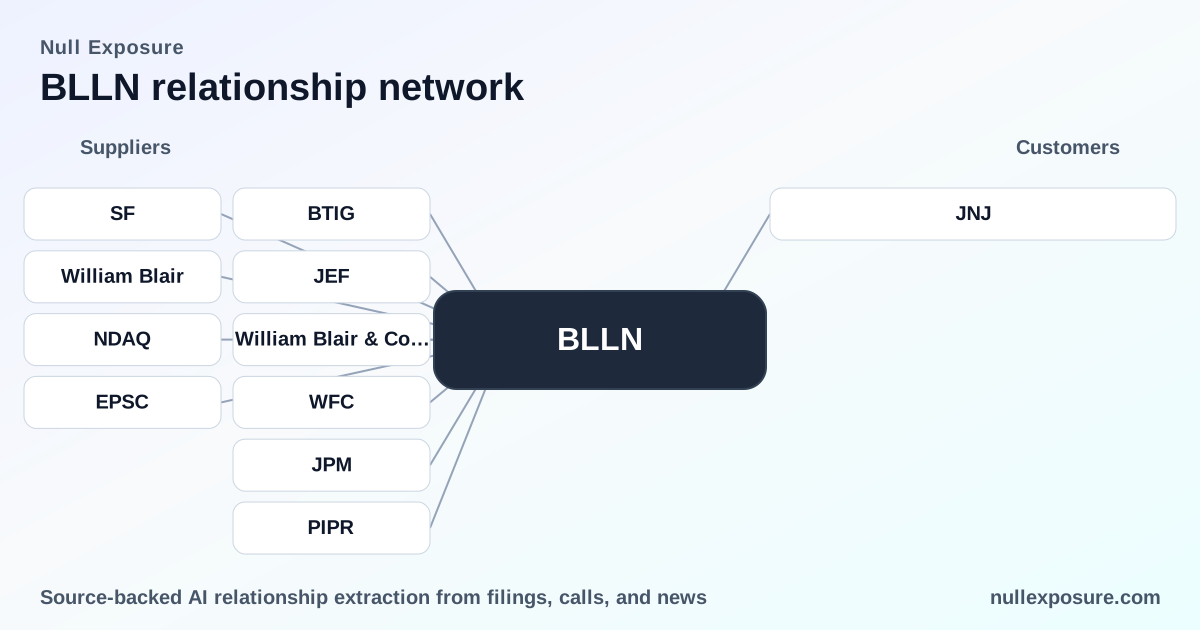
- Johnson & Johnson (JNJ): BillionToOne finalized an exclusive agreement to serve as the official companion diagnostic partner for hemolytic disease of the fetus and newborn, positioning BLLN as the diagnostic gatekeeper for that indication with J&J. This was disclosed on the company’s 2025 Q3 earnings call in March 2026.
- JNJ: The same mention is recorded again under the ticker-style label JNJ in the 2025 Q3 earnings call; the text reiterates the exclusivity and companion diagnostic role for hemolytic disease of fetus and newborn. The repeated entry reflects the same disclosed agreement on the 2025 Q3 earnings call (March 2026).
How this relationship fits into BillionToOne’s operating model
The J&J agreement exemplifies BillionToOne’s commercial posture: strategic exclusivity with large pharma to accelerate clinical adoption and scale. That posture has four investor-relevant implications:
- Contracting posture: BillionToOne pursues exclusive companion diagnostic roles that trade one-time development and regulatory support for longer-term revenue capture and barriers to competitive diagnostics.
- Concentration and counterparty leverage: Exclusive ties to a multinational like Johnson & Johnson concentrate commercial risk but also create high-leverage distribution optionality if the partner’s therapeutic is broadly adopted.
- Criticality: Companion diagnostics are often mission-critical to therapy launch strategies; serving as the official diagnostic partner increases the diagnostics’ clinical relevance and reimbursement prospects.
- Maturity and commercialization cadence: The model shifts near-term revenue toward partner milestone and launch timing, implying earnings and cash flow will track pharma development cycles rather than purely organic lab-volume growth.
For more on customer and partner mapping across life‑science relationships, see NullExposure: https://nullexposure.com/.
Company-level financial signals that inform customer risk/reward
BillionToOne is a high-growth, early‑commercial company with a valuation reflective of future adoption rather than current earnings:
- Revenue (TTM): $305.1M; Gross profit (TTM): $208.5M, indicating strong gross margins at the product level.
- Profit margin: ~0.96%, while Operating margin (TTM): 10.8%, showing operating leverage exists but net profitability is still minimal relative to valuation.
- Market cap: ~$3.32B, Trailing P/E: 554.8, and EV/Revenue: 10.38, consistent with a premium growth multiple that prices successful commercialization.
- Ownership structure shows insiders hold ~46.7% and institutions ~36.0%, signaling concentrated insider alignment on strategy while still providing institutional oversight.
These metrics underline that the company’s value is sensitive to partnership execution: successful scale with J&J would validate the premium multiple; delays or weaker-than-expected adoption would compress valuation quickly.
Risk and upside specific to the J&J relationship
- Upside: Exclusive companion-diagnostic status with J&J accelerates commercial adoption and improves reimbursement positioning for the assay tied to the therapy, delivering a potential step-change in recurring revenue.
- Risk: Reliance on a single large partner for a specific indication concentrates execution risk — regulatory timing, J&J’s clinical outcomes, and commercial rollout pace will materially influence BillionToOne’s revenue trajectory.
Investment takeaway
BillionToOne’s strategy of converting proprietary assays into exclusive companion diagnostics with large pharmas is a high‑conviction commercial play that trades concentration risk for accelerated scale and higher margins. The Johnson & Johnson deal is a meaningful validation of BillionToOne’s platform and raises the probability of faster clinical adoption, but the company’s current valuation already prices in significant success. Investors should balance the premium multiple and thin net margin against the asymmetric potential of a successful J&J launch.
If you want a structured comparison of partner concentration and contract terms across diagnostics companies, NullExposure maintains curated relationship mappings and investor briefs: https://nullexposure.com/.