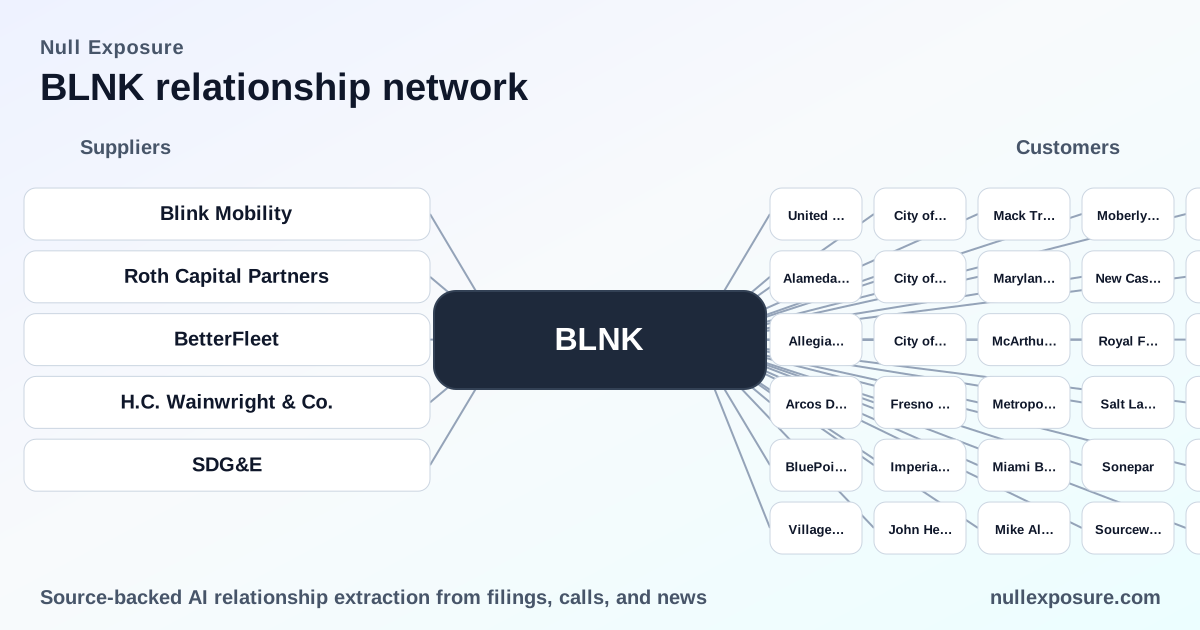
Blink Charging’s customer footprint: commercialization, recurring revenue, and public‑sector scale
Blink Charging owns, operates and sells EV chargers and a cloud management network, monetizing through a mix of product sales, recurring network fees, usage‑based charging sessions, and operator‑owned site revenue. Hardware sales generate spot revenue when equipment ships or is installed, network fees are billed annually on multi‑year contracts, and charging service income is recognized per session—together forming a blended revenue stream that combines one‑time and annuity economics. For a concise vendor view and relationship signals, see https://nullexposure.com/ for our coverage and datasets.
How Blink’s customer list shapes the investment case
Blink's disclosed customers illustrate a diversified go‑to‑market across public-sector, retail, hospitality, and fleet channels. The company doubles as a seller and operator: it ships equipment to partners (spot revenue), signs longer property partner agreements that lock in recurring network fees (subscription revenue), and runs Blink‑owned charging sites that produce usage‑based cash flows.
- Contracting posture is mixed and deliberate. Blink runs short‑term rentals and car‑sharing revenues recognized over short periods, nine‑year property partner agreements with extensions up to 27 years for deployed equipment, annual network fee contracts, and per-session charging revenue. These characteristics create blended cash flow duration and multiple monetization levers.
- Customer concentration is notable and trackable. Blink disclosed that a single significant customer accounted for 15% of revenue in 2022 and that one significant accounts receivable position represented 12% of receivables as of year‑end 2024, signaling exposure to large counterparties.
- Counterparty mix is strategic. The roster includes governments and large enterprises as primary channels, implying procurement cycles and public‑sector contract dynamics alongside faster retail/hospitality rollouts.
- Geographic reach is broad but North America‑centric. Blink reports material revenue in the U.S. while operating throughout the U.S., Europe, Mexico and Central America, supporting both domestic scale and incremental international expansion.
- Product / service segmentation supports multiple revenue levers. Blink’s business combines hardware, services (installation, maintenance, operator revenue), and software (the Blink Network) — enabling upsell and recurring margin capture.
Learn more about Blink relationship signals and modeling inputs at https://nullexposure.com/.
Relationship roll call — one‑to‑two sentence capsule notes with sources
Sonepar — Blink lists Sonepar among significant new customers secured in 2024, suggesting channel or distribution agreements that can accelerate commercial EVSE placements (FY2024 10‑K).
Source: Blink 2024 Form 10‑K filing.
Alameda City — Blink reported entering into an agreement with Alameda City in 2024, indicating municipal procurement activity and public‑sector deployments (FY2024 10‑K).
Source: Blink 2024 Form 10‑K filing.
Allegiant Stadium (Las Vegas) — Blink disclosed a 2023 agreement to expand deployments at major venues, including Allegiant Stadium, supporting high‑visibility, high‑throughput charging use cases (FY2024 10‑K).
Source: Blink 2024 Form 10‑K filing.
Arcos Dorados (McDonald’s Puerto Rico) — Blink named Arcos Dorados among 2023 customer agreements, reflecting retail and franchise network installations in Puerto Rico (FY2024 10‑K).
Source: Blink 2024 Form 10‑K filing.
BluePoint — Included in Blink’s list of 2023 customer wins, BluePoint represents another commercial installation partner for charger deployment (FY2024 10‑K).
Source: Blink 2024 Form 10‑K filing.
Village of Tuckahoe (NY) — Blink recorded the Village of Tuckahoe among 2023 municipal customers, reflecting localized public charging rollouts (FY2024 10‑K).
Source: Blink 2024 Form 10‑K filing.
United States Postal Service (USPS) — Blink cited an agreement with the USPS in 2023, representing a strategic fleet or government program customer with scale deployment potential (FY2024 10‑K).
Source: Blink 2024 Form 10‑K filing.
City of Fresno — Listed among 2024 municipal agreements, the City of Fresno is a municipal deployment that expands Blink’s public‑sector footprint (FY2024 10‑K).
Source: Blink 2024 Form 10‑K filing.
City of Porterville — Blink included Porterville in its 2024 roll‑up of new municipal customers, reinforcing public procurement momentum (FY2024 10‑K).
Source: Blink 2024 Form 10‑K filing.
City of South Lake Tahoe — A 2024 agreement with South Lake Tahoe was disclosed, consistent with local government site deployments and public charging availability expansion (FY2024 10‑K).
Source: Blink 2024 Form 10‑K filing.
Fresno Unified School District — Blink’s 2024 customer list includes the district, indicating education‑sector installations and institutional procurement (FY2024 10‑K).
Source: Blink 2024 Form 10‑K filing.
Imperial Center — Identified as a 2024 customer, Imperial Center adds to Blink’s commercial site roster (FY2024 10‑K).
Source: Blink 2024 Form 10‑K filing.
John Henry General Store — Named among 2023 commercial customers, this local retail deployment signals Blink’s reach into convenience and neighborhood retail locations (FY2024 10‑K).
Source: Blink 2024 Form 10‑K filing.
Mack Trucks — A 2023 agreement with Mack Trucks indicates fleet and heavy‑duty vehicle charging considerations in Blink’s customer mix (FY2024 10‑K).
Source: Blink 2024 Form 10‑K filing.
Maryland Department of General Services — Blink listed the Maryland DGS among 2024 customers, representing state‑level government procurement and institutional deployments (FY2024 10‑K).
Source: Blink 2024 Form 10‑K filing.
McArthurGlen — Included in Blink’s 2023 customer list, McArthurGlen represents retail destination deployments in outlet or mall properties (FY2024 10‑K).
Source: Blink 2024 Form 10‑K filing.
Metropolitan Government of Nashville‑Davidson County — Blink named this metropolitan government among 2023 customers, supporting municipal and county‑level electrification projects (FY2024 10‑K).
Source: Blink 2024 Form 10‑K filing.
Miami Beach (FL) — Blink disclosed an agreement with Miami Beach in 2023, underscoring deployments in high‑traffic municipal and tourism markets (FY2024 10‑K).
Source: Blink 2024 Form 10‑K filing.
Mike Albert Fleet Solutions — Appearing in the 2023 customer list, this fleet management partner signals commercial fleet charging engagements (FY2024 10‑K).
Source: Blink 2024 Form 10‑K filing.
Moberly Motor Company — Named among 2023 customers, Moberly Motor Company represents dealership or local automotive retail placements (FY2024 10‑K).
Source: Blink 2024 Form 10‑K filing.
New Castle County — Blink included New Castle County in its 2024 customer agreements, another county‑level public sector deployment (FY2024 10‑K).
Source: Blink 2024 Form 10‑K filing.
Royal Farms — Listed as a 2023 commercial customer, Royal Farms represents convenience retail chain rollouts for charger placement (FY2024 10‑K).
Source: Blink 2024 Form 10‑K filing.
Salt Lake City International Airport — Blink disclosed an airport agreement from 2023, demonstrating deployments at major transportation hubs (FY2024 10‑K).
Source: Blink 2024 Form 10‑K filing.
AAA — Blink named AAA among 2023 customers, pointing to partnerships with membership organizations that drive consumer charging demand (FY2024 10‑K).
Source: Blink 2024 Form 10‑K filing.
Sourcewell — Blink was selected as a Sourcewell supplier in a contract effective through 2029, enabling tens of thousands of public agencies to procure Level 2 and DC charging equipment and services via a cooperative purchasing vehicle (reported March 2026).
Source: Company announcement reported via QuiverQuant and other outlets, March 2026.
Comfort Suites Lake City / Comfort Suites — Blink commissioned a company‑owned DC fast charging site at a Comfort Suites in Lake City, FL and referenced Comfort Suites deployments in 2026 press coverage of Earth Day installations (news releases, May 2026).
Source: GlobeNewswire press release syndicated in Manila Times (April/May 2026) and TradingView reporting, May 2026.
Korian Belgium / Korian Netherlands — Blink announced a partnership with Korian Belgium to deploy 200+ ports across 90 locations, with a similar roll‑out planned for Korian Netherlands, marking a sizable European care‑home customer deployment (press releases and news coverage March 2026).
Source: GlobeNewswire press release and multiple news syndications, March 2026.
The Rosemyr Corporation — Blink teamed with The Rosemyr Corporation for Earth Day promotions and free charging at Morganton Plaza, reflecting local retail site activations (news coverage May 2026).
Source: Bitget news item and related press coverage, May 2026.
Brookhaven Market — Blink deployed a company‑owned site at Brookhaven Market in Darien, Illinois, part of operator‑owned site expansion that produces usage revenue (TradingView, May 2026).
Source: TradingView coverage, May 2026.
PHAT — A reported excerpt indicates more than half of certain prescription flows go through the Blink network in a healthcare/pharmaceutical context, highlighting Blink’s network utility beyond pure charging use (news excerpt, March 2026).
Source: InsiderMonkey transcript reference, March 2026.
SDG&E — Blink cited collaborative projects with SDG&E for accelerated fleet charging rollouts, representing a utility partnership that facilitates large‑scale fleet electrification (trading commentary May 2026).
Source: TradersUnion reporting on Blink financial call, May 2026.
Lake City Hotels / Tru by Hilton — Blink’s Earth Day installations included Lake City Hotels and a Tru by Hilton site where Blink offered two hours free charging, showcasing hospitality channel execution and operator‑owned site activity (press release April 2026).
Source: GlobeNewswire / ManilaTimes syndication, April/May 2026.
CED / CEDAX — Blink listed CED (and CEDAX) among 2024 significant new customers, indicating additional distribution or installer partnerships that support commercial deployments (FY2024 10‑K).
Source: Blink 2024 Form 10‑K filing.
Investment takeaways and risk framing
- Positive: diversified revenue architecture. Blink combines spot hardware sales, multi‑year property partner agreements, annual network fees and per‑session charging income—this reduces reliance on any single revenue type.
- Risks: counterparty and receivable concentration. Historical disclosure of a single customer representing 15% of revenue and a large receivable concentration create measurable counterparty risk to model.
- Operational nuance: government and large‑enterprise procurement cycles increase sales cadence but lengthen cash conversion. Public sector wins (cities, counties, state agencies, cooperative purchasing frameworks like Sourcewell) scale deployments but involve lengthy procurement.
- Geographic expansion is active. European rollouts (Korian), Latin American presence and U.S. municipal scale create global optionality while keeping North America central to revenue.
For a deeper parsing of Blink’s customer contracts, revenue recognition drivers, and scenario modeling inputs, consult our premium research hub at https://nullexposure.com/.