BioLineRx (BLRX): royalties-first biotech with commercial partners driving near-term cash flow
BioLineRx operates as a clinical-stage oncology-focused developer that monetizes primarily through out‑licensing of its lead asset, APHEXDA® (motixafortide), and the collection of royalties, milestones and limited direct sales revenue. The company has shifted commercialization risk to partners while retaining upside through structured license agreements and milestone economics; investors should evaluate partner execution, milestone timing, and pipeline replenishment as the primary drivers of value. For a deeper look at partner exposures and how they translate into revenue, see https://nullexposure.com/.
How BioLineRx makes money today
BioLineRx generates revenue almost exclusively from license agreements and royalties rather than direct U.S. commercial operations. 2025 revenues were concentrated in royalties and license income—$1.2 million for the year—with quarter-level royalty receipts reported as $0.3–$0.4 million, reflecting the commercial roll‑out by licensees. The company’s operating profile shows negative margins and low institutional ownership, consistent with a small-cap biopharma that is executing an out‑licensing strategy while funding ongoing R&D. (SAHM Capital / company press releases, FY2025–FY2026).
Why that business model matters for investors
- Contracting posture: BioLineRx is in a seller / licensor posture—outsourcing commercialization to specialists and monetizing via royalties and milestones rather than building a large commercial organization.
- Revenue concentration: A small number of licensees (and a handful of milestone events) drive the company’s near-term top line.
- Criticality: APHEXDA royalties are a material revenue source today; partner performance materially affects reported revenue and cash flow.
- Maturity: The firm is clinical-stage overall but operates an approved-asset monetization model for APHEXDA, reflecting a hybrid maturity profile.
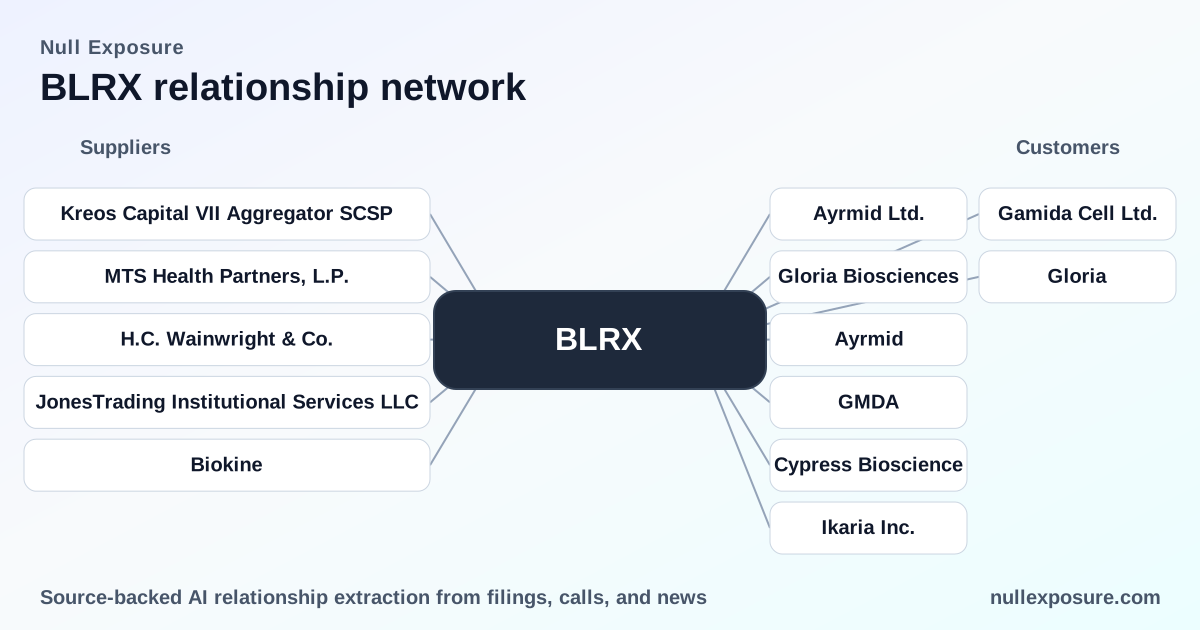
If you evaluate partner risk and upside, our partner map below summarizes every counterpart mentioned in public disclosures and news monitored through 2026.
Who BioLineRx sells into and why it matters
Ayrmid Ltd.
Ayrmid holds the exclusive license to develop and commercialize APHEXDA globally, excluding Asia, and is the primary source of current U.S. royalty income to BioLineRx; BioLineRx reported that Ayrmid-generated sales of APHEXDA produced royalties of approximately $0.4 million in Q3 2025 and contributed materially to 2025 revenue. The initial exclusive license agreement and subsequent commercial reporting are documented in company press releases and earnings materials. (PR Newswire announcement of the Ayrmid license, March–May 2026; Q3 2025 earnings call transcript, InsiderMonkey, FY2025).
Source: PR Newswire, “BioLineRx and Ayrmid Ltd. enter into exclusive license agreement” (FY2024); InsiderMonkey Q3 2025 transcript reporting Ayrmid sales -> royalties (FY2025).
Gloria Biosciences (a.k.a. Gloria)
Gloria Biosciences controls APHEXDA rights in Asia and delivered up‑front and milestone payments that materially affected BioLineRx’s 2024–2025 revenue mix (the company disclosed $15.0 million of payments related to the Gloria license and milestones as a principal revenue driver in 2024/2025 comparisons). Gloria also participates in commercialization in Asia, and receivable/milestone timing has influenced BioLineRx’s working capital profile. (SAHM Capital and PR Newswire summaries, FY2025–FY2026).
Source: SAHM Capital / PR Newswire reporting on license economics and revenue recognition (FY2025–FY2026).
Gamida Cell (GMDA)
Gamida Cell became involved in the commercialization chain following a transition of commercialization responsibilities for Aphexda; press coverage and analyst notes reference a handoff to Gamida Cell as part of commercialization management. This transition alters the counterparty map and potentially affects where and how royalties are tracked. (Zacks / analyst coverage referencing the transition, FY2025).
Source: Zacks commentary and company press materials summarizing the commercialization transition (FY2025).
Hemispherian AS
BioLineRx established a joint venture with Hemispherian to develop GLIX1 (an oral small molecule targeting DNA damage response in glioblastoma), representing a strategic development partnership distinct from APHEXDA licensing; the JV underscores BioLineRx’s emphasis on partnering new assets rather than direct commercialization. (PR Newswire, JV announcement, 2025–2026).
Source: PR Newswire release, “BioLineRx Ltd and Hemispherian AS establish joint venture to develop GLIX1” (FY2025).
Cypress Bioscience
Cypress Bioscience is a historical licensee: BioLineRx out‑licensed BL-1020 to Cypress for development and commercialization in North America (July 2010). This is an example of BioLineRx’s longstanding strategy of originating assets and transferring development/commercial risk to partners. (NBC News historical coverage, FY2011).
Source: NBC News piece summarizing the 2010 out‑license of BL‑1020 to Cypress (FY2011).
Ikaria Inc.
Ikaria received rights to BL‑1040 for post‑myocardial infarction treatment in a 2009 out‑license valued at $282.5 million plus royalties, another historical example of BioLineRx’s out‑licensing model and its ability to negotiate large potential deal values for selected assets. (NBC News historical coverage, FY2011).
Source: NBC News summary of the BL‑1040 transaction with Ikaria (FY2011).
Key signals from the relationship map
- Royalty and milestone dependency: Current operating cash inflows are strongly tied to partner sales and milestone schedules; 2025 revenues demonstrate the economics but also their lumpy nature (SAHM Capital / PR Newswire, FY2025).
- Limited direct commercial footprint: BioLineRx closed its U.S. commercial operations following out‑licensing, reallocating capital to R&D and smaller corporate overhead—evident in the reduction of motixafortide-related R&D expense in 2025 (Zacks / FY2025).
- Partner execution is the primary risk/catalyst: Upside accrues via partner-driven sales and milestone achievement; downside comes from poor commercialization or delayed milestones.
Catalysts and risk checklist for investors
- Catalysts: APHEXDA sales growth under licensees, milestone payments already recognized from Gloria/Ayrmid, and progress of GLIX1 development via the Hemispherian JV and Phase 1/2a initiation. (PR Newswire clinical and JV releases, FY2025–FY2026).
- Risks: concentration of revenue into a few counterparties, lumpy timing of milestone receipts, and negative operating margins that leave the company dependent on partner cash events or capital markets for funding.
For a focused view of partner exposures and to track new license or milestone events as they publish, visit https://nullexposure.com/ to follow updates and source documents.
Bold takeaways: BioLineRx is a royalties-first small-cap biotech with most near-term economics driven by a handful of licensees (Ayrmid and Gloria). Investors should underwrite partner execution, milestone timetables, and GLIX1 development outcomes when valuing BLRX.