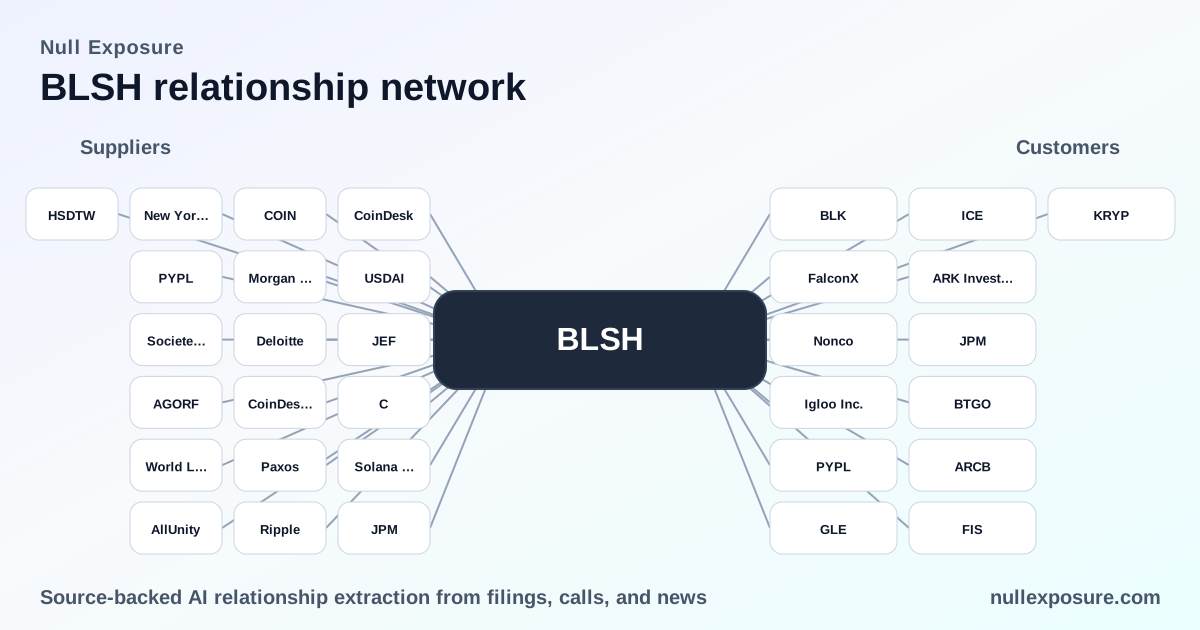
Bullish (BLSH) — Institutional relationships that drive liquidity, listings, and revenue
Bullish operates an institutional-grade digital-asset exchange and market-information business that monetizes through trading fees, issuer listing and market-making services, and premium connectivity to custodians and prime brokers. The company converts institutional order flow and issuer mandates into recurring fee streams while selling ancillary services—index licensing, data, and custody integrations—that deepen customer stickiness. For investors, runway depends on continued traction with large asset managers, prime brokers, and stablecoin issuers that generate both trading volume and listing fees.
Explore deeper relationship data at https://nullexposure.com/.
How Bullish makes money and why customer relationships matter
Bullish generates primary revenue from three linked channels: execution fees on its exchange, issuer services for listing and promoting token products, and platform access sold to institutional intermediaries (custodians, prime brokers, HFT firms). Institutional partners both drive immediate transaction revenue and create distribution for partner-issued products (for example, stablecoins and ETF-linked instruments). Bullish’s public statements and filings show a deliberate focus on multi-product deals—multi-year agreements and issuer mandates—that convert large, sophisticated clients into predictable revenue sources.
Company-level operating signals investors should treat as fact
- Contracting posture: Bullish pursues multi-year, multi-product commercial relationships with institutional clients and issuers, positioning itself as a full-stack partner rather than a venue-only provider. This is visible through its announced “multi-year, multi-product” deals.
- Concentration: The client base includes large asset managers, prime brokers, and corporate issuers; while no single counterparty concentration is disclosed, the presence of heavyweight players implies both opportunity and counterparty risk tied to a small number of large relationships.
- Criticality: Relationships with liquidity providers, custodians, and index/futures partners are material to Bullish’s value proposition because they underpin execution quality and product distribution.
- Maturity: Many commercial ties are early-stage (FY2025 launch activity) but involve incumbent financial institutions and legacy infrastructure partners, signaling a hybrid of startup growth and institutional validation.
Who Bullish counts as customers and partners — one-by-one
Below are concise, source-backed summaries of every customer relationship disclosed in the underlying results.
BlackRock (BLK)
BlackRock indicated interest in participating in Bullish’s equity offering, expressing intent to purchase up to $200 million of shares according to Bullish’s updated IPO filing described by CNBC on August 11, 2025 (https://www.cnbc.com/2025/08/11/crypto-exchange-bullish-raises-ipo-size-seeks-nearly-5-billion-valuation.html). This signals institutional investor validation and potential strategic alignment.
HODL / MarketVector Indexes change
MarketVector Indexes GmbH updated the MarketVector Bitcoin Benchmark Rate constituents on November 30, 2025 and removed Bullish from the index composition, replacing it with other platforms, per The Globe and Mail coverage (https://www.theglobeandmail.com/.../vaneck-bitcoin-trust-updates-trading-platform-index/). Index inclusion and exclusion directly affect market visibility and flow from index-linked products.
ARK funds and ARK Invest (ARKW, ARKF, ARKK)
Cathie Wood’s ARK vehicles increased positions in Bullish stock across ARKF, ARKW, and ARKK, aggregating reported purchases in early May 2026, according to TradingView’s report of CoinPedia data (https://www.tradingview.com/news/coinpedia:483d09c05094b:0-cathie-wood-s-ark-invest-buys-circle-bitmine-and-bullish-shares-amid-market-dip/). Active purchases by ARK funds show retail/institutional interest and can support secondary-market liquidity.
Nonco (unnamed institutional client)
Bullish’s launch announcement lists “Nonco” among day-one institutional clients alongside BitGo, indicating enterprise-level adoption from launch (Bullish press release, March 2026 — https://www.bullish.com/news-insights/bullish-launches-in-the-us-offering-institutions-and-advanced-traders-a-new-standard-in-digital-asset-trading). Presence of institutional day-one clients reduces go-to-market friction for additional institutional onboarding.
Igloo Inc.
Bullish disclosed a signed multi-year, multi-product agreement with Igloo Inc., owner of Pudgy Penguins, in its Q2 2025 results (Bullish investor release, Q2 2025 — https://www.bullish.com/news-insights/bullish-reports-second-quarter-2025-results). These issuer deals expand Bullish’s listing and promotional revenue streams.
PayPal (PYPL) and Société Générale (GLE)
Analysts noted Bullish’s role supporting stablecoin issuers including PayPal and Société Générale, specifically in listings, liquidity and promotional support, according to CoinDesk’s September 8, 2025 coverage (https://www.coindesk.com/markets/2025/09/08/wall-street-sees-u-s-entry-as-catalyst-for-bullish-s-next-leg-up). Participation with major financial brands positions Bullish in the emerging institutional stablecoin ecosystem.
FalconX
A 2023 partnership announcement indicates FalconX gained access to trading on Bullish, positioning Bullish as a venue for FalconX’s institutional customers (PR Newswire/APAC release, FY2023 — https://www.prnewswire.com/apac/news-releases/bullish-and-falconx-partner-to-deliver-institutional-clients-access-to-deep-liquidity-and-best-execution-crypto-trading-301975409.html). Prime-broker connectivity is a strategic distribution channel for institutional volumes.
JPMorgan (JPM)
Market commentary on December 23, 2025 highlights Bullish as a potential execution venue for broker-mediated institutional crypto flows, including those from JPMorgan, which could route orders to exchanges like Bullish (CoinDesk — https://www.coindesk.com/markets/2025/12/23/j-p-morgan-s-institutional-crypto-push-could-boost-rivals-like-coinbase-bullish-analysts-say). Bank-led order flow represents a material optional growth vector for execution revenue.
Intercontinental Exchange (ICE)
Bullish’s Q4 2025 earnings call mentioned ICE launching futures benchmarked to CoinDesk indices, linking Bullish’s index/data ecosystem to exchange-traded derivative distribution (BLSH 2025 Q4 earnings call transcript, Mar 2026). Index-to-derivatives pipelines increase product depth and provide additional licensing opportunities.
Ripple Prime
Bullish expanded options market access to users of Ripple Prime, integrating its options into Ripple’s global prime brokerage offering per Traders Magazine (May 2026 — https://www.tradersmagazine.com/departments/digital-assets/bullish-integrates-options-trading-with-ripple-prime/). This partnership extends execution capability into prime-broker networks and broadens institutional reach.
BitGo (BTGO)
BitGo was listed as a day-one institutional client on Bullish’s U.S. launch, signaling custody and settlement integration for institutional clients (Bullish press release, March 2026 — https://www.bullish.com/news-insights/bullish-launches-in-the-us-offering-institutions-and-advanced-traders-a-new-standard-in-digital-asset-trading). Custody partnerships are essential for institutions to route order flow to Bullish.
ARC / ARCB and ProShares (KRYP)
Bullish’s earnings commentary lists mandates from top-tier ETF issuers including ARC/ARCB and ProShares, indicating issuer relationships for product listing and custody/distribution services (BLSH 2025 Q4 earnings call transcript, Mar 2026). ETF issuer mandates translate to recurring listing and market-making engagements.
Fidelity / FIS
Bullish announced expectations to list partner assets including a Fidelity stablecoin in the near term, confirming issuer-level collaboration with Fidelity (BLSH 2025 Q4 earnings call transcript, Mar 2026). Partnership with a major custodian/asset manager like Fidelity is a high-value commercial credential.
Investment implications and risk factors
- Upside: Institutional validation from BlackRock, ARK funds, and custody/prime partners supports a pathway to sustainable volume-based revenue and diversified product fees.
- Key risks: Customer concentration risk given the strategic importance of a small number of large partners, index inclusion volatility that can affect flows, and execution competition from incumbent venues. Operational delivery on multi-year, multi-product contracts will be the critical execution risk to monitor.
For a consolidated view of these relationships and to track new disclosures, visit https://nullexposure.com/ for ongoing updates and data-driven summaries.