BLX Customer Relationships: Syndications, One‑Off Fees, and What Investors Should Price In
Banco Latinoamericano de Comercio Exterior (Bladex, ticker BLX) operates as a specialist trade finance bank for Latin America and the Caribbean, monetizing through net interest on trade assets plus underwriting and fee income from syndicated financing where it frequently acts as lead arranger. The bank’s 2025–2026 results show high operating and profit margins and a meaningful dividend yield, but public reporting and market commentary flag that a small number of large syndications materially influence fee growth and near‑term earnings volatility. For further background on how we source relationship signals, see Null Exposure’s coverage hub at https://nullexposure.com/.
The one‑line thesis for investors
Bladex delivers high margins through a concentrated mix of interest income on trade finance and episodic, high‑margin syndication fees; the persistence of outsized fee drivers—rather than core loan growth—will determine whether current earnings and the dividend are sustainable.
How customer deals translate into the P&L
Bladex’s business model combines traditional banking economics with an arranger/market‑maker posture on large transactions. Key operating characteristics to consider:
- Contracting posture: Bladex usually leads syndications, underwriting and distributing large credits to other banks—an active arranger role that generates upfront fees and distribution risk.
- Concentration and criticality: Large, one‑off syndications can contribute a meaningful share of fee income in a reporting period, increasing revenue concentration and episodic volatility.
- Maturity and repeatability: Syndication income is inherently lumpy; the bank’s ability to replicate large mandates is the primary lever to convert episodic upside into recurring earnings power.
These are company‑level signals derived from relationship coverage; no contractual constraints were recorded in the relationship data reviewed, which indicates no flagged long‑term customer lock‑ins or restrictive covenant exposures surfaced in the public coverage set.
What the relationship list actually shows
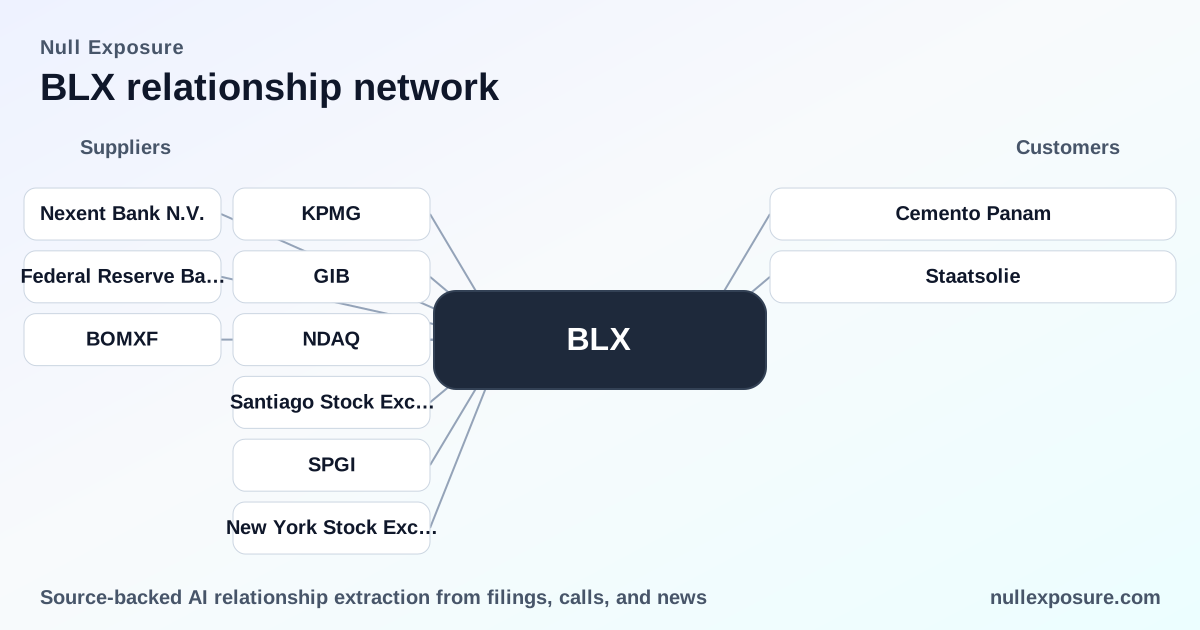
The relationship set for BLX in the reviewed coverage is concise and focused on two customer stories: Cemento Panam and Staatsolie. Both illustrate how syndication activity drives headline earnings and investor narrative.
Cemento Panam — a large acquisition financing led by Bladex
Bladex led a $206 million syndicated loan to support Cemento Panam’s acquisition in Panama, demonstrating the bank’s role as lead arranger on regional corporate M&A financings; the transaction was cited in coverage of Bladex’s third‑quarter 2025 disclosures and broader press. Source: MarketScreener coverage of Bladex and the Q3‑2025 conference‑call write‑up (reported March 9, 2026).
Staatsolie — the one‑off syndication that shapes fee narratives
Multiple market commentaries single out a Staatsolie syndication as an example of extraordinary fee income that boosted margins in 2025 and early‑2026 coverage. Analysts and market notes state that fee growth in recent periods benefited materially from one‑off transactions like Staatsolie, and that earnings narratives depend on whether Bladex can repeatedly originate similar mandates. Source: SahmCapital analysis and market commentary (Nov 2025; Jan–Feb 2026).
Why these two relationships matter to valuation
Both relationships illustrate the bank’s strategic strength—the ability to originate and lead large cross‑border syndications—and the central valuation risk: revenue concentration. Bladex’s TTM revenue (~$323m) and extremely high reported profit and operating margins are consistent with periods when large fees were realized. Investors should treat syndication fee realization as an earnings swing factor rather than stable core yield.
Financial context that investors should keep front of mind
Bladex reported a high profit margin (71.7% TTM) and strong operating margin (72.8% TTM), alongside a dividend per share of $2.625 and a dividend yield near 4.9% as of the latest data. The stock trades at a modest P/E (trailing ~8.9, forward ~8.4) with an analyst target price centered in the mid‑$60s. Those metrics reflect the market pricing of both recurring trade finance returns and the premium assigned to fee‑laden quarters. Public commentary from market analysts tied to the relationship coverage explicitly credits one‑off syndications for a material portion of recent upside; investors must therefore price in outsized quarter‑to‑quarter variability in non‑interest income. (Company fundamentals and multiples from Bladex public data; analyst commentary cited in SahmCapital and MarketScreener coverage.)
If you want a structured, relationship‑level readout and continuous monitoring of how transactional mandates feed reported fees, visit Null Exposure for the full relationship index: https://nullexposure.com/.
Risk and opportunity drivers distilled
- Risk — fee volatility: Large syndications like Staatsolie create short‑term upside but introduce unpredictability to earnings and dividend coverage.
- Risk — regional sovereign exposure: Syndications tied to state‑owned entities concentrate sovereign and political risk in outcomes.
- Opportunity — arranger premium: Leading syndications command high fees and reinforce client intimacy, supporting cross‑sell of traditional trade finance products.
- Opportunity — repeatability: If Bladex can consistently secure large mandates, episodic fee income transitions into a sustainable premium on top of net interest margins.
Practical checklist for modelers and operators
- Adjust base fee revenue assumptions for lumpy syndication recognition; treat large mandates as stochastic events rather than recurring streams.
- Stress‑test dividend coverage with and without one‑off fee realizations given the bank’s current dividend policy and payout history.
- Monitor deal announcements (lead‑arranger roles) and pipeline commentary for forward indications of repeat syndication flow.
Bottom line
Bladex’s customer relationships highlighted in recent coverage are not small repeatable retail accounts but large, sometimes sovereign‑linked syndications that materially affect earnings. Investors should value BLX as a trade finance specialist with an arranger franchise — a bank whose organic interest‑earning base is complemented, and occasionally overshadowed, by lumpy arranger fees. That business mix explains both the high margins and the earnings sensitivity observed in 2025–2026 commentaries.
For ongoing relationship intelligence and to track which customer mandates are moving the income statement next quarter, see Null Exposure’s coverage hub at https://nullexposure.com/.