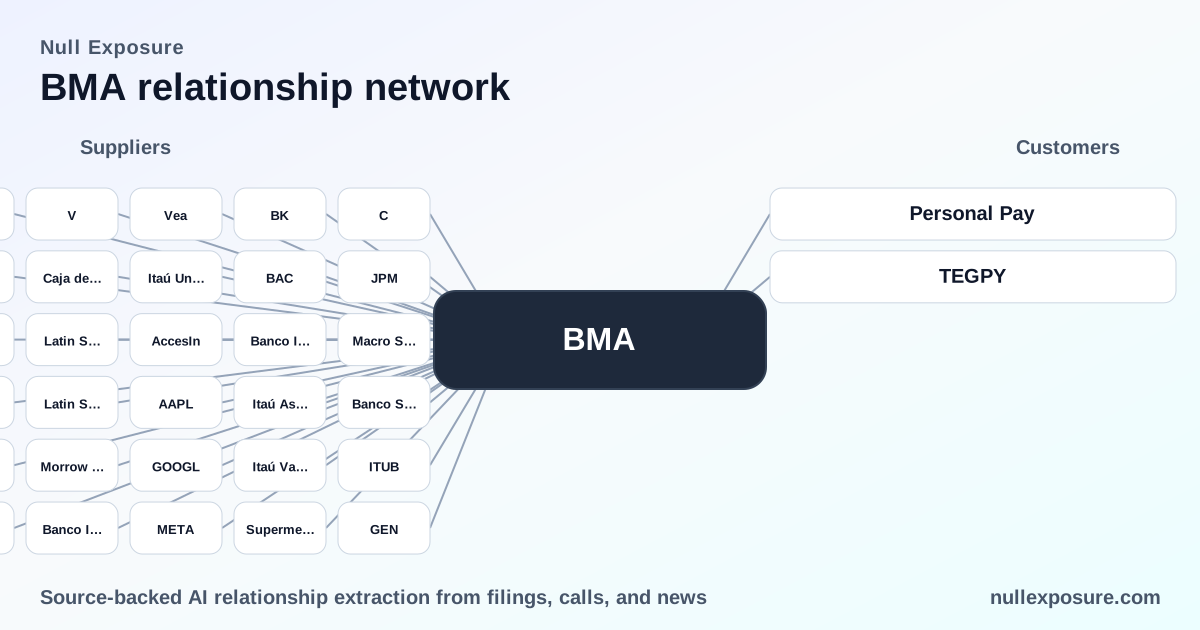
Banco Macro’s customer pivot: monetizing Telecom’s wallet through bank-as-a-service
Banco Macro operates as a regional Argentine bank that monetizes retail and corporate deposits, lending margins, fee income and increasingly, third‑party financial services. The bank’s FY2026 strategy centers on an equity-led expansion into bank‑as‑a‑service (BaaS) by acquiring a 50% stake in Personal Pay — Telecom Argentina’s digital wallet — positioning Banco Macro to capture payment volumes, interchange and financial intermediation revenue from an estimated ~30 million telecom users. For investors this is a clear shift from pure balance‑sheet banking towards fee and platform economics that scale with user engagement. Learn more about our institutional coverage at https://nullexposure.com/.
A concise read for allocators: why the Personal Pay transaction matters
Banco Macro announced a cash equity investment to acquire half of Personal Pay and to operate it as a BaaS partner for Telecom’s wallet, which brings a large captive customer base and an immediate payments flow to monetize. According to Banco Macro’s FY2026 earnings call transcript published in March 2026, the bank intends to use the wallet to perform financial intermediation while building products on top of Telecom’s user base. That positions Macro to earn a mix of fee income, interchange and lending spread from wallet users rather than relying solely on traditional deposit‑loan spread.
Every customer relationship in the results — what investors should know
- Personal Pay — Banco Macro acquired 50% of Personal Pay in a cash transaction and will develop the product as a bank‑as‑a‑service offering to leverage Telecom’s wallet users and execute financial intermediation. According to the FY2026 earnings call transcript (InsiderMonkey, March 2026), the equity investment funds the development of the joint business and platform.
- TEO (Telecom Argentina, ticker TEO) — Telecom framed the deal as combining Banco Macro’s banking expertise with Micro Sistemas’ existing user base to expand Personal Pay’s product set; public reporting on the transaction highlighted Telecom’s role in supplying customers and transaction volume to the JV. A market report covering the deal referenced Telecom’s strategic intent (TS2 Tech, January 22, 2026).
- TEGPY — The same earnings call language referencing Telecom’s wallet and the 50% acquisition of Personal Pay appears in filings and media items that also map to Telecom’s international ADR lines (TEGPY), underscoring cross‑listed market interest in the partnership and its potential scale (InsiderMonkey earnings call transcript, March 2026).
- Telecom — Banco Macro explicitly described Personal Pay as Telecom’s wallet and confirmed the plan to engage Telecom’s roughly 30 million customers through the JV and deliver banking services on that channel; this was disclosed in the FY2026 earnings call transcript (InsiderMonkey, March 2026).
Each relationship above is covered directly in public statements or market reports tied to the FY2026 transaction disclosures.
How the deal changes Banco Macro’s operating model
Banco Macro is shifting from a traditional retail/corporate banking posture into a hybrid model that blends equity partnerships and platform services. Key operating characteristics for investors:
- Contracting posture: Banco Macro took an equity stake (50%) rather than a supplier or pure licensing arrangement, which signals a long‑term, co‑owned operating relationship with Telecom rather than a short‑term vendor contract.
- Concentration: The JV concentrates exposure to one major channel owner — Telecom — as the primary distribution partner; this delivers scale but increases counterparty dependence on a single corporate partner.
- Criticality: Personal Pay will be a critical distribution and revenue channel if user adoption and transaction volume scale; the wallet is now a strategic asset for Macro’s digital expansion.
- Maturity: The initiative is early stage operationally — the investment and platform development were described as the start of building the BaaS business — so revenue ramp is front‑loaded to investment and execution risk rather than immediate margin expansion.
These are company‑level signals inferred from the structure and public disclosures, not relationship‑specific constraints.
Revenue mechanics and where value accrues
The path to monetization is straightforward: payments volume → fee and interchange income → deposits and lending opportunities → financial intermediation spread. By owning 50% of the wallet operator, Banco Macro both captures platform economics and retains upside from future lending and cross‑sell. The model reduces reliance on traditional interest income and enhances fee diversification if user activation and transaction frequency scale as Telecom’s distribution suggests.
Risk map investors must price in
- Execution risk: Converting Telecom’s customer base into active wallet users requires product design, incentives and integration across billing and telecom services; early stage execution will determine profitability.
- Concentration and counterparty risk: The JV ties significant growth prospects to one corporate partner and its customer retention economics.
- Regulatory and macro risk: As an Argentine lender, Banco Macro carries local regulatory, inflation and FX exposures that will influence the net benefit of foreign‑denominated ADR flows and domestic earnings.
- Capital and funding: Equity funding for the JV accelerates investment spend and affects capital deployment; the partnership structure spreads both upside and funding obligations across the two owners.
These are the primary commercial and financial risks investors should incorporate into any valuation or scenario analysis.
Market reaction and analyst context
Market reports and coverage referenced the acquisition date and the strategic rationale: TS2 Tech called out the combination of Banco Macro’s banking expertise with Telecom’s user base (TS2 Tech, Jan 22, 2026), while multiple earnings call transcripts highlighted the 50% acquisition and the BaaS intent (InsiderMonkey, March 2026). Analysts’ consensus continues to weigh Macro’s traditional banking strengths against the execution needed to monetize platform initiatives.
Bottom line for allocators
Banco Macro’s stake in Personal Pay represents a deliberate push toward platform economics financed by equity investment and anchored to a dominant telecom distribution partner. If user activation and transaction monetization meet management’s plan, the move materially diversifies fee income and opens scalable lending channels. Investors should balance that upside against execution, concentration and Argentina‑specific macro/regulatory risk.
For a deeper client brief and ongoing monitoring of how these customer relationships translate into revenue and risk metrics visit https://nullexposure.com/.
Bold takeaway: The Personal Pay JV converts a captive telecom customer base into a monetizable banking channel — a strategic pivot that transforms Banco Macro into a platform operator as well as a regional bank.