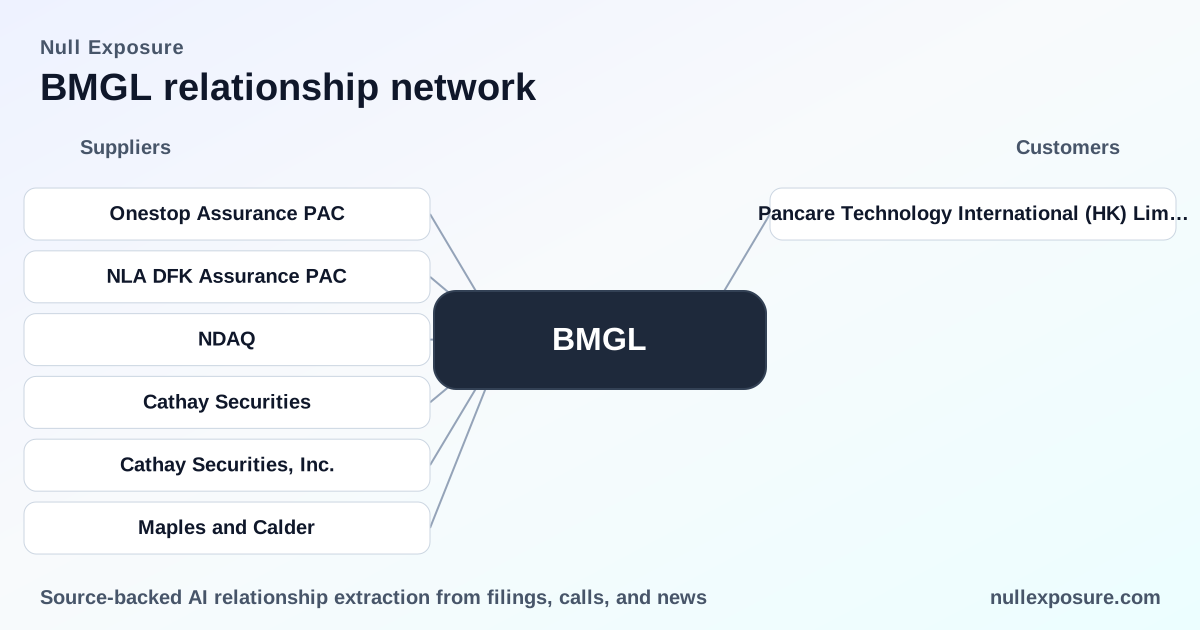
Basel Medical Group (BMGL): Customer Relationships That Could Reprice a Microcap
Basel Medical Group operates healthcare facilities and related services in Singapore and the Asia‑Pacific region, monetizing primarily through clinical services and product sales routed through subsidiaries; its revenue base is small today but the company is executing commercial contracts that can materially change future cash flows. Investors should treat BMGL as an operationally focused healthcare services operator whose valuation will be driven by contract wins, execution on supply sales, and balance‑sheet capacity to scale. For a concise dashboard of institutional relationship signals and sourcing, visit https://nullexposure.com/.
Why one large contract changes the story
BMGL’s reported trailing twelve‑month revenue is $11.35 million with negative operating and net margins, reflecting a company still in the early commercial stage. The most consequential relationship surfaced in news coverage is a reported S$375 million multi‑year supply contract awarded to a Basel Medical subsidiary by Pancare Technology International (HK) Limited. That contract is orders of magnitude larger than BMGL’s current revenue base, and therefore is both a potential growth catalyst and a source of execution risk: converting a headline contract into recurring, margin‑accretive revenue requires operational scale, working capital, and distribution capability. According to StockTitan coverage published in March 2026, the arrangement is positioned to cover healthcare product supply across the Asia‑Pacific region (news reports, March 9, 2026).
For a full, exportable view of BMGL customer mentions and their source materials, see https://nullexposure.com/.
Customer mentions and what each one means
Pancare Technology International (HK) Limited — news entry 1
Basel Medical disclosed that a subsidiary secured a S$375 million contract to supply essential healthcare products over multiple years across the Asia‑Pacific region, representing a potential step‑change to BMGL’s revenue profile. This item was reported by StockTitan in March 2026 and cited as connected to the company’s FY2025 disclosures (StockTitan coverage, March 9, 2026).
Pancare Technology International (HK) Limited — news entry 2
A second StockTitan reference reiterates that the award is for multi‑year product supply and positions the subsidiary as the contracting party for regional distribution — the duplication in sources highlights market attention on this single, large commercial award. The second mention is likewise from StockTitan’s March 9, 2026 coverage.
WMG (Warner Music Group) — news entry
This result is unrelated to Basel Medical Group’s commercial relationships: the referenced item describes Warner Music Group’s revenue impact from terminating a distribution agreement with BMG and contains no BMGL customer linkage. The press release from Warner Music Group is dated in its FY2025 results commentary (Warner Music Group press release, FY2025).
How these relationships map to BMGL’s operating model
- Contracting posture: The Pancare award is described as a multi‑year supply contract, indicating a shift from single‑site clinical revenue to longer‑term commercial supply agreements that carry higher revenue visibility but require fulfillment capabilities and capital to scale. This is a company‑level signal derived from the reported contract terms.
- Concentration risk: A single counterparty contract of reported S$375 million inherently creates concentration risk if delivered revenue flows depend materially on one customer or one line of supply.
- Criticality and margin leverage: For a company with negative operating margins and a TTM revenue base of $11.35M, a multi‑year supply contract has the potential to drive material margin improvement if BMGL captures higher‑margin product sales and achieves scale economies.
- Maturity and execution demands: BMGL is an early‑stage commercial operator whose gross profit of $2.40M TTM and EBITDA loss signal that fulfilling a large contract will require robust execution, likely capital expenditure, working capital, and partner logistics.
These operating‑model signals are drawn from BMGL’s latest quarter data (latest quarter 2025‑06‑30) and the public news coverage of the Pancare award.
Financial context that influences deal realization
BMGL’s market capitalization (~$10.86M) and balance sheet profile impose real constraints on near‑term ability to self‑fund large fulfilment obligations. Insider ownership is high (54.3%) while institutional ownership is near zero (0.62%), which historically limits access to public capital without dilution or strategic partnerships. The company’s negative net margin (-93.7%) and EBITDA loss highlight the gulf between headline contract value and deliverable free cash flow unless external financing or partner arrangements are put in place.
Investment implications — upside and required evidence
- Upside: If the Pancare contract is fully executable and BMGL secures financing or third‑party logistics partners, the contract can rapidly rebase revenue and lift operating leverage, creating a visible rerating catalyst for a microcap.
- Evidence investors should demand: verifiable contract milestones, proof of product supply chain and warehousing capacity, counterparty payment terms, staged revenue recognition, and third‑party confirmations or bankable guarantees that reduce counterparty and execution risk.
- Downside: Failure to fund or execute fulfillment would convert a headline contract into a reputational and financial liability, magnifying liquidity strain and dilutive financing needs.
Quick read: what to watch next
- Public disclosures from BMGL that confirm contract milestones, delivery timetables, and payment arrangements; StockTitan flagged the award on March 9, 2026, but formal filings or audited confirmations are the decisive items.
- Any equity or debt raises: given the company’s current market cap and negative margins, capital raises are likely required to scale fulfillment.
- Customer diversification: whether BMGL signs additional multi‑year customers or signs subcontracts to mitigate concentration risk.
Bottom line
Basel Medical is a small healthcare operator with a potentially transformative commercial contract reported by third‑party media. The Pancare S$375 million multi‑year award is the single most material customer relationship in the public record to date and will determine whether BMGL’s growth thesis is credible or overstated. Investors should prioritize confirmation of contractual substance, financing plans, and operational partnerships before revaluing the equity. For a concise repository of the underlying source links and signals, visit https://nullexposure.com/.
Sources: Basel Medical Group filings and company profile (latest quarter 2025‑06‑30), StockTitan news coverage (March 9, 2026) on Pancare contract mentions, Warner Music Group FY2025 results release (reference item).