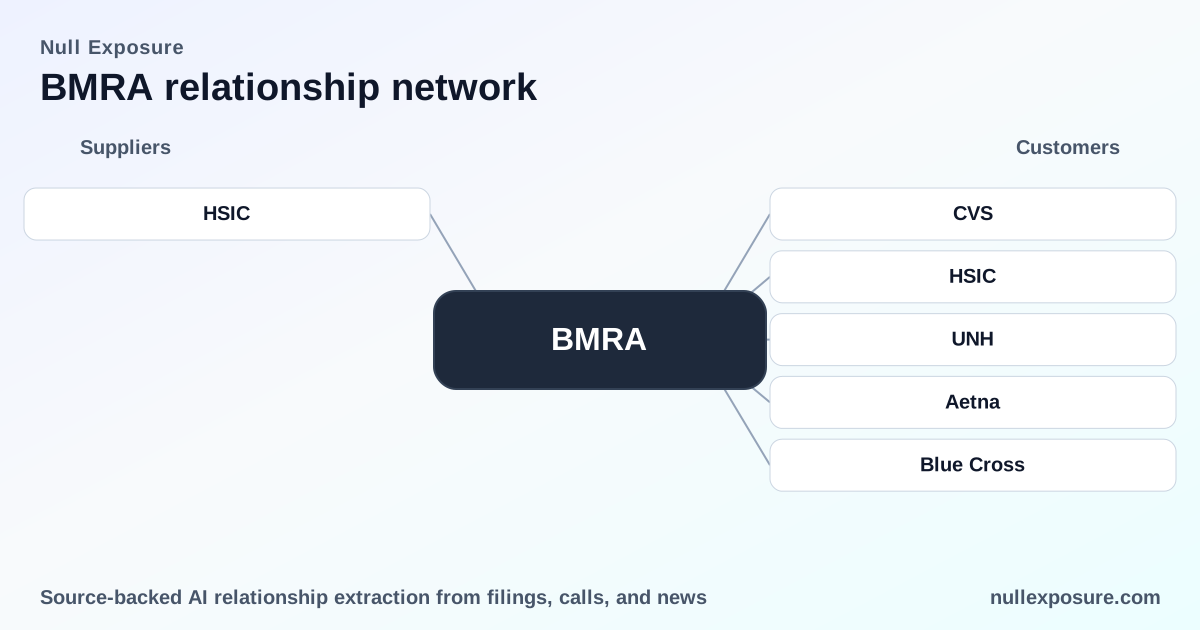
Biomerica (BMRA) — Customer Relationships That Drive Commercial Traction
Biomerica operates as a diagnostics developer and manufacturer, monetizing through product sales, contract manufacturing services, and distribution partnerships that commercialize proprietary tests such as inFoods® IBS. Revenue comes from three channels: direct sales and distributors, contract manufacturing, and commercialization agreements with large channel partners and payors that set reimbursement benchmarks. For investors, the critical thesis is that scalable reimbursement (CMS establishing a $300 national payment rate) plus distribution relationships create a path to revenue leverage while concentration in distributors and regional backlog exposure drive near-term operational risk. For a closer look at the commercial map, visit https://nullexposure.com/.
Why the CMS decision matters for commercial economics
The Centers for Medicare & Medicaid Services (CMS) set a $300 national payment rate for Biomerica’s inFoods® IBS test effective January 1, 2026, creating an explicit pricing anchor that transforms commercial negotiations and margin outlook. That federal payment rate functions as a de facto price floor for private insurers and materially improves the company’s ability to negotiate coverage and reimbursement with large payors and provider networks. According to an Investing.com report dated May 2, 2026, the CMS action triggered immediate market re-pricing of BMRA stock and is central to management’s commercialization playbook.
All reported customer and channel relationships (one-by-one)
Below I list every customer/partner name that appears in the collected reporting, with a concise summary and source reference.
-
United Healthcare (UNH) — Biomerica will use the CMS $300 reimbursement benchmark as the basis for negotiations with UnitedHealthcare to attain private payer coverage for the inFoods® IBS test; this linkage was highlighted after the CMS pricing announcement. (Investing.com, May 2, 2026: https://au.investing.com/news/stock-market-news/biomerica-stock-soars-after-medicare-sets-300-payment-rate-for-ibs-test-93CH-4183103)
-
UNH — Multiple outlets echo that Biomerica intends to benchmark CMS pricing when negotiating with UNH for private coverage of inFoods® IBS; the company’s release and subsequent news coverage name UNH explicitly. (GlobeNewswire coverage reprinted by ManilaTimes and StockTitan, Mar–Dec 2025/2026)
-
Aetna — Management has stated it will use the CMS $300 rate as a negotiation benchmark with Aetna to secure private coverage; Aetna is named repeatedly in the company release and third‑party reports. (QuiverQuant press summary, Mar 9, 2026: https://www.quiverquant.com/news/Biomerica%2C+Inc.+Announces+Medicare+Payment+Rate+for+inFoods%C2%AE+IBS+Test+Set+at+%24300+Effective+January+1%2C+2026)
-
CVS — Reports list CVS (inferred for Aetna-related negotiations in some outlets) among the private commercial insurers Biomerica expects to engage using CMS pricing as leverage. (QuiverQuant, Mar 9, 2026)
-
Blue Cross — Biomerica will reference the CMS reimbursement benchmark in discussions with Blue Cross plans to secure coverage for inFoods® IBS across commercial lines. (Investing.com and QuiverQuant summaries, Mar–May 2026)
-
Henry Schein — Biomerica announced a U.S. marketing/distribution services agreement with Henry Schein designed to accelerate commercial roll‑out of inFoods® IBS; management expects this partnership to enhance commercialization trajectory. (Marketscreener summary and TradingView coverage referencing the Oct 16, 2025 marketing agreement; Marketscreener/TradingView, Mar 2026)
-
HSIC — Several news items cite HSIC as the ticker for the Henry Schein marketing relationship and link that agreement to expected margin expansion from inFoods® IBS revenue. (MedicalBuyer and other March 2026 press coverage: https://medicalbuyer.co.in/us-based-biomerica-reports-net-sales-of-usd-1-21m-in-q2-2026/)
-
Phoenix Airmid Biomedical — Biomerica announced an exclusive Canadian distribution arrangement with Phoenix Airmid Biomedical to launch inFoods® IBS in Canada; Phoenix Airmid will serve as the exclusive Canadian distributor. (GlobeNewswire reprint on ManilaTimes, Apr 14, 2026: https://www.manilatimes.net/2026/04/14/tmt-newswire/globenewswire/biomerica-launches-infoods-ibs-in-canada-through-partnerships-with-phoenix-airmid-biomedical-and-canalt-health-labs/2320008)
-
Centers for Medicare & Medicaid Services (CMS) — CMS established the $300 national payment rate for the inFoods® IBS test effective Jan 1, 2026; this regulatory action is the principal catalyst for subsequent commercial negotiations and distributor marketing efforts. (Investing.com coverage of the CMS action, May 2, 2026)
Each of the entries above reflects the coverage found in the company release and broader press cycle following the CMS decision; management has consistently tied distribution and payor discussions back to the CMS pricing announcement (QuiverQuant and multiple news outlets, Mar–May 2026).
How those relationships map to Biomerica’s operating model and constraints
The filings and press coverage yield a set of company-level signals that together explain how Biomerica contracts, scales, and where execution risk concentrates.
-
Concentration and counterparty risk: For FY2025 management disclosed that two distributors accounted for 41% of net sales and historically one distributor represented 33% of sales — this is a material concentration signal that exposes revenue to distributor performance and contract renewal dynamics.
-
Global distribution footprint with regional exposure: Sales and backlog statistics show substantial exposure to APAC and EMEA, with Asia and Europe representing meaningful shares of backlog and receivables; North America also represents a significant share but not a majority. These regional mix signals influence working capital, FX sensitivity, and logistics constraints.
-
Distribution + manufacturing duality: The company mixes contract manufacturing revenue (~$1.07M noted) with clinical lab product distribution. That mix means Biomerica is simultaneously a supplier to distributors and reliant on those same distributors to reach end customers — a structurally important interdependence.
-
Commercial maturity and criticality: The CMS reimbursement decision upgrades the criticality of the inFoods® product to payors and distributors — the product moves from an early commercial stage into the reimbursement‑anchored rollout phase, improving monetization prospects and bargaining power with commercial insurers.
-
Contract posture and stage: Relationships are active and commercial, with announced marketing agreements (Henry Schein, Phoenix Airmid) and ongoing payor negotiations (UnitedHealthcare, Aetna, Blue Cross) driven by CMS pricing. Management’s public statements indicate an aggressive commercialization posture rather than a wait‑and‑see approach.
-
Operating leverage dynamics: Management has described fixed costs “largely in place,” implying incremental revenue from inFoods® and new partnerships will drive material margin expansion if volume scales as anticipated.
Investment implications — what investors should watch
-
Primary upside: Rapid payer coverage using the CMS rate as a commercial benchmark and successful scale via Henry Schein and regional distributors (Phoenix Airmid in Canada) should convert the existing top line into expanding gross margins and improved operating leverage.
-
Primary downside: Distributor concentration and regional backlog exposure create single‑counterparty and regional execution risk; loss of a major distributor or persistent shipment delays to Asia/EMEA would compress revenue and cash flow.
-
Near-term catalysts: Successful contracting with major private payors (UNH, Aetna, Blue Cross), volume ramp through Henry Schein, and execution on contract manufacturing expansions are the immediate commercial milestones to watch.
For an institutional view of commercial counterparties and contract signals that matter for underwriting and operational diligence, see more at https://nullexposure.com/.
Bold takeaways: CMS reimbursement is the decisive commercial pivot, distributor concentration is a material risk, and channel partnerships (Henry Schein, Phoenix Airmid) are central to converting price into scale.