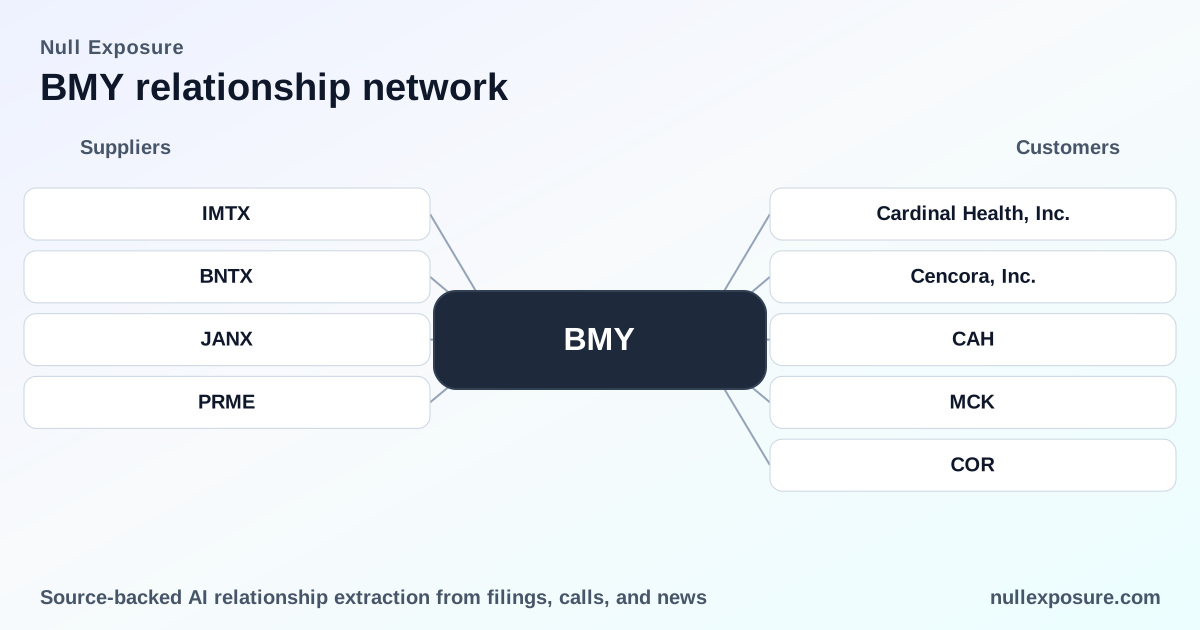
Bristol‑Myers Squibb (BMY) — customer relationships that drive the revenue engine
Bristol‑Myers Squibb is a global integrated pharmaceutical manufacturer that monetizes primarily through prescription drug and biologic sales, supplemented by licensing, royalties and strategic collaborations. The company sells finished product into wholesale and distribution channels, licenses assets to regional partners, and co‑develops drugs with biotech and pharma peers; its top wholesalers constitute a concentrated and economically significant customer set that directly shapes cash flow and working capital. For a concise commercial risk read on customers and active collaborations, see Null Exposure’s research hub: https://nullexposure.com/.
How BMS runs its commercial machine and where value comes from
BMS operates as a vertically integrated drug company: discovery, development, manufacturing and global distribution of branded therapies across oncology, immunology and cardiology. The firm reported roughly $48.5 billion in trailing twelve‑month revenue, with net product sales representing more than 95% of total revenues, which makes product sales the company’s core monetization vector. Manufacturing footprint in the U.S., Puerto Rico, the Netherlands, Ireland and Switzerland supports global supply, while royalties and licensing agreements (for example with other large pharmas and regional developers) provide recurring, lower‑capital income streams.
Customer concentration in plain terms
BMS sells predominantly through wholesalers and distributors. The FY2025 Form 10‑K discloses a high concentration among three U.S. wholesalers that together account for a material share of U.S. gross revenue—a structural commercial characteristic that tightens working capital sensitivity to a small set of counterparties. Payment terms are short‑term (typically 30–90 days), and BMS fulfills orders rapidly with minimal backlog, which emphasizes cash‑cycle exposure rather than long contract duration.
For a deep dive into how customer concentration affects enterprise risk, visit https://nullexposure.com/.
Every relationship in the public record (documented sources)
-
Cencora, Inc. (also listed as COR). According to BMS’s FY2025 Form 10‑K, Cencora accounted for 29% of U.S. gross revenues in 2025, making it one of the three largest U.S. wholesalers for BMS product flows. (FY2025 10‑K disclosure)
-
Cardinal Health, Inc. (Cardinal Health / CAH). BMS’s FY2025 10‑K reports Cardinal Health represented 22% of U.S. gross revenues in 2025, another principal wholesale channel for product distribution. (FY2025 10‑K disclosure)
-
McKesson Corporation (MCK). The FY2025 10‑K shows McKesson was the largest single U.S. wholesaler at 36% of U.S. gross revenues in 2025, up from 34% in 2024, reflecting a dominant distribution relationship that materially concentrates receivables and shipment volume. (FY2025 10‑K disclosure)
-
QTTB. Q32 Bio licensed the asset bempikibart from Bristol‑Myers Squibb as part of a strategic reprioritization, signaling BMS’s ongoing asset rationalization and out‑licensing strategy for select candidates. (Investing.com analyst note, May 2026)
-
Compugen Ltd. (CGEN). Compugen announced it ended a collaboration agreement with BMS as part of a refocus on its own discovery strategy, highlighting the transactional and time‑limited nature of certain R&D partnerships. (Globes, March 2026)
-
IMNM. As disclosed in IMNM’s FY2024 filing, IMNM assumed a license agreement with BMS in connection with an acquisition, receiving a worldwide exclusive license under certain BMS patent rights and know‑how—an example of BMS transferring IP to third parties via transactional deals. (IMNM FY2024 SEC filing)
-
AstraZeneca (AZN). Under a revised 2025 agreement AstraZeneca will pay BMS mid‑teens royalties for U.S. sales of the product referenced, reflecting BMS’s role as a royalty recipient in cross‑company licensing arrangements. (Pharmaceutical‑Technology / Research‑Tree reporting, 2026)
-
Mark Cuban Cost Plus Drug Company / Cost Plus Drugs. The BMS‑Pfizer alliance announced a program to offer Eliquis (apixaban) on CostPlusDrugs.com, moving a major BMS product into a direct‑to‑consumer cash channel alongside partner Pfizer. (Biospace press release, May 2026)
-
RVMDW / RVMD (Revolution Medicines). Recent disclosures show a clinical collaboration with BMS to evaluate daraxonrasib in combination with BMS’s navlimetostat, demonstrating active clinical partnerships with smaller biotech firms. (RVMDW Q4 2025 earnings call; Finviz reporting, March 2026)
-
Replimune (REPL). Replimune’s biologics license application centers on RP1 delivered in combination with BMS’s checkpoint inhibitor Opdivo, illustrating BMS’s strategic role as a collaborator and supplier of backbone immuno‑oncology agents. (Fierce Biotech, March 2026)
-
Immunocore Holdings (IMCR). Immunocore has entered a clinical trial collaboration with BMS to investigate a bispecific TCR candidate in combination with nivolumab, underlining ongoing co‑development ties in oncology. (TradingView summary of SEC 10‑K reporting, 2026)
-
Perspective Therapeutics (CATX). Perspective has a clinical trial collaboration with BMS to evaluate a radiolabeled candidate [212Pb] VMT01 with nivolumab, another example of BMS providing checkpoint inhibitors to trial partners. (MarketBeat reporting, May 2026)
-
Zai Lab (ZLAB). Zai Lab holds exclusive Chinese rights to Augtyro through a license agreement originating from BMS’s acquisition activity, demonstrating regional licensing strategies following asset transfers. (Pharmaceutical Business Review, March 2026)
-
Innate Pharma (IPHA). Innate Pharma works in collaboration with BMS on a Phase I cancer antibody program, consistent with BMS’s routine use of external partnerships to expand clinical pipelines. (Intellectia.ai preview, 2026)
-
Cencora / COR (duplicate entries in filings). Multiple 10‑K line items refer to Cencora using different tickers/labels (Cencora, COR), but all reflect the same top‑three wholesaler concentration disclosed in the FY2025 Form 10‑K. (FY2025 10‑K disclosure)
-
Cardinal Health / CAH (duplicate labels). The Form 10‑K also lists Cardinal Health under different nomenclature (Cardinal Health, Cardinal Health Inc, CAH); each entry corresponds to the same 22% U.S. gross revenue disclosure. (FY2025 10‑K disclosure)
Operating constraints and commercial implications
-
Short‑term contracting posture: Payment terms are typically 30–90 days, so BMS’s commercial cash conversion is sensitive to billing and inventory turns rather than long multi‑year payer contracts. This is a company‑level signal drawn from BMS’s commercial disclosures.
-
Counterparty mix: BMS sells principally to wholesalers, distributors and specialty pharmacies, with secondary sales to retailers, hospitals, clinics, government agencies and patients; this diversification softens single‑channel risk but does not eliminate concentration among the top three wholesalers. (Company 10‑K)
-
Geographic concentration: The United States accounts for ~69% of revenues, making U.S. market dynamics and regulation the primary revenue driver while international sales remain material but smaller. (FY2025 revenue breakdown)
-
Materiality and criticality: With net product sales >95% of total revenues, commercial execution on product distribution and pricing is central to enterprise value; licensing and royalties are meaningful but subordinate. (Company FY2025 reporting)
-
Distributor dependence and receivable risk: The 10‑K explicitly flags risk if a major wholesaler encounters financial distress, which would directly affect collections and inventory flow—an operational exposure tied to the high concentration among the three wholesalers.
-
Active, transactional relationships: Customer orders are typically fulfilled within days and most relationships are operationally active rather than contractual long‑duration purchase agreements; collaborations and licenses are the mechanism for longer‑term strategic alignment.
Investment takeaways
- Concentration creates leverage and risk: The top three wholesalers (McKesson, Cencora, Cardinal) are material to revenue and working capital, so changes in their purchasing behavior or credit position will affect BMS’s near‑term cash and inventory metrics.
- Partnerships and out‑licensing are regular monetization tools: BMS balances direct sales with licenses, royalties and clinical collaborations to diversify pipeline risk and capture regional value.
- Operational predictability is high but not immune: Short payment terms and rapid fulfillment increase throughput predictability while concentrating counterparty credit risk.
For more customer‑level disclosures and signal tracking across healthcare corporates, see Null Exposure’s research coverage at https://nullexposure.com/.