Brand Engagement Network (BNAIW) — customer relationships and commercial posture
Brand Engagement Network sells conversational AI and human-like avatar solutions to enterprises and smaller organizations, monetizing through subscription agreements, bespoke implementation services, and channel resale arrangements. The product set is offered across on-premises, private-cloud, and community-cloud deployments to fit enterprise security profiles, while commercial activity remains early-stage: trailing twelve‑month revenue is $275,120 against a negative EBITDA of $8.24 million, reflecting a company still investing in go-to-market and product maturity. For a quick company overview, visit https://nullexposure.com/.
What investors should know in one sentence
BNAIW is a software-plus-services vendor selling conversational AI as multi‑year subscriptions with significant customization and channel activity; revenue is nascent, enterprise pipeline includes global pilots and partnerships, and the business model is sensitive to execution on sales, reseller stability, and enterprise deployment complexity.
Customer relationships: the reported partners and what they mean
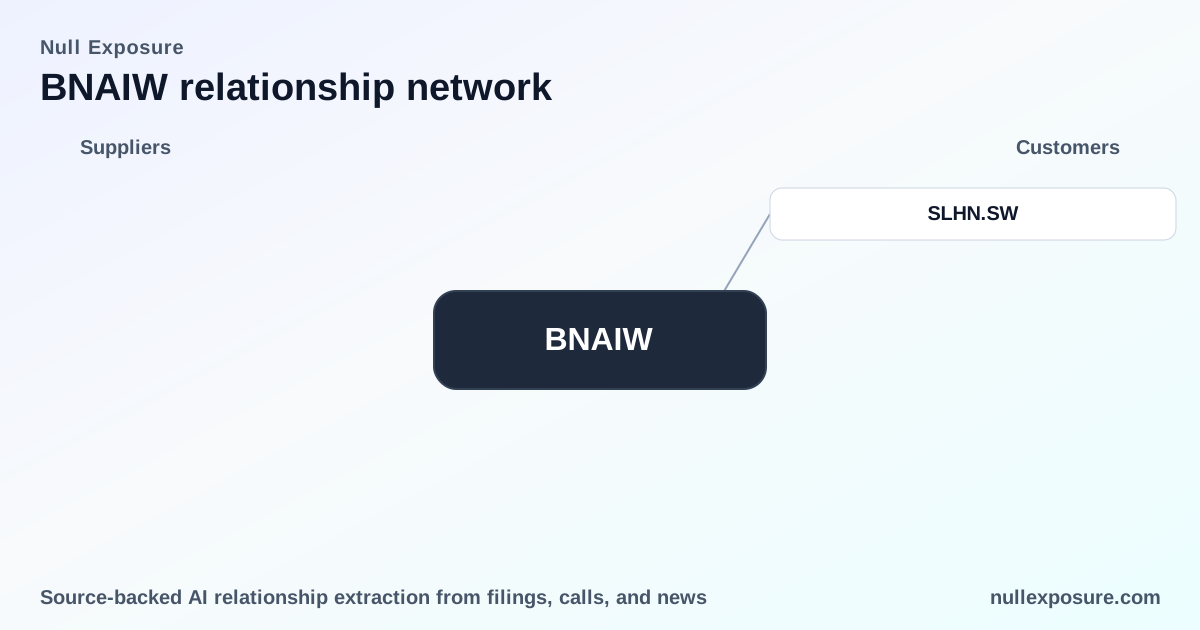
- SLHN.SW — Management disclosed a global partnership established with SLHN.SW as an example of enterprise traction; the arrangement began prior to the March 2024 merger and was referenced on the 2025 Q2 earnings call. According to the 2025 Q2 earnings call (filed March 7, 2026), management positioned this as a global partnership developed before the merger.
- Swiss Life — Management specifically cited a global partnership with Swiss Life in the same 2025 Q2 earnings call, highlighting it as an example of cross-border commercial engagement. The company discussed Swiss Life on the 2025 Q2 earnings call (March 7, 2026) to illustrate enterprise-level adoption.
Both entries in the results reference the same disclosure in the 2025 Q2 earnings call, confirming at least one notable global enterprise engagement (Swiss Life) in the company’s customer roster.
Commercial structure and contract posture — what the constraints reveal
Company disclosures and public excerpts make the commercial model clear: subscriptions are the core contract form, generally one to three years, supported by customization and integration services. Management stated, “We expect the terms of our subscription agreements will primarily be one to three years,” which positions revenue as recurring but dependent on multi‑year wins.
Deployment and customer segmentation follow a tiered approach:
- On‑Premises deployments are targeted at large enterprises requiring ring‑fenced solutions and strict data security. This signals a higher contracting complexity and longer sales cycles.
- Private Cloud offerings address mid‑market customers with complex privacy needs and proprietary infrastructure requirements.
- Community Cloud packages cater to small enterprises that need simpler customization and shared infrastructure.
The company also disclosed channel activity: an exclusive Reseller Agreement with AFG provided stock and warrants as partial consideration, and that agreement was terminated in January 2025, with the forfeiture of certain warrants—an explicit sign that channel relationships have been both strategic and fragile. The reseller disclosure names AFG and details equity-based compensation tied to reseller services.
Finally, management reported a programmatic expansion into healthcare pilots and international partnerships in 2024, a signal that go‑to‑market is focused on vertical initial use cases and geographic breadth.
How these operating signals translate into investor risks and opportunities
- Contracting complexity and sales cadence. Offering on‑premises and fully ring‑fenced solutions to large enterprises implies long, resource‑intensive sales cycles and significant implementation services revenue up front. That supports higher ARR once deployed but increases go‑to‑market cost and time to scale.
- Concentration and criticality. The cited global partnership with Swiss Life is strategically meaningful; landing more high‑quality enterprise customers will materially improve revenue visibility, but current revenue is too small for true diversification.
- Channel fragility. The AFG reseller arrangement involved meaningful equity consideration and its termination in January 2025 indicates channel risk and potential go‑to‑market disruption when resellers change or when equity incentives unwind.
- Pilots to revenue conversion. Management referenced AI Agent pilots with five additional healthcare companies in 2024 alongside commercial partnerships — that pattern underlines a strategy oriented toward pilot-led adoption that must convert to subscriptions to materially move the revenue needle.
- Product + services mix. The company calls itself a GenAI conversational-solution provider but also emphasizes conversation design, system integration, and cross‑platform execution — a services tilt that supports customer stickiness but limits gross margin expansion until software scale is reached.
Financial and liquidity context
The financial picture confirms an early commercial stage. Trailing twelve‑month revenue is $275,120 with gross profit equal to that figure, indicating direct costs are currently minimal or grouped in operating expense. Operating margin is -14.03%, EBITDA is -$8,235,768, return on assets -0.452, and return on equity -2.825. Public float is low (3,868,100 shares) and both institutional and insider ownership are reported at 0%, producing very limited liquidity and market support. The company’s 52‑week trading range (high $0.84, low $0.0101) underscores investor volatility.
How to read signals for positioning and next steps
- Accumulate conviction only after reproducible enterprise wins. One named global partner (Swiss Life) demonstrates potential product-market fit at the enterprise level, but scale requires repeatable multi-year subscription conversions from pilots.
- Monitor reseller and channel stability. The AFG equity‑for‑resale arrangement and its January 2025 termination are a concrete example of how channel economics and incentives materially affect distribution.
- Watch bookings cadence and ARR composition. Given the subscription contract posture (one to three years), the transition from pilots to contracted subscriptions will be the most informative forward-looking metric.
For a concise summary of customer coverage and constraints across relationships, see the company’s recent disclosures and commentary on the 2025 Q2 earnings call (March 7, 2026). Additional analysis and ongoing tracking of contract rollovers will be posted at https://nullexposure.com/.
Final assessment for investors and operators
Brand Engagement Network is an early-stage GenAI conversational vendor selling subscription-based, deployment-flexible solutions with a services overlay. The Swiss Life partnership is a meaningful enterprise reference, but revenue remains minimal and EBITDA negative. Key investor considerations are the company’s ability to convert pilots into multi-year contracts, stabilize channel distribution after the AFG termination, and scale software margins as services intensity declines.
If your thesis requires early enterprise traction with the expectation of rapid revenue scaling, BNAIW is a high-risk, high-leverage play on conversational AI adoption at the enterprise level; otherwise, wait for sustained ARR growth and clearer channel stability before increasing exposure.