Barnes & Noble Education (BNED): Campus partnerships driving recurring retail economics
Barnes & Noble Education operates and monetizes a nationwide network of college and K‑12 retail outlets by running on‑campus bookstores, selling course materials and general merchandise, and licensing hardware, software and marketing services to institutions. Revenue mixes point‑of‑sale course materials and recurring, usage‑based services (marketing, e‑commerce and inventory software), creating a hybrid retail + services business with stable cash flow from institutional partnerships. For deeper, indexed coverage and tracking of BNED customer activity visit https://nullexposure.com/.
What the recent customer announcements tell investors
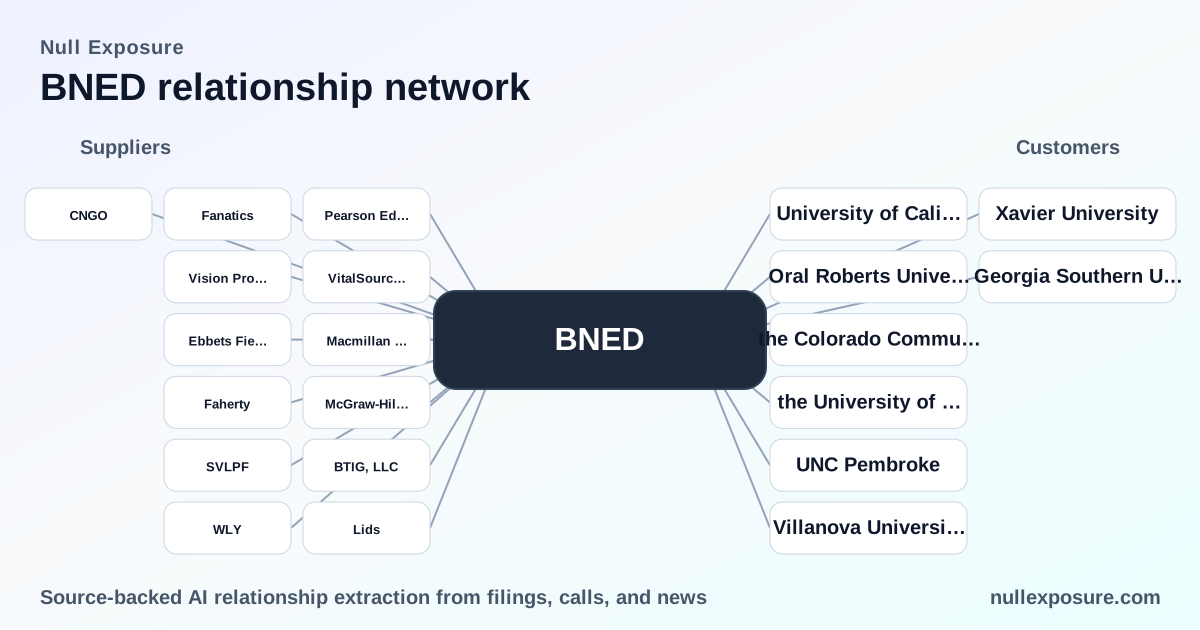
BNED’s headline wins over FY2025–FY2026 confirm two strategic patterns: expansion of management contracts across a broad range of campuses, and continued emphasis on omnichannel and technology‑enabled retail services. Below are the explicit customer relationships captured in recent reporting.
-
University of California, Berkeley — BNED’s Barnes & Noble College unit won a competitive bid to manage retail, course materials and e‑commerce for UC Berkeley, with a stated focus on modernizing retail operations, improving affordability and expanding digital customer engagement; announced in press releases spanning FY2025–FY2026 (GlobeNewswire, Jan 6, 2026; GlobeNewswire, Dec 23, 2025).
Source: GlobeNewswire press release, Jan 6, 2026 and company 10‑K disclosures, Dec 23, 2025. -
Oral Roberts University — Identified as one of a wave of new campus partnerships announced by BNED in FY2025, reflecting a multi‑campus expansion initiative (GlobeNewswire, May 12, 2025).
Source: GlobeNewswire press release, May 12, 2025. -
Colorado Community College System — Included among BNED’s FY2025 announced new partners, signaling expansion into multi‑campus community college systems (GlobeNewswire, May 12, 2025).
Source: GlobeNewswire press release, May 12, 2025. -
University of Denver — Named in the FY2025 partnership surge; this win expands BNED’s footprint among private research and liberal arts institutions (GlobeNewswire, May 12, 2025).
Source: GlobeNewswire press release, May 12, 2025. -
UNC Pembroke — Announced as part of BNED’s FY2025 campus partnership list, reflecting continued penetration of public regional universities (GlobeNewswire, May 12, 2025).
Source: GlobeNewswire press release, May 12, 2025. -
Villanova University — Cited among notable FY2025 additions, reinforcing BNED’s ability to win national competitive processes at private institutions (GlobeNewswire, May 12, 2025).
Source: GlobeNewswire press release, May 12, 2025. -
Xavier University — Listed in the FY2025 expansion announcement, adding to BNED’s private university roster (GlobeNewswire, May 12, 2025).
Source: GlobeNewswire press release, May 12, 2025. -
Georgia Southern University — Also named in the FY2025 partnership surge; another public research institution added to BNED’s managed retail base (GlobeNewswire, May 12, 2025).
Source: GlobeNewswire press release, May 12, 2025.
These wins are documented in BNED press materials and public filings over FY2025–FY2026 and represent both scale and diversification across institution types — private, public, and community college systems.
Why these customer relationships matter to revenue quality
BNED’s commercial model is not pure transactional retail. Company disclosures show revenue recognition that mixes point‑in‑time sales (book sales at checkout) with usage‑based and time‑based services (advertising/brand marketing revenue recognized over time or by impressions). The consequences for investors are clear:
- Revenue stability and stickiness: Institutional management contracts for campus retail and e‑commerce create recurring revenue lines (services, software and royalty-like retail management fees) that extend beyond seasonal textbook cycles.
- Margin complexity: Retail gross margins sit alongside service and software margins; management contracts require investment in store modernization and technology, which can compress near‑term margins while building long‑term operating leverage.
- Geographic concentration as a strength: BNED operates across all 50 states and DC — 653 physical and 493 virtual locations as of May 3, 2025 — enabling national scale in buying, distribution and technology deployment.
Source: Company disclosure as of May 3, 2025.
If you track customer contract flow as an upstream indicator of revenue momentum, BNED’s steady roster of campus wins is a primary signal of pipeline conversion into recurring service income. Learn more about how we surface these customer signals at https://nullexposure.com/.
Operating model constraints and what they signal about risk
The structured signals extracted from company filings describe BNED’s operating posture:
-
Contracting posture: Usage‑based and time‑based contracts for brand marketing and advertising, with revenue recognized over time for impressions or stated periods. This creates variable, performance‑linked revenue streams rather than pure fixed fees.
Evidence: company revenue recognition description for brand marketing and advertising. -
Role breadth: BNED operates as seller, distributor and service provider — it sells course materials and hardware/software, distributes textbooks at scale, and provides managed retail/services to campuses. This vertical breadth reduces single‑point dependency but increases operational complexity.
Evidence: filings noting hardware/software sales to ~318 college bookstores and BNED’s status as one of the largest textbook wholesalers. -
Segments and criticality: Course materials remain the core product, supplemented by distribution, hardware, software and services; course materials accounted for the largest single component of sales in reported periods (Course Materials Product Sales reported in filings). This positions BNED as a critical campus partner for students and institutions.
Evidence: company segment disclosures. -
Maturity and scale: BNED’s scale in physical and virtual bookstores and textbook wholesale positions it as a mature operator in the campus retail niche, with established relationships that compete on contract wins rather than on sporadic retail promotions.
These constraints imply BNED’s revenue will track contract renewals, seasonal textbook cycles and adoption of its software/hardware stack. Usage‑based advertising revenue can accelerate growth but adds variability tied to campaign volume and impression delivery.
Investment implications — upside, cadence and risks
- Upside drivers: Contract wins and managed retail expansions convert to predictable service revenue and incremental e‑commerce share, while scale in procurement supports gross margin maintenance. The UC Berkeley contract is a high‑visibility example of BNED winning large, strategic accounts that can be a template for similar institutions.
- Cadence: Expect revenue recognition to show mixed timing — point‑in‑time retail receipts plus over‑time advertising and service revenues that smooth earnings across quarters.
- Key risks: Execution risk on store modernization investments, working capital tied to inventory, and variability in usage‑based advertising revenue. The company’s FY2025 results and recent filings show modest profitability metrics (Revenue TTM $1.73B; EBITDA reported at $61.9M) that require margin recovery through scale and higher‑margin service penetration.
Source: Company financials and FY2025 filing disclosures.
Bottom line: repeatable campus economics with execution sensitivity
BNED’s recent customer wins across a wide spectrum of institutions are evidence of a repeatable, contract‑driven growth model anchored in course materials sales and expanding services/software. The business combines predictable, high‑frequency retail transactions with higher‑margin, usage‑based services — a mix that rewards scale and execution on technology and store modernization. Investors should focus on contract renewal cadence, margin trends in services versus retail, and the conversion of announced partnerships into sustained e‑commerce and marketing revenue.
For a systematic feed of BNED customer activity and how it maps to revenue signals, visit https://nullexposure.com/.