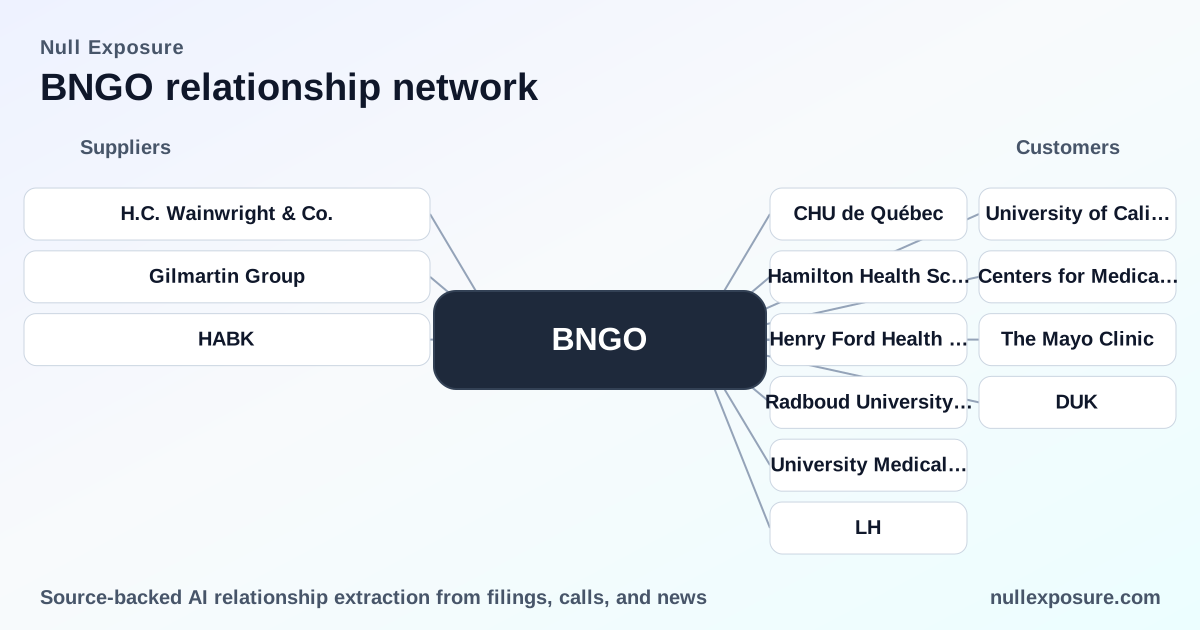
Bionano Genomics (BNGO) — Customer Map and Commercial Signals for Investors
Bionano Genomics sells optical genome mapping instruments (Saphyr, Stratys, Ionic), consumables and VIA™ analysis software (sold on a subscription basis), and operates a CLIA laboratory service. The company monetizes through one‑time instrument placements, recurring consumables and software subscriptions, and nascent diagnostics services; management has pivoted from new placements toward driving utilization across an installed base that grew to 371 OGM systems in 2024. For investors, the business combines hardware capital sales with recurring software and consumable economics, exposed to academic, governmental and commercial clinical labs globally.
[Explore the platform at https://nullexposure.com/]
How Bionano makes money and how customers fit in
Bionano’s revenue stack is straightforward: hardware placements (hardware segment), consumables and reagents, subscription software (VIA), and laboratory services through Bionano Laboratories. Company disclosures state VIA is sold by subscription and that customers are primarily academic and governmental research institutions, clinical labs, and biopharma/contract research organizations (company filing excerpts, FY2024–FY2025). Direct sales dominate North America and Europe, with third‑party distributors in Asia‑Pacific.
Key operating signals:
- Contracting posture: mix of one‑off hardware sales plus recurring subscriptions for VIA and steady consumables demand. Service agreements and on‑site equipment servicing are part of the installed‑base economics (company filing excerpts).
- Geographic footprint: global sales with revenue split showing Americas ~44.3%, EMEA ~46.3% and APAC ~9.4% for 2024 (company filing disclosures).
- Customer type & criticality: concentration toward academic/governmental labs and commercial clinical labs—customers that drive validation, clinical translation, and referral volumes; these customers also anchor long sales cycles but produce durable reference datasets.
- Maturity & strategy: installed base expansion to 371 systems (2024) but strategy shifted in 2024 to prioritize utilization and adoption over aggressive new placements—this implies a short‑term focus on recurring revenue and services rather than capital expansion.
The customer list that matters (what each relationship signals)
Below I cover each reported relationship in the data set with a concise, sourced takeaway.
Revvity (RVTY)
Bionano announced a collaboration to integrate VIA software into Revvity’s newborn sequencing workflow, positioning Bionano’s structural‑variant capabilities alongside Revvity’s sequencing in clinical newborn screening funnels (GlobeNewswire, Apr 2026). Takeaway: strategic software integration into clinical workflows increases VIA’s addressable market and potential subscription traction.
Radboud University Medical Center
Radboud operates multiple Stratys and Stratus systems and has automated UHMW DNA isolation workflows for OGM, giving it one of the largest OGM capacities outside Bionano itself (Q4 2025 earnings call transcript; InsiderMonkey, FY2026; GlobeNewswire, Feb 2026). Takeaway: leading academic adopters validate throughput and sample‑prep automation important for scale.
Labcorp (LH)
Labcorp presented a scaled Stratus workflow claim that one Stratus workflow processes up to 10,000 cancer samples/year versus ~240 for a comparable long‑read sequencing platform, and emphasized dramatically lower capital cost per sample; Labcorp KOLs also spoke at Bionano’s symposium (InsiderMonkey earnings call and GlobeNewswire, FY2026). Takeaway: commercial labs can translate Bionano’s tech into high‑throughput, cost‑efficient cancer testing pipelines.
Hamilton Health Sciences Center
Hamilton Health Sciences staff presented comparative SV/CN detection data using Stratys and contributed a symposium presentation on Bionano tools (GlobeNewswire and StockTitan, Feb–Mar 2026). Takeaway: hospital systems are integrating OGM for cytogenetics and hematologic analyses, supporting clinical adoption.
Henry Ford Health System
Henry Ford clinicians reported that VIA can unify genomic data streams and standardize workflows across methods after adopting OGM, speaking at Bionano’s symposium (GlobeNewswire and StockTitan, Feb–Mar 2026). Takeaway: integrated software value proposition resonates in large health systems.
CHU de Québec
Researchers at CHU de Québec developed and presented an Ionic‑based protocol for extracting nucleic acids from FFPE samples for downstream NGS workflows (StockTitan, Mar 2026). Takeaway: Ionic strengthens sample prep interoperability with existing NGS pipelines — a practical route to broader lab uptake.
University Medical Centre Groningen
Groups at Groningen reported using VIA for hematologic malignancy analysis and described workflows that emphasize standardized reviews and clearer interpretation of complex rearrangements (GlobeNewswire and StockTitan, Feb–Mar 2026). Takeaway: VIA’s software orchestration is gaining traction in specialist cancer labs.
University of California San Diego
UCSD faculty served as speakers at Bionano’s symposium describing the company’s systems and software in clinical and research contexts (GlobeNewswire, Feb 2026). Takeaway: academic centers in the U.S. provide validation and peer visibility that accelerate clinical acceptance.
Johns Hopkins University School of Medicine
Johns Hopkins presented the largest OGM sarcoma dataset, identifying complex abnormalities and potential biomarkers (Q4 2025 earnings call transcript; InsiderMonkey, FY2026). Takeaway: large academic datasets materially strengthen the clinical evidence base for OGM.
Centers for Medicare & Medicaid Services (CMS)
CMS updated the 2026 Clinical Lab Fee Schedule and increased the Category I CPT 81195 payment by 47% (from $1,263.53 to $1,853.22 effective Jan 1, 2026), concretely improving reimbursement economics for labs performing OGM (StockTitan summary of CMS schedule, Mar 2026). Takeaway: significant reimbursement uplift materially improves the clinical economic case and addressable revenue for Bionano and its lab customers.
The Mayo Clinic
Earlier coverage noted Mayo Clinic as an early Bionano user and cited the move from research users toward more commercial traction (InvestorPlace coverage, FY2021). Takeaway: marquee academic adopters provide long‑term validation and referral advantages.
Duke
Duke was named alongside Mayo Clinic as an early research adopter in historical coverage, illustrating academic penetration in the company’s early expansion (InvestorPlace, FY2021). Takeaway: early academic adoption set the foundation for subsequent clinical translations.
Investor implications — what to watch and why it matters
- Recurring revenue is the growth lever. VIA subscriptions and consumable stickiness underpin unit economics once instruments are placed; investor return will depend on moving utilization from research to routine clinical workflows.
- Reimbursement is a catalyst. The CMS increase to the CPT 81195 payment (effective 2026) is a discrete policy event that improves per‑test economics and reduces the adoption barrier for clinical labs.
- Customer mix reduces some commercial risk but preserves long sales cycles. Heavy exposure to academic and government labs provides credibility and dataset generation, but procurement cycles and budgetary constraints slow conversion to high‑volume clinical rollouts.
- Concentration & maturity signals. The installed base growth to 371 systems and the 2024 strategic shift toward utilization indicate management aims to harvest recurring revenue before pursuing another round of capital placements.
Bottom line
Bionano’s commercial model is a hybrid: capital sales create an installed base that generates recurring consumable and subscription revenue, while clinical reimbursement improvements and integrations with partners such as Revvity accelerate clinical routes to market. For investors, the key dichotomy is validation vs. commercialization — evidence and marquee customers validate the technology, while subscription and reimbursement dynamics determine scalability and margin expansion. If you evaluate BNGO, prioritize metrics that show rising VIA adoption, consumables pull‑through, utilization per installed system, and the pace of clinical volume conversion.
To dive deeper into customer signals and relationship analytics, visit https://nullexposure.com/ for the full platform.