Burning Rock Biotech (BNR): Pharma partnerships are the growth fulcrum for its CDx business
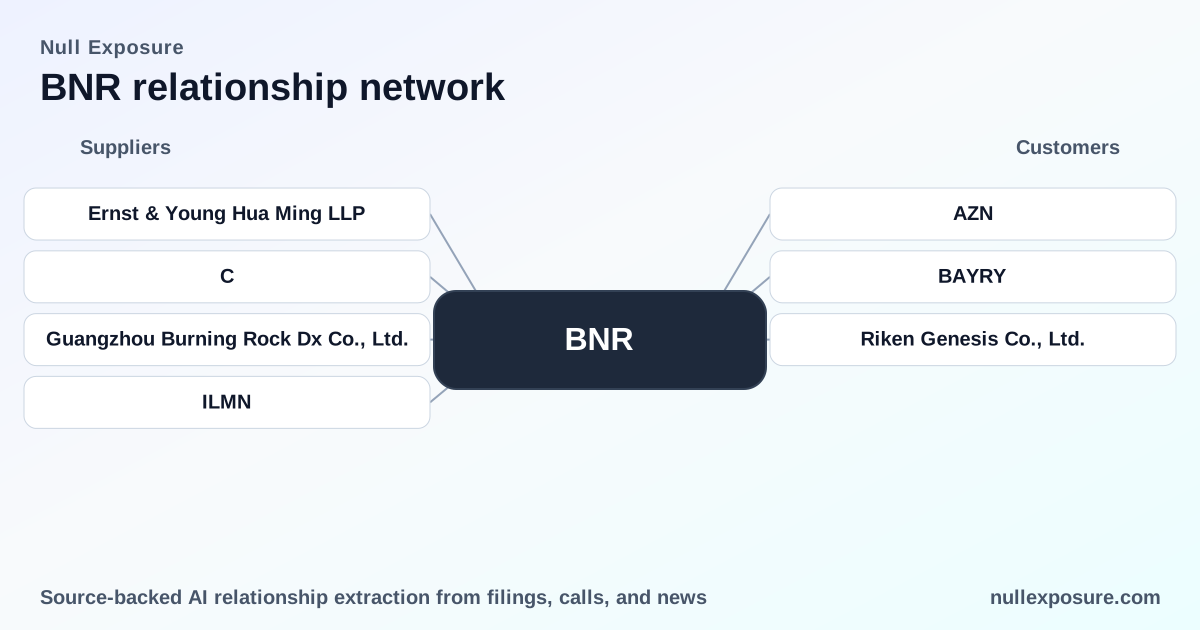
Burning Rock Biotech develops and commercializes next‑generation sequencing (NGS) cancer screening tests and companion diagnostics (CDx) and monetizes through clinical test sales, CDx licensing and collaborative development agreements with global pharmaceutical companies. Recent approvals and deal activity with AstraZeneca, Bayer and Riken Genesis convert R&D capability into commercial optionality, supporting expansion outside China while the company works toward sustainable profitability. For an integrated view of these customer relationships and source coverage, visit https://nullexposure.com/.
Why the partner list matters to investors
Burning Rock operates as a diagnostics developer that delivers technical platforms to pharma partners and hospital labs rather than a pure‑play drug company. This operating model produces three important investor implications:
- Contracting posture: The firm routinely enters collaborative agreements and CDx development partnerships with large pharmaceutical firms, positioning Burning Rock as a development and regulatory partner rather than the sole commercial lead in many markets.
- Concentration and counterparty quality: Partnerships with global firms such as AstraZeneca and Bayer are strategically valuable—high‑quality counterparties reduce commercial execution risk and unlock regulated markets—but create dependence on partner clinical and regulatory timetables.
- Product criticality and maturity: Regulatory approvals for a CDx in Japan indicate the technology has crossed a commercialization threshold; approval as a companion diagnostic materially increases the product’s commercial relevance to prescribed therapies.
Financial context reinforces the strategic shift: Burning Rock reported trailing twelve‑month revenue of roughly $539.6 million with gross profit near $402.9 million, while remaining loss‑making on the bottom line—a profile consistent with a scaling diagnostics business investing in partnerships and market expansion.
If you want the raw relationship documents and signal aggregation that support these conclusions, explore the public relationship feed at https://nullexposure.com/.
Customer relationships on the record
Below are every customer relationship captured in the provided results, with a plain‑English takeaway and the original source noted for verification.
AstraZeneca — companion diagnostic for capivasertib
Burning Rock’s OncoGuide™ OncoScreen™ Plus CDx System received Manufacturing and Marketing Approval from Japan’s Ministry of Health, Labour and Welfare (MHLW) in September 2025 to serve as the companion diagnostic for AstraZeneca’s capivasertib in breast cancer, validating the CDx in a major, regulated market. This development was disclosed in Burning Rock’s corporate filings and press releases covering third‑quarter 2025 results and in a GlobeNewswire release (Nov 20, 2025) summarizing the approval and commercial significance. (See the company’s Q3 2025 announcement and GlobeNewswire coverage.)
Bayer — NGS‑based CDx collaboration for China
Burning Rock entered a collaboration with Bayer to co‑develop NGS‑based companion diagnostic assays intended for use in China, positioning Burning Rock as an in‑country CDx development partner that supports treatment selection for oncology patients. ContractPharma reported on the collaboration in FY2024, framing the agreement as an effort to accelerate CDx availability that enables Bayer’s oncology programs in China. (ContractPharma, FY2024.)
Riken Genesis Co., Ltd. — Japan marketing authorization holder and local partner
Riken Genesis is identified as the Marketing Authorization Holder (MAH) in Japan for the OncoGuide OncoScreen Plus CDx System and collaborated with Burning Rock on the regulatory submission that achieved MHLW approval, establishing local commercialization capability in Japan. This was documented in a GlobeNewswire release dated Sept 24, 2025 and supported by subsequent press coverage on BioSpace and Yahoo Finance in early 2026. (GlobeNewswire, Sept 24, 2025; BioSpace and Yahoo Finance, 2026.)
What the relationships imply about business risk and runway
- Regulatory milestones drive revenue inflection points. Approval in Japan for a companion diagnostic amplifies near‑term commercial opportunity tied to capivasertib prescriptions and associated testing revenue. Regulatory wins convert R&D investment into addressable market access.
- Partner commercialization strategy reduces single‑market execution risk but shifts revenue timing to partners’ launches. Riken Genesis as MAH indicates Burning Rock leverages local partners for market entry, which accelerates presence but shifts revenue realization and margin capture.
- Concentration in large pharma partners is a strategic positive but creates dependency. Deals with AstraZeneca and Bayer provide credibility and potential scale, but outcomes hinge on partner product uptake and reimbursement dynamics.
- Profitability path requires scaling test volumes and favorable contract economics. The company reports solid top‑line and gross margin but remains loss‑making, so investors should track contract terms, reimbursement arrangements, and volume ramp post‑approval.
Constraints and company‑level signals
The relationship feed provided contains no explicit contractual constraints or flagged limitations tied to individual partnerships. At the company level, that absence registers as a positive signal for now—no relationship‑level red flags were captured in the reviewed coverage. Operationally, the partner mix signals a company operating in a cooperative contracting posture, low apparent legal friction in the reported deals, and a commercialization strategy that offloads local regulatory and market responsibilities to strong regional partners.
Bottom line for investors
Burning Rock’s visible customer relationships—AstraZeneca, Bayer and Riken Genesis—represent authentic commercial pathways for its OncoGuide platform. Approvals in Japan and formal collaborations validate the technology and provide near‑term revenue channels tied to partner drug launches. The company’s revenue base and gross margins show commercial traction, but continued losses require investors to focus on post‑approval test volume growth, contract economics, and partner commercialization pacing. For a consolidated view of published relationship signals and source links, visit https://nullexposure.com/.