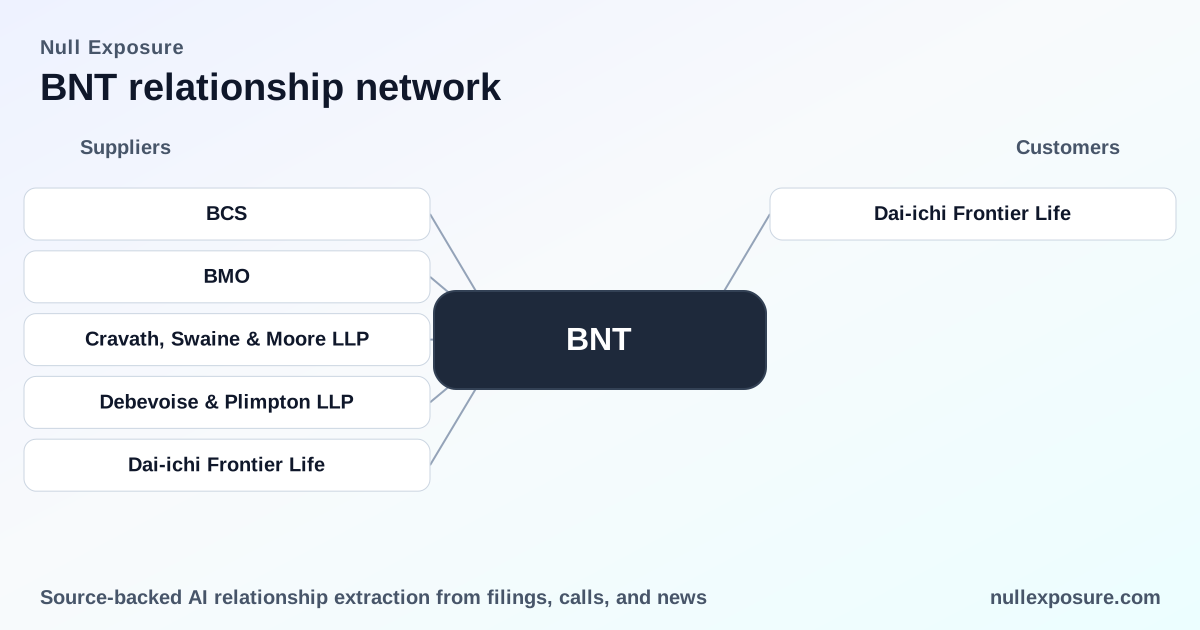
Brookfield Wealth Solutions (BNT): Customer relationships that expand reach and mobilize capital
Brookfield Wealth Solutions operates as a reinsurer and insurance solutions provider, monetizing through reinsurance premiums, investment income on insurance float, and structured capital transactions such as funding agreement‑backed notes (FABNs). Its business model combines bilateral reinsurance contracts with capital markets distribution to scale risk transfer and balance-sheet capacity, allowing the company to generate fee and spread income while managing insurance liabilities. For investors, the focus is on how customer counterparties drive geographic expansion, premium flows and the firm’s ability to place capital efficiently. For a consolidated view of BNT’s counterparty map, visit https://nullexposure.com/.
A direct lane into Japan: Dai‑ichi Frontier Life — two confirmations, one relationship
Press release via Ritzau (March 9, 2026)
Brookfield announced that it has signed a reinsurance agreement with Dai‑ichi Frontier Life, marking a formal entry into the Japanese life reinsurance market according to a March 9, 2026 press release distributed by Ritzau. This transaction signals BNT’s strategy of expanding geographic footprint through local partnerships to access long‑dated life liabilities. (Ritzau press release, March 2026)
Press release via NTB Kommunikasjon (May 2, 2026)
An NTB Kommunikasjon release on May 2, 2026 repeated the announcement that Brookfield Wealth Solutions executed a reinsurance agreement with Dai‑ichi Frontier Life, underscoring the transaction’s public disclosure and relevance to Japanese market positioning. The dual distribution of the announcement reflects coordinated investor and media outreach around BNT’s first reinsurance placement in Japan. (NTB Kommunikasjon press release, May 2026)
Capital markets execution: American National and a $500M FABN
NTB Kommunikasjon (May 2, 2026)
Brookfield completed a $500 million funding agreement‑backed note (FABN) issuance at American National, a structured funding solution that converts future policy liabilities into immediate capital for the cedant and fees/spread for BNT. This is evidence that BNT combines traditional reinsurance with capital markets instruments to scale engagement with large U.S. insurers. (NTB Kommunikasjon press release, May 2026)
What these customer relationships reveal about BNT’s operating model
- Contracting posture: BNT transacts through formal reinsurance agreements and structured note issuance, indicating a preference for legally robust, long‑dated bilateral contracts and capital markets structures that lock in economics and limit open‑ended credit exposure.
- Concentration and diversification: The two disclosed customer relationships illustrate a dual strategy—partnering with a major Japanese insurer to penetrate a new geography and using U.S. structured finance channels to scale domestic activity—supporting revenue diversification across products and regions.
- Criticality of counterparties: Both Dai‑ichi Frontier Life and American National are material counterparties for strategic reasons: one provides access to a new market and the other demonstrates BNT’s role as a capital provider to large insurers. Counterparty credit and regulatory standing are therefore central to BNT’s underwriting and distribution playbook.
- Maturity of business model: The mix of bespoke reinsurance accords and FABN issuance shows a transition from pure reinsurance to hybrid capital solutions, consistent with a maturing insurer‑reinsurer that mobilizes capital markets expertise alongside underwriting capabilities.
Note: there were no relationship‑level operational constraints returned in the customer results payload; this absence is itself a company‑level signal that the disclosed relationships are presented without flagged contractual limitations in the source materials.
Why investors should care — upside drivers and risk signals
- Upside drivers: Geographic expansion into Japan and active use of FABNs both increase premium and fee earning potential. BNT’s public metrics support a material enterprise: market capitalization listed at roughly $12.35 billion and Revenue TTM of approximately $11.64 billion, showing scale to underwrite large transactions. Successful execution on these relationships expands revenue diversity and margin sources.
- Risk signals: Structured transactions and cross‑border reinsurance introduce counterparty credit, regulatory and operational complexity—each deal requires tight capital management and legal protections. Concentration risk is present if a small set of large counterparties or repeat FABN programs account for outsized volumes. BNT’s quarterly revenue and earnings growth have shown volatility, which investors should monitor as new relationships scale.
- Balance‑sheet implications: The FABN with American National is a direct example of capital markets‑style funding that can accelerate deployment but requires disciplined hedging and capital adequacy governance.
For further analysis of how BNT maps counterparties and transaction types, visit https://nullexposure.com/ for a consolidated exposure view.
Practical takeaways for portfolio managers
- Trade the business model, not individual press releases. Individual deals illustrate strategy; persistent execution across jurisdictions and instrument types is what changes valuation multiples.
- Prioritize counterparty credit analysis. Reinsurance and funding agreements depend on counterparties’ balance sheets and reputations; due diligence on cedants and distribution partners is essential.
- Watch for repeatable capital solutions. If FABNs and similar structures become a recurring distribution channel, expect higher fee capture and predictable cash flows, but also rising complexity in asset‑liability management.
Bottom line
Brookfield Wealth Solutions is actively combining bilateral reinsurance relationships with capital markets funding mechanisms to broaden its addressable market and monetize long‑dated liabilities. The Dai‑ichi Frontier Life agreement establishes a foothold in Japan, while the $500 million FABN with American National demonstrates BNT’s ability to package liability cash flows into capital instruments. These customer relationships reflect a deliberate strategy to scale through both underwriting and structured capital, and they should be evaluated against counterparty credit, regulatory complexity and the company’s ongoing execution record.