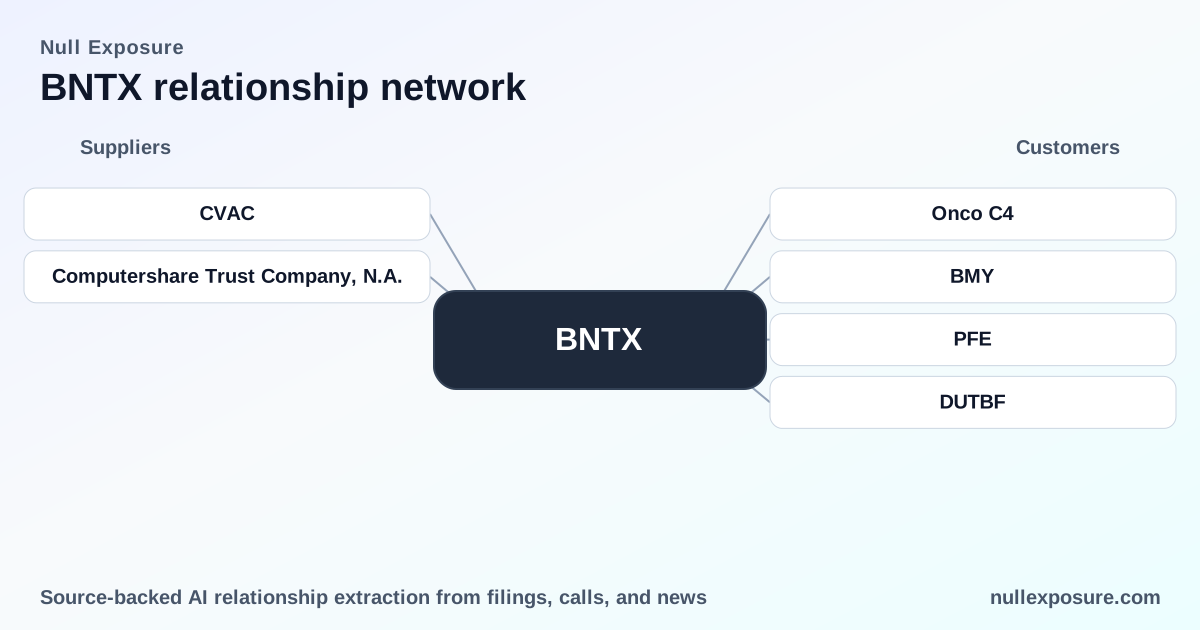
BioNTech’s partner map: who pays, who develops, and what that means for BNTX investors
BioNTech develops mRNA- and antibody-based immunotherapies and monetizes primarily through a mix of direct product sales, large collaboration agreements with upfront and milestone payments, and co-development partnerships that promise royalties and joint commercialization. The company’s near-term cash profile is driven by vaccine revenue (partnered with Pfizer) and a handful of high-value oncology collaborations that have produced multi-hundred-million to multi‑billion dollar upfronts and ongoing registrational programs. For investors, the thesis is straightforward: value now is partner-dependent — product sales plus a small number of material collaboration deals — while future upside depends on converting registrational programs into approvals and commercial launches.
Learn more at https://nullexposure.com/.
Why the relationship map matters for valuation and risk
BioNTech’s operating model is partner-centric: it outsources commercialization and shares clinical risk through deals while retaining upside via royalties, co‑promotion, or milestone structures. This contracting posture produces a bumpy revenue profile — high one‑time receipts from deals offsetting volatile product sales — and creates concentration risk around a few counterparties whose payments and trial progress materially affect reported revenues and guidance.
Company-level signals relevant for underwriting:
- Contracting posture: BioNTech generates sizable non‑operational cash from collaboration upfronts and anniversary payments, which support near-term liquidity but are not recurring product revenue. Media reports and company commentary highlight large upfront receipts in recent filings and press coverage.
- Revenue concentration and criticality: COVID‑19 vaccine sales (partnered with Pfizer) remain a material line but are declining year-over-year; in parallel, a few oncology partnerships provide the majority of non-vaccine collaboration proceeds. This creates binary outcomes if registrational trials succeed or fail.
- Program maturity: The company is running registrational studies and planning BLA filings for selected ADCs and antibodies, indicating mid‑ to late‑stage program maturity that can be value‑creating if regulatory milestones are achieved. Company commentary and earnings transcripts identify specific BLA timelines.
A mid-article note: for continued, consolidated intelligence on corporate relationships and payment signals, visit https://nullexposure.com/.
The relationships you need to know now
Bristol Myers Squibb (BMY / BMS)
BioNTech has a major oncology collaboration with Bristol Myers Squibb that has produced substantial upfront and anniversary payments and funds a broad registrational program across multiple antibody candidates. Multiple news outlets reported a stabilizing upfront receipt (reported figures range from $1.5 billion to $2.0 billion depending on the coverage) and company commentary confirms an active registrational program with BMS. (Sources: ad-hoc-news coverage of FY2026 and FY2025 press reports; company earnings commentary cited in press coverage, March–May 2026.)
Pfizer (PFE)
Pfizer is BioNTech’s co‑commercial partner for the COVID‑19 vaccine franchise; the relationship drives seasonal vaccine launches and remaining vaccine revenue, but management has guided materially lower adjusted revenues for 2026 as vaccine sales decline and one‑time Pfizer proceeds run off. BioNTech cited the Pfizer partnership and product launches in its 2025 Q3 earnings commentary and subsequent press coverage framed 2026 guidance around reduced COVID revenue. (Sources: BioNTech 2025 Q3 earnings call; The Globe and Mail reporting on FY2026 guidance, May 2026.)
Duality (DUTBF / Duality)
Duality is a co‑developer on the HER2‑targeted ADC (Trastuzumab‑Pamirtecan, formerly BNT323) where BioNTech reports progress toward a first BLA submission now planned for 2026, subject to regulatory feedback. This positions the program as a near-term regulatory inflection point if timelines hold. (Source: BioNTech 2025 Q3 earnings call, March 2026.)
Onco C4
BioNTech is partnering with Onco C4 on a global Phase III trial evaluating its anti‑CTLA‑4 antibody Gotistobart versus chemotherapy in second‑line squamous non‑small cell lung cancer; data from the non‑registrational first part of the trial was scheduled for presentation later in the year. This program reflects BioNTech’s strategy of advancing multiple checkpoint and antibody programs through external partnerships. (Source: BioNTech 2025 Q3 earnings call, March 2026.)
How each relationship translates into investment-relevant exposure
- Cash smoothing vs. one‑off volatility: Collaboration deals with large upfronts have materially improved BioNTech’s cash position in recent quarters, but these are not recurring revenues and therefore create volatility in reported top‑line between deal announcements and product sales cycles (company filings and media reports document the magnitude and timing of these receipts).
- Concentration risk: A small number of partners — notably Pfizer for vaccines and large pharma collaborators for oncology assets — dominate both revenue and program execution risk; investor returns depend on trial outcomes and milestone triggers from these same relationships.
- Regulatory gating items: Several assets are in registrational or near‑registrational stages (e.g., BLA planned for TPAM), which converts scientific readouts directly into valuation movement; company earnings remarks list these program timelines explicitly.
Investment implications and risk checklist
- Positive catalysts: Successful registrational readouts and approvals (BLAs) for ADCs and antibodies will convert partnership milestones into recurring royalties and potentially new product sales, unlocking upside beyond vaccine revenue.
- Key risks: Trial enrollment issues, failed registrational endpoints, or the decay of vaccine demand will have outsized negative impact on guidance and near‑term cash flow given the partnership concentration. Company guidance for 2026 already signals lower revenue as vaccine sales decline and one‑time proceeds are absent. (Source: The Globe and Mail and company guidance disclosures, May 2026.)
- Liquidity posture: Large collaboration payments provide a liquidity buffer, but they should be treated as discrete events rather than steady-state cash flow; underwriters should stress-test scenarios without additional upfronts.
Bottom line
BioNTech’s commercial profile for investors is partner-dependent and milestone-driven: Pfizer supports the remaining vaccine franchise while a small number of high‑value oncology collaborations (notably with Bristol Myers Squibb and co‑developers like Duality and Onco C4) supply the bulk of non‑vaccine cash and near‑term upside. Monitor upcoming registrational readouts and the cadence of collaboration payments closely — these items will determine whether BioNTech’s strategic pivot beyond COVID translates into stable, repeatable revenue or episodic value events.
For a consolidated view of partner signals and contract‑level cash flows, visit https://nullexposure.com/.