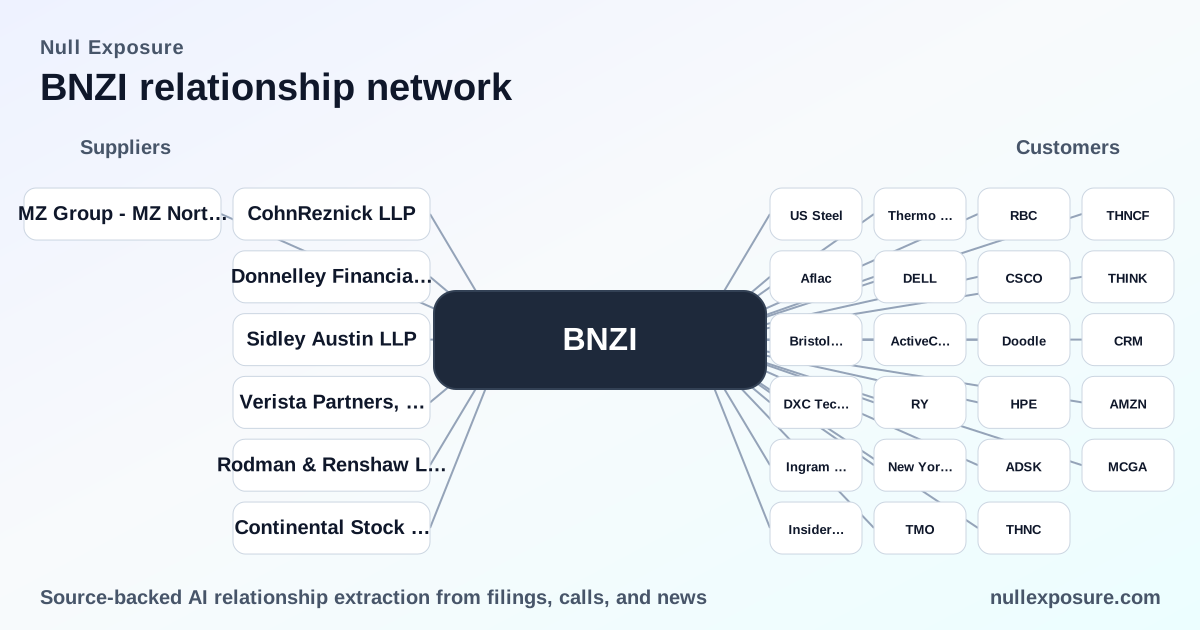
Banzai International (BNZI) — Customer Map and Commercial Signals for Investors
Banzai International sells AI-enabled marketing and webinar SaaS and managed services to a global mix of buyers, monetizing primarily through recurring subscription licenses and professional services tied to its marketing stack and recent acquisitions. The company reports a broad base of customers across enterprise, mid‑market and small business segments and highlights marquee logos to signal commercial traction; these brand relationships drive revenue growth, cross‑sell potential and valuation optionality for investors focused on go‑to‑market scaling and customer concentration risk.
For a fast read of the full commercial roster and what each relationship implies for revenue quality and go‑to‑market, see NullExposure’s coverage: https://nullexposure.com/.
What the customer list tells you at a glance
Banzai’s cited customers range from Fortune 500 enterprises to SMBs, and the company discloses that no single customer contributes a material share of revenue. Contracting is a mix of short‑ and long‑term subscription agreements, distributed across Americas, EMEA and APAC — a profile consistent with SaaS providers that sell both transactional and enterprise offerings. The firm’s operating model shows low concentration, global reach, and a product portfolio that requires ongoing renewal and service delivery, which together point to recurring revenue with embedded churn and expansion dynamics.
A deeper technical and competitive analysis is available at NullExposure: https://nullexposure.com/.
Customer roster — every referenced relationship and what it means
US Steel
Banzai lists US Steel among enterprise users of its OpenReel product, signaling adoption in heavy industry use cases for remote video capture and enterprise media workflows. This mention comes from Banzai’s FY2024 10‑K filing (Dec 31, 2024).
Insider Inc.
Insider Inc. is named as an OpenReel enterprise customer, indicating media and publishing vertical traction for remote video production solutions. Source: BNZI FY2024 10‑K.
Ingram Micro
Ingram Micro appears in the FY2024 10‑K as an OpenReel customer, showing distribution and technology channel engagement for Banzai’s enterprise offerings. Source: BNZI FY2024 10‑K.
DXC Technology
DXC Technology is listed among OpenReel enterprise customers in the FY2024 10‑K, reinforcing adoption by global IT services organizations. Source: BNZI FY2024 10‑K.
Bristol Myers Squibb
Bristol Myers Squibb is referenced as an OpenReel enterprise user in the FY2024 10‑K, representing adoption in regulated bio‑pharma and life‑sciences communications. Source: BNZI FY2024 10‑K.
Aflac
Aflac is cited in Banzai’s customer examples in the FY2024 10‑K, demonstrating penetration into financial services and insurance use cases. Source: BNZI FY2024 10‑K.
Thermo Fisher Scientific
Thermo Fisher Scientific is repeatedly named across filings and press releases (FY2024 10‑K and multiple March–May 2026 news items) as a customer, highlighting healthcare and laboratory enterprise engagement. Sources: BNZI FY2024 10‑K; March–May 2026 press releases (MarketScreener, Yahoo Finance).
Dell / Dell Technologies
Dell Technologies (also referenced as Dell in the 10‑K) is consistently listed across filings and press coverage (FY2024 10‑K; March 2026 press releases), indicating Banzai’s ability to win major technology customers and validate enterprise GTM motion. Sources: BNZI FY2024 10‑K; MarketScreener/QuiverQuant/Finance Yahoo (Mar–May 2026).
New York Life
New York Life is named in multiple March–May 2026 press releases as a customer, supporting Banzai’s traction in large financial services accounts. Sources: MarketScreener and Investing.com press items (FY2025–FY2026 coverage).
RBC / RY / RBC Capital Markets
RBC (ticker RY) and RBC Capital Markets are cited in press announcements and prior news as customers and as a party to expanded agreements for OpenReel, reflecting institutional sales into capital markets and banking verticals. Sources: March 2026 news items (MarketScreener, QuiverQuant, StockTitan) and a FY2023 note on expanded RBC Capital Markets agreements.
ActiveCampaign
ActiveCampaign is listed across multiple March 2026 press pickups as a customer, demonstrating Banzai’s reach into marketing automation and mid‑market SaaS ecosystems. Sources: MarketScreener and various March 2026 press items.
Thinkific
Thinkific appears across filings and press (March–May 2026) as a named customer, signaling adoption among SaaS and e‑learning platforms. Sources: QuiverQuant, MarketScreener, and press releases (FY2025–FY2026).
Cisco (CSCO)
Cisco is mentioned in press coverage announcing the OpenReel acquisition and is listed among customer examples, pointing to enterprise networking and collaboration use cases. Source: CityBiz article (Mar 2026).
Hewlett Packard Enterprise (HPE)
HPE is included in the citybiz customer list and press materials, indicating penetration into enterprise IT and hardware customers for marketing and video solutions. Source: CityBiz (Mar 2026).
Doodle
Doodle is cited in acquisition/press coverage as among customers, showing usage across scheduling and productivity tool verticals. Source: CityBiz (Mar 2026).
Salesforce (CRM)
Salesforce is named in the FY2024 10‑K customer list, validating Banzai’s engagement with CRM‑centric marketing and sales ecosystems. Source: BNZI FY2024 10‑K.
Amazon (AMZN)
Amazon is included among customers cited in the FY2024 10‑K, signaling enterprise and e‑commerce adoption. Source: BNZI FY2024 10‑K.
Autodesk / ADSK
Autodesk is listed in press coverage and news summaries as a customer, pointing to design/enterprise use cases for Banzai’s tools. Sources: StockTitan March 2026 news items.
ActiveCampaign (additional mentions)
ActiveCampaign is referenced multiple times across news pickups confirming repeated media mentions of the relationship; those citations reinforce consistent market messaging rather than new revenue detail. Sources: Yahoo Finance, MarketScreener, StockTitan (Mar 2026).
MCGA
An entry for MCGA appears in the FY2024 10‑K in the context of financing and share issuance options (SEPA), which is recorded in the relationship results and links legal/financing counterparties to corporate capital strategy. Source: BNZI FY2024 10‑K.
Yorkville
Yorkville is cited in the FY2024 10‑K describing an option to sell shares under a subscription arrangement (SEPA), representing a financing counterparty rather than a product customer. Source: BNZI FY2024 10‑K.
(Where a company appears under multiple trade names or tickers in the results, the entries above consolidate that reporting into a single plain‑English note with the original filing or press source cited.)
Constraints and what they imply about Banzai’s business model
- Contracting posture — mixed term structure. Banzai discloses that customer contracts range from single months to multiple years and that it sells primarily through recurring subscription licenses, a classic SaaS revenue mix that produces predictable renewal cycles but requires constant retention and upsell effort (source: FY2024 10‑K excerpts).
- Counterparty mix — diversified by size. The company explicitly serves solo entrepreneurs through Fortune 500 enterprises, which reduces single‑customer concentration risk because no customer represents more than 1% (or, by another excerpt, not more than 10%) of revenue, depending on the period (company filing signals).
- Geographic exposure — global revenue footprint. Revenue by billing region shows 57% Americas, 33% EMEA, 10% APAC (FY2024 table), confirming a global customer base and attendant currency and regional sales execution implications.
- Materiality and criticality — immaterial large customers, recurring reliance. Public disclosures classify customer revenue as immaterial at the single‑customer level while the business remains dependent on subscription renewals and expansion to scale gross margin leverage.
- Segment and product mix — software‑first with services. Banzai operates with software (SaaS) as the primary segment supported by services (Reach managed services, OpenReel media), which drives higher CAC and the need for strong account management to deliver expansion ARR.
Investment takeaways
- Strengths: Broad logo roster with enterprise names demonstrates sales access and cross‑vertical applicability; recurring subscription model supports predictable ARR expansion if churn remains controlled.
- Risks: Small market cap, negative EBITDA and operating losses highlight execution and liquidity risk; global but non‑concentrated revenue means scale is required to reach profitable operating leverage.
For follow‑up analysis on customer concentration metrics, renewal cohorts and ARR dynamics, visit NullExposure’s BNZI coverage at https://nullexposure.com/.