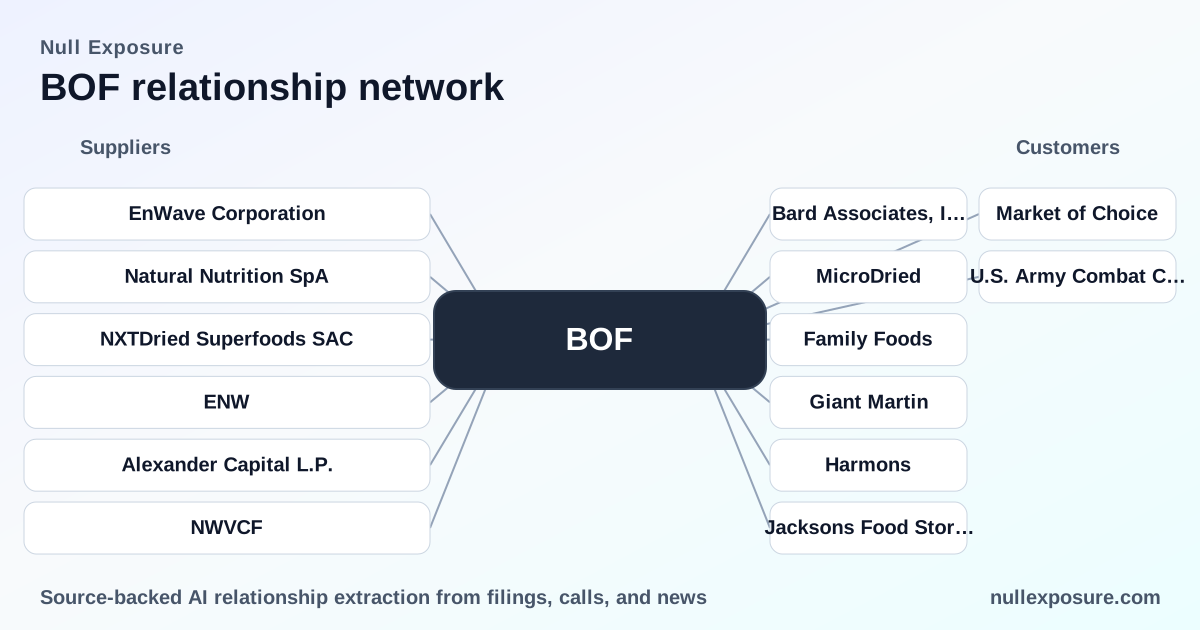
BranchOut Food (BOF): Customer Relationships That Drive Revenue and Risk
BranchOut Food manufactures and sells plant‑based dehydrated fruit and vegetable snacks and ingredient powders, monetizing through finished‑goods sales to large retailers (including private‑label agreements), direct ecommerce and ingredient supply agreements; recent capacity expansion and club/retailer wins are the immediate growth vector while investor placements and strategic partners finance scale. Learn more about the full relationship set at https://nullexposure.com/.
How BranchOut’s go‑to‑market actually works
BranchOut runs a retailer‑centric, manufacturing‑led commercial model: it manufactures finished snacks and powders, sells predominantly to retailers (including private‑label contracts), and supplements revenue with ingredient sales and select co‑brand partnerships. The company’s revenue profile is highly concentrated, driven by a small number of large retail contracts and a handful of strategic ingredient partners. Capacity investment is deliberate—BranchOut has expanded production lines to support large warehouse‑club and national retailer rollouts—which reinforces its reseller posture and capital intensity.
Key operating signals: the customer base is concentrated and retailer‑focused; primary geography is North America with some LatAm cost and operations activity; the company functions primarily as a reseller/manufacturer of core product lines, with an adjacent ingredient business and government testing engagements.
Constraints and what they imply for investors
- Concentration is a dominant risk‑reward tradeoff. Company filings show the top two customers accounted for 99% of net revenue in 2024. That level of concentration creates near‑term revenue leverage but elevates counterparty execution risk and working capital volatility.
- Contracting posture is vendor/manufacturer to large resellers. BranchOut’s commercial relationships are predominantly sales of finished product to retailers rather than long‑term tolling or licensing contracts, which increases dependence on SKU placement and retail sell‑through.
- Customer mix is predominantly North American but with LatAm operations. The company reports U.S. operations as the primary sales base while maintaining Latin American cost/reporting lines—this supports diversified sourcing but also cross‑border execution complexity.
- Strategic partnerships add margin optionality. MicroDried and other ingredient partners shift revenue mix toward higher‑margin ingredient sales; these relationships are material to margin expansion and are expected to contribute meaningfully in 2026.
- Maturity is early commercial scale. BranchOut is transitioning from proof‑of‑concept to scaled retail distribution; capacity expansion and initial institutional equity placements indicate early‑stage commercialization rather than steady‑state operations.
These constraints are visible in filings and press releases and should be factored into valuation and operational diligence.
Customers and partners: what each relationship contributes
MicroDried — a core strategic ingredient partner
MicroDried is identified as BranchOut’s core strategic partner for ingredient sales, with management projecting $5–6 million of revenue from this relationship in 2026 and rapid follow‑on orders after an initial Q1 delivery. According to a January 2026 GlobeNewswire release and subsequent investor summaries, MicroDried is central to BranchOut’s ingredient revenue growth and margin expansion.
Target (TGT) — national retailer order flow
Target is listed among major new orders expected to drive further growth as BranchOut scales capacity and adds a fourth production line. A TradingView summary of company commentary in 2026 cites Target as a material retailer win that supports the company’s retail rollouts and revenue acceleration.
Sam’s Club (WMT) — warehouse club expansion
Sam’s Club is called out alongside Target as a substantial new customer for club channel distribution, representing bulk rollout potential through club lanes that complement national retail placements. This relationship was noted in the same 2026 TradingView/Quartr coverage describing imminent order flow tied to capacity expansion.
Zesty Snacks — co‑brand / channel partner for single‑ingredient chips
BranchOut announced a partnership to supply Zesty Snacks for a single‑ingredient fruit chip launch, planning to ship the first full container in April with container‑sized follow‑on orders thereafter. The March 11, 2026 GlobeNewswire release describes the arrangement as a commercial roll‑out leveraging influencers and co‑branding.
Bard Associates, Inc. — institutional purchaser and placement partner
Bard Associates has purchased blocks of BranchOut common stock in institutional transactions and participated in secondary placements; press reporting covers a $2.5 million institutional purchase (1,034,600 shares) and Bard’s involvement in ATM transactions. GlobeNewswire and SEC/Investing.com notices from late 2025 through mid‑2026 document Bard’s role as an equity purchaser supporting liquidity and working capital.
Jacksons Food Stores — convenience channel entry
BranchOut launched its branded line into Jacksons Food Stores (approximately 300 locations) as the company’s first convenience store channel deployment, signaling geographic and channel diversification beyond grocery and club channels. StockTitan coverage of the company results highlights the Q3 rollout.
Family Foods — grocery channel placement
Family Foods is among several regional grocery chains where BranchOut added SKU placements during its grocery channel expansion, contributing to broadened retail distribution. StockTitan reporting on FY2024 customer launches lists Family Foods as a new grocery partner.
Market of Choice — regional grocery expansion
Market of Choice is included in the company’s grocery channel rollouts, representing targeted regional distribution that supports brand building and test‑market sell‑through. This placement is documented in the company’s FY2024 channel disclosures summarized by StockTitan.
Harmons — additional grocery channel presence
Harmons was added as part of the grocery channel launches that diversified BranchOut’s retail footprint and test markets, as reported in FY2024 summaries. These regional grocer placements collectively demonstrate a staged national strategy.
Giant Martin — regional grocery partner
Giant Martin appears alongside other grocery placements in FY2024 reporting, indicating incremental retail penetration that complements national club and retailer agreements.
U.S. Army DEVCOM — government testing and validation
BranchOut’s product was selected for testing by the U.S. Army Combat Capabilities Development Command (DEVCOM) for potential inclusion in Close Combat Assault Rations, following shelf‑life and sensory validation. A July 2025 GlobeNewswire release documents the DEVCOM testing engagement, which is a strategic validation channel that can open institutional and government procurement pathways.
What investors should prioritize now
- Concentration monitoring: with the top two customers accounting for nearly all revenue in 2024, investors must track contract length, SKU placement permanence, payment terms and retailer sell‑through by quarter.
- Capacity and execution: the fourth production line and fulfillment scale are required to realize Target/Sam’s Club order upside; track production ramp milestones and COGS trends.
- Ingredient channel traction: MicroDried’s projected $5–6 million contribution in 2026 is a direct lever on gross margins—monitor purchase orders and timing.
- Capital and liquidity: institutional purchases and ATM activity with Bard Associates provide near‑term funding but also dilute; follow equity placements and cash runway disclosures.
For a concise diligence package that maps these relationships to revenue run‑rate and counterparty concentration, visit https://nullexposure.com/.
Bottom line
BranchOut’s customer set mixes high‑impact national retailer wins (Target, Sam’s Club), strategic ingredient partnerships (MicroDried), and a growing roster of regional grocery and convenience placements—all underscored by acute revenue concentration and an early‑stage capacity ramp. Investors should price both the upside from scaled retail rollouts and the execution risk tied to a narrow counterparty base.