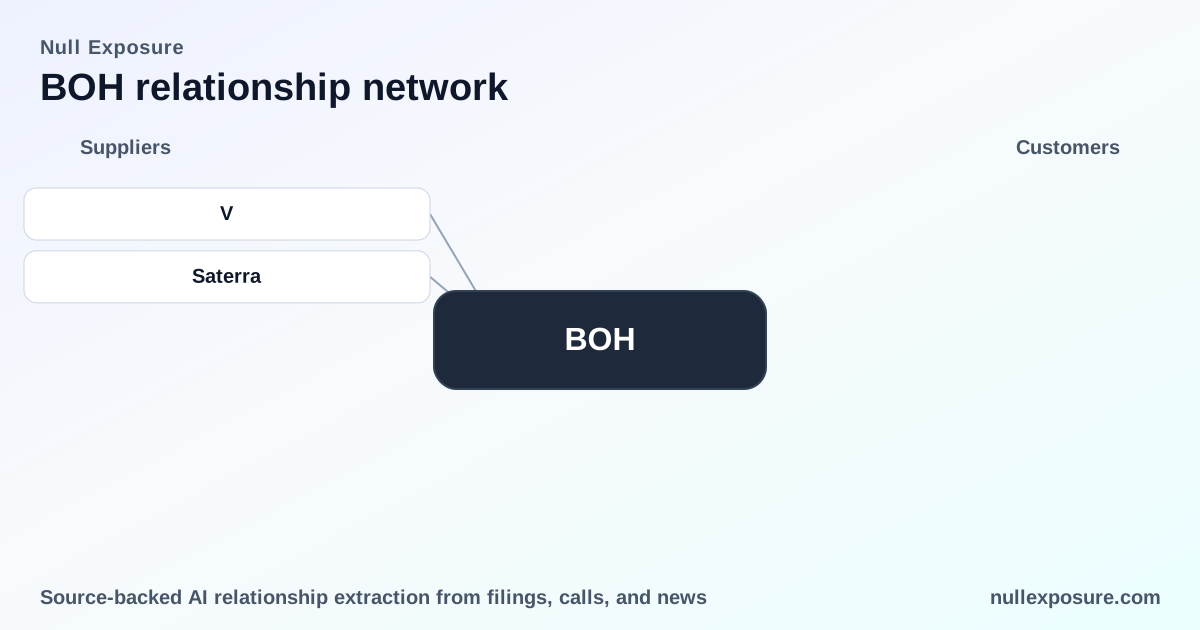
Bank of Hawaii (BOH) — Customer Relationships and Operational Profile for Investors
Thesis: Bank of Hawaii is a regionally focused commercial bank that monetizes through traditional spread-based lending, fee income from deposit and trust services, and wealth-management fees across Hawai‘i, Guam and other Pacific Islands; its capital-light deposit franchise, visible credit commitments, and entrenched local distribution create stable cash flows but concentrate credit and operational risk in a narrow geography. For investors evaluating counterparty and customer relationships, BOH behaves like a full-service regional bank — provider of loans, letters of credit, private banking and treasury services — with material on‑balance sheet commitments and durable local client ties. For a quick look at BOH’s market positioning, see the firm profile at Null Exposure: https://nullexposure.com/.
Business model in one line
- A regional deposit-funded lender and wealth manager: BOH funds lending and capital markets activity primarily with local deposits, sells fee-based trust and private banking services, and supports commercial customers with trade and cash-management products. The firm’s profitability derives from net interest margin on loans and recurring fees from trust/private banking; it also maintains significant liquidity reserves for credit and contingent exposures.
How BOH’s customer relationships translate to financial realities
- Local concentration matters: BOH operates 50 branches and 317 ATMs across Hawai‘i and the West Pacific, making it a critical banking provider for local businesses, consumers and government entities — a dynamic that supports stable deposit capture but concentrates macro and credit risk regionally (BOH 2024 filings).
- Contracting posture is lender-centric and commitment-heavy: The bank extends unfunded credit commitments in the billions, issues standby and commercial letters of credit, and underwrites mortgage commitments (IRLCs) — all forms of contingent exposure that create liquidity and capital considerations beyond funded loans.
- Service breadth raises stickiness: Private banking, trust services, and institutional investment advisory offerings increase client entrenchment, reducing volatility of deposit flows and fee income through business cycles.
- Mature franchise with institutional ownership: Founded in 1897, BOH trades with significant institutional ownership and pays a meaningful dividend yield, positioning it as a stable regional bank for long-duration investors.
Key takeaways for investors
- Strengths: Deposit-rich balance sheet, diversified fee income (trust, private banking), and entrenched local relationships that generate predictable core funding and recurring revenue.
- Constraints / risks: Geographic concentration in Hawaii and the Pacific, sizable unfunded credit commitments ($~3.13B as of Dec 31, 2024), and standby/commercial letters of credit (standby LCs ≈ $96.5M; commercial LCs ≈ $9.3M, per 2024 filings) that create contingent credit risk.
- Capital and liquidity posture: The bank reported cash and cash equivalents of $0.8B and available-for-sale investment securities of $2.7B as of Dec 31, 2024, supporting its credit commitments and contingency profile.
A compact scorecard of operating-model signals
- Contracting posture: Active commitment book (IRLCs, letters of credit, unfunded commitments) — BOH operates as both lender and counterparty for customer hedging and liquidity needs.
- Client types: Businesses, individuals (including HNW), and governments — the bank’s client mix reflects both retail and institutional service lines.
- Geographic concentration: Dominant regional exposure (Hawai‘i, Guam, other Pacific Islands) — local macro shocks transmit directly to credit and deposit dynamics.
- Spend/magnitude signals: Large contingent exposure — credit commitments crossing the $1B+ and $100M+ bands imply material second-order capital considerations.
Customer relationship coverage: what we found (complete list)
- Public Storage — Kaneohe refinance (PSA-P-K)
- Bank of Hawaii provided a $10 million refinancing loan for Public Storage’s Kaneohe facility; the transaction was facilitated by Gantry. This is a straightforward commercial real-estate refinance that illustrates BOH’s role as a regional commercial lender to real-estate operators. Source: Pacific Business News (bizjournals), July 15, 2025 — https://www.bizjournals.com/pacific/news/2025/07/15/public-storage-kaneohe-refinance.html.
Operational implications of that relationship
- The Public Storage loan is representative of BOH’s mid-market commercial lending book: relatively modest-sized loans to local or regional real estate operators that rely on local banking relationships rather than national balance-sheet lenders.
- The involvement of a facilitator (Gantry) in the transaction demonstrates BOH’s willingness to participate in brokered or facilitated financings tied to local commercial real-estate transactions, reinforcing its role as a go-to regional lender.
Why the company-level constraints matter to relationship risk and valuation
- Unfunded commitments are non-trivial: With approximately $3.13B of unfunded commitments as of Dec 31, 2024, BOH carries material contingent credit exposure that does not show up as funded loans until drawn — this reduces liquidity flexibility under stress and increases capital sensitivity.
- Letters of credit and IRLCs are active instruments: Standby letters of credit (
$96.5M) and commercial LCs ($9.3M) create corridors of contingent liability; for credit investors these exposures are second-order risk drivers that affect loss-given-default dynamics and funding needs. - Client diversity reduces volatility but not concentration: Serving governments, individuals (including HNW clients), and businesses spreads revenue streams, yet the geographic concentration in the Pacific region means systemic local shocks would correlate across customer segments.
- Service-provider posture expands revenue but deepens operational reliance: The bank executes foreign exchange and derivative transactions on behalf of customers and uses derivatives to manage interest-rate risk — these activities increase fee income but also introduce operational and market risks.
Practical considerations for investors and counterparties
- For credit investors: stress-test downside scenarios that factor in draws on unfunded commitments and upticks in standby LC usage under adverse local economic conditions.
- For counterparties and relationship managers: BOH’s branch and trust presence signal durable local relationships, so strategic partnerships (e.g., community lenders, property operators) tend to be long-lived and operationally integrated.
- For M&A or lending partners: expect BOH to underwrite local CRE and corporate credits in the $1M–$100M band routinely, while engaging in larger contingent commitments where necessary.
Further reading and next steps
- For detailed filings and balance-sheet line items consult BOH’s public filings (Form 10-K/10-Q) for FY2024–FY2026, which document the credit commitments, liquidity position and segment disclosures quoted above.
- To monitor customer-level deal flow and relationship activity from this research channel, visit Null Exposure for ongoing updates: https://nullexposure.com/.
Bottom line: Bank of Hawaii is a mature, deposit-rich regional bank with an entrenched local franchise and a meaningful contingent commitment profile; its customer relationships, exemplified by transactions like the $10M Kaneohe refinance for Public Storage, underscore BOH’s role as a primary regional lender and financial services provider — a profile that supports stable earnings but requires active attention to local credit cycles and contingent exposures.