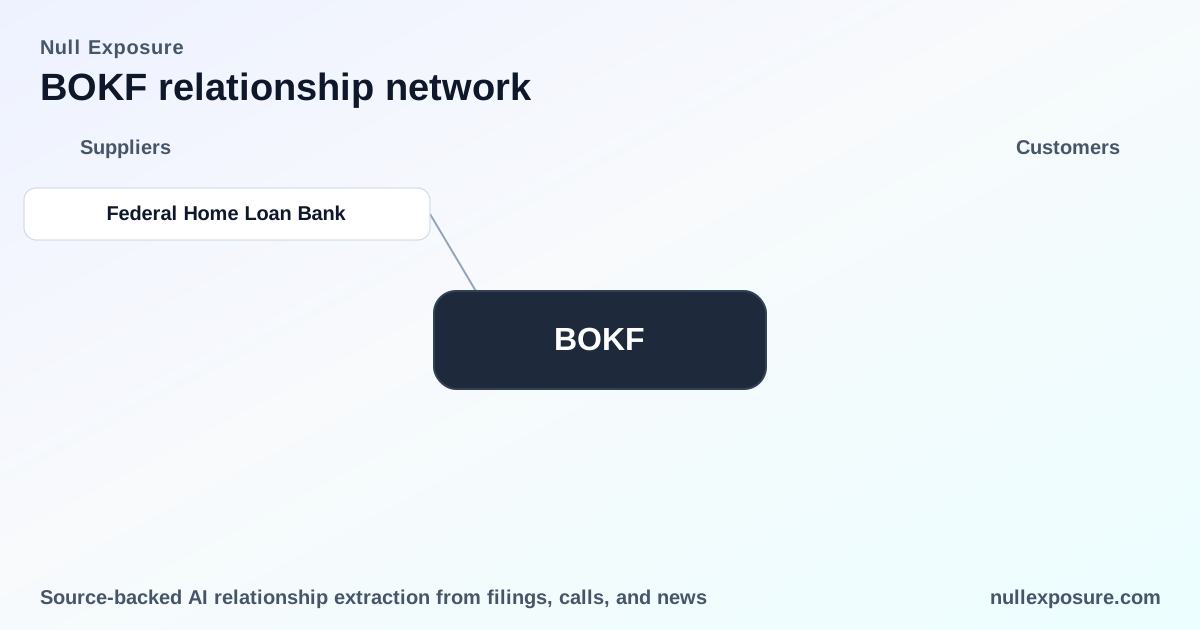
BOK Financial’s customer footprint: concentrated commercial banking with broad, short-term retail exposure
BOK Financial Corporation operates as a regional bank holding company and monetizes by providing commercial loans and treasury services, consumer deposit and mortgage origination, and wealth management across its core Southwest and Plains footprint; revenue flows from net interest margin, fee income on payment/treasury services, mortgage origination gains, and advisory/asset fees. For credit and commercial partners, BOKF functions as both lender and trustee; for consumers it is a short-term mortgage originator and deposit taker. Learn more on the platform that aggregated these relationship signals: https://nullexposure.com/.
Business model and operating constraints — the practical implications for investors
- Contracting posture is mixed but often short-term for consumer mortgage commitments. The firm routinely underwrites residential mortgage loan commitments that are outstanding for about 60–90 days from commitment to sale, indicating rapid turnover and limited long-duration execution risk on that book.
- Commercial banking is a material business line while customer concentration is low. Although commercial banking represents a significant portion of activity, the company discloses that no single external customer accounted for more than 10% of total revenue in recent years, which reduces single-counterparty concentration risk.
- Counterparties are broadly diversified across segments and sectors. BOKF serves individuals, small businesses, mid‑market and large enterprises, non‑profits, municipalities and Native American tribal entities, reflecting client diversity that spreads sector and credit risk across many borrower types.
- Geography is domestic and regional. Operations and revenues are substantially derived from North America with banking centers concentrated in Oklahoma, Texas, New Mexico, Colorado, Arizona, and Kansas/Missouri — a regional footprint that concentrates economic exposure to the U.S. Southwest and Plains.
- Relationship roles are multi-faceted. The company operates as seller (product provider), buyer (customer of third‑party services in some cases), and service provider (wealth and fiduciary services), which increases cross-selling potential but also means operational complexity across product lines.
- Maturity profile and criticality. Many relationships are transactional and short-to-medium maturity (consumer mortgages, working capital facilities), while certain commercial and trustee roles (e.g., indentures) create longer-tenor obligations that are functionally critical to counterparties’ financing.
These operating characteristics frame credit, strategic, and operational risk: low customer concentration dampens single-client shock, short mortgage cycles reduce interest-rate lock-in on originations, and commercial lending remains the primary earnings driver. If you want the raw relationship signals and source links consolidated for due diligence, visit https://nullexposure.com/.
Customer relationships in the record: what each counterparty tells investors This section summarizes every relationship instance identified in public filings and press reports. Each entry is a plain-English distillation with a concise source note.
AXR (AMREP Southwest Inc. / AMREP Corporation subsidiary)
BOKF served as lender to AMREP Southwest Inc., modifying a revolving line of credit to extend maturity and increase the borrowing capacity for general corporate purposes — an example of BOKF’s role as a commercial lender to regional real-estate related borrowers. A March 2026 SEC filing on StockTitan that republishes AMREP’s disclosures describes the amendment to the revolving facility. (Source: StockTitan SEC filing of AMREP, reported March 2026.)
EDUC (Educational Development Corporation)
Educational Development Corporation executed amendments to its credit agreement with BOKF, including adjustments to revolving loan commitments and interest terms, indicating BOKF’s participation in corporate credit facilities for smaller public companies. The amendment language was disclosed in EDUC’s FY2025 SEC filing, summarized by a TradingView news piece in March 2026. (Source: TradingView coverage of EDUC’s FY2025 10‑K disclosures, March 2026.)
OGE (OGE Energy Corp., trustee role)
BOKF acted as trustee under a supplemental indenture for a registered offering of long-term senior notes, positioning the bank in a capital markets trustee role that supports issuers’ debt programs and underscores BOKF’s non-lending service capabilities. The transaction and trustee role were reported in a May 2026 press release covered by The Globe and Mail regarding OGE Energy’s $350 million note issuance. (Source: The Globe and Mail press release summary, May 2026.)
How these relationships map to risk and revenue dynamics
- Lending and facility amendments (AXR, EDUC) reinforce BOKF’s traditional commercial-lending franchise: extension and repricing of working capital and revolving facilities generate fee income, interest income, and relationship stickiness, but also concentrate credit exposure in commercial real estate and corporate borrowers typical for a regional bank.
- Trustee and capital-markets services (OGE) are fee-oriented, lower credit-risk relationships where BOKF’s role is administrative; these engagements improve fee diversification and demonstrate the bank’s ability to serve as an institutional counterparty beyond pure lending.
Key takeaways for investors evaluating partnership and counterparty exposure
- Diversified counterparty base lowers single-name concentration risk; the company explicitly reports no single external customer exceeded 10% of revenue across recent years. This is an important guardrail against idiosyncratic customer failure.
- Commercial banking is a core revenue driver even as consumer mortgage activity is high-turnover; that combination supports stable net interest income while keeping origination-to-sale cycles short on the consumer side.
- BOKF’s service roles (trustee, wealth management, payment/treasury) broaden fee income and reduce absolute dependence on lending spreads. These services also position the bank to capture recurring, non‑interest revenue streams.
Risks investors should monitor
- Regional concentration risk: although counterparties are diverse by type, the geographic footprint is concentrated in the Southwest and Plains — a macro shock to those regions would have outsized earnings impact.
- Commercial credit sensitivity: commercial lending is material to earnings; deterioration in mid-market or real-estate sectors in BOKF’s footprint would pressure asset quality and provisioning.
- Operational complexity from multi-role engagements (lender, trustee, servicer) increases the need for robust risk controls and compliance, which investors should track via disclosures and regulatory commentary.
Conclusion — what this means for positioning BOKF combines a material commercial-lending core with short-cycle consumer mortgage operations and fee-based institutional services, delivering diversified earnings but retaining regional and sectoral concentration risk that investors must underwrite. For due diligence that aggregates these relationship signals into an actionable view, visit https://nullexposure.com/ for the consolidated relationship intelligence and source references.