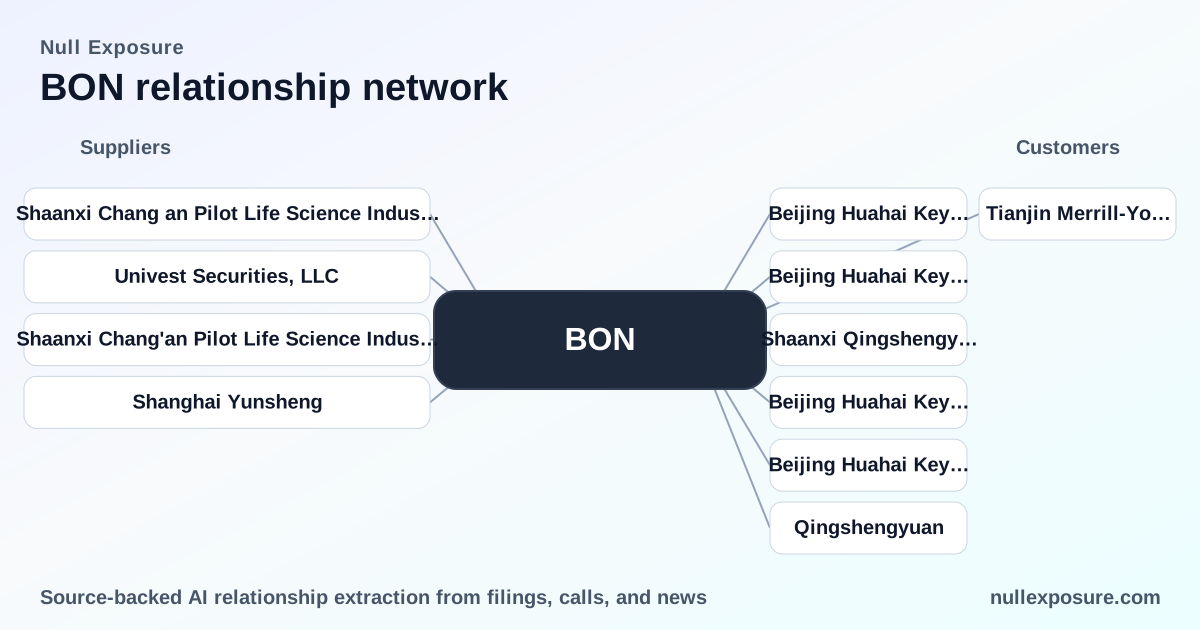
BON Customer Relationships: Distribution deals, revenue mechanics and what investors should price in
Bon Natural Life (NASDAQ: BON) develops, manufactures and sells functional active ingredients extracted from herbal plants and monetizes primarily through product supply agreements, non‑exclusive distribution partnerships, and brand co‑licensing executed by its App‑Chem subsidiary. The company’s revenue profile depends on multi‑year distributor contracts in Greater China, targeted supply deals with ingredient distributors, and selective co‑branding arrangements—each contract driving near‑term top‑line recognition and channel penetration. For more on how we source these partner reads, visit https://nullexposure.com/.
How BON brings products to market and where cash flows come from
BON’s operating model is channel‑led: R&D and manufacturing are internal, while go‑to‑market execution relies on third‑party distributors and co‑brand partners that buy or market finished formulations across Greater China. Contracts in the public record are non‑exclusive, multi‑year, and geographically concentrated, which creates a straightforward monetization path but raises concentration and execution risk because revenue realization requires distributor performance and inventory absorption.
- Contracting posture: BON uses non‑exclusive sales cooperation and supply agreements rather than direct retailing, signaling a low‑capex, partner‑oriented route to market.
- Concentration: A small set of named distributors account for headline contract values (examples below), concentrating commercial exposure.
- Criticality: Third‑party distribution is critical to revenue growth; the agreements grant partners authority to market and distribute key product lines across Greater China.
- Maturity: Public announcements reference 24–36 month cooperation windows and discrete supply deals announced in late 2025 and early‑mid 2026, indicating a near‑term revenue ramp schedule.
Partner readouts — who BON is doing business with (and what they agreed)
Below I cover every partner referenced in the public results and summarize the practical commercial element of each relationship.
Beijing Huahai Keyuan Technology Co., Ltd.
Bon has signed multiple non‑exclusive cooperation agreements with Beijing Huahai Keyuan to distribute BON’s second‑generation tea pigment digestive health products and other health lines across Greater China, with reported contract values cited at US$26 million and separate program references at US$18 million for Apple Series products; the partner will market, sell and distribute these product families under the cooperation framework. MarketScreener and StockTitan reported the November 25, 2025 cooperation and subsequent commercial descriptions (MarketScreener, Mar 2026; StockTitan, Mar 2026).
Shanghai Yunsheng
BON secured a supply agreement with Shanghai Yunsheng described as a significant supply deal, positioning Yunsheng to distribute functional ingredients sourced from BON; the deal was covered in a May 2026 Investing.com report as a material supply relationship with a multi‑million dollar profile. Investing.com reported the supply agreement and the strategic distributor role (Investing.com, May 2026).
Tianjin Merrill‑Youli Trading Co., Ltd.
SEC filings and company overviews indicate Tianjin Merrill‑Youli is among the distributors engaged under App‑Chem sales cooperation agreements to sell BON products, establishing it as an active channel partner in BON’s network of regional distributors. The StockTitan company overview cited the inclusion of Tianjin Merrill‑Youli in these sales cooperation agreements (StockTitan, Mar 2026).
Shaanxi Qingshengyuan Health Industry Co., Ltd. (Qingshengyuan)
BON entered a 24‑month strategic sales agreement with Qingshengyuan to distribute its kombucha‑inspired and high‑tea‑pigment products through Greater China, with media noting a US$12 million total contract value; the agreement is non‑exclusive and intended to accelerate market rollout for BON’s digestive and metabolic health lines. Multiple press reports and filings documented the November–December 2025 deal and its $12 million headline figure (Investing.com; StockTitan, Nov–Dec 2025).
Guangdong JUWO Trading Co., Ltd.
In 2024 BON granted Guangdong JUWO non‑exclusive authority to co‑brand products using BON’s App‑Chem mark for alcoholic health products, establishing a brand licensing and co‑branding channel rather than a pure supply contract. The strategy creates a route into adjacent product categories via co‑branding. This arrangement was disclosed in a 2024 GlobeNewswire release (GlobeNewswire, May 2024).
What these relationships mean for revenue, risk and valuation
The commercial architecture is clear: product revenue scales when distributors execute marketing, inventory and retail placements. The suite of announced agreements demonstrates a deliberate push into digestive, metabolic and beverage‑adjacent health products using multiple regional distributors.
- Revenue mechanics: Contracts are supply and distribution centric; revenue will flow from product shipments to distributors and recognized per GAAP as sales to customers when control transfers. Reported contract values (e.g., $12M, $18M, $26M) set a visible near‑term revenue runway.
- Execution risk: Because agreements are non‑exclusive and third‑party executed, realized revenue and timing depend on partner sales execution, inventory turns and co‑marketing effectiveness.
- Concentration risk: A small number of distributors carry headline contractual exposure; investor models should stress‑test scenarios where one or more partners underdeliver.
- Geographic concentration: All named partners are focused on Greater China distribution, which concentrates regulatory, market and currency exposure in a single region.
- Maturity profile: Contract lengths (24–36 months reported) imply revenue should materialize within a discrete and short planning horizon, supporting near‑term forecasts if partners perform.
Key takeaways for investors
- Channel‑first monetization: BON sells through non‑exclusive distributors and co‑branding partners rather than direct retailing, delivering rapid geographic scale with limited capex but greater execution dependence.
- Visible but concentrated contracts: Publicly reported headline values provide a tangible revenue base, but a concentrated partner set amplifies counterparty and timing risk.
- Brand and product diversification: Co‑branding deals (e.g., JUWO) expand product touchpoints beyond ingredient supply and signal a mix of licensing and supply revenue streams.
- Near‑term visibility: Multi‑year cooperation and supply agreements announced in late‑2025 and early‑2026 underwrite a near‑term revenue ramp if partner distribution is effective.
If you want a monitored feed of these partnership developments and structured, investor‑grade summaries, see our research hub at https://nullexposure.com/.
Bold strategic bets require disciplined risk modeling: stress partner performance, apply conservative revenue recognition timing, and treat Greater China concentration as a principal risk factor when valuing BON’s growth prospects.