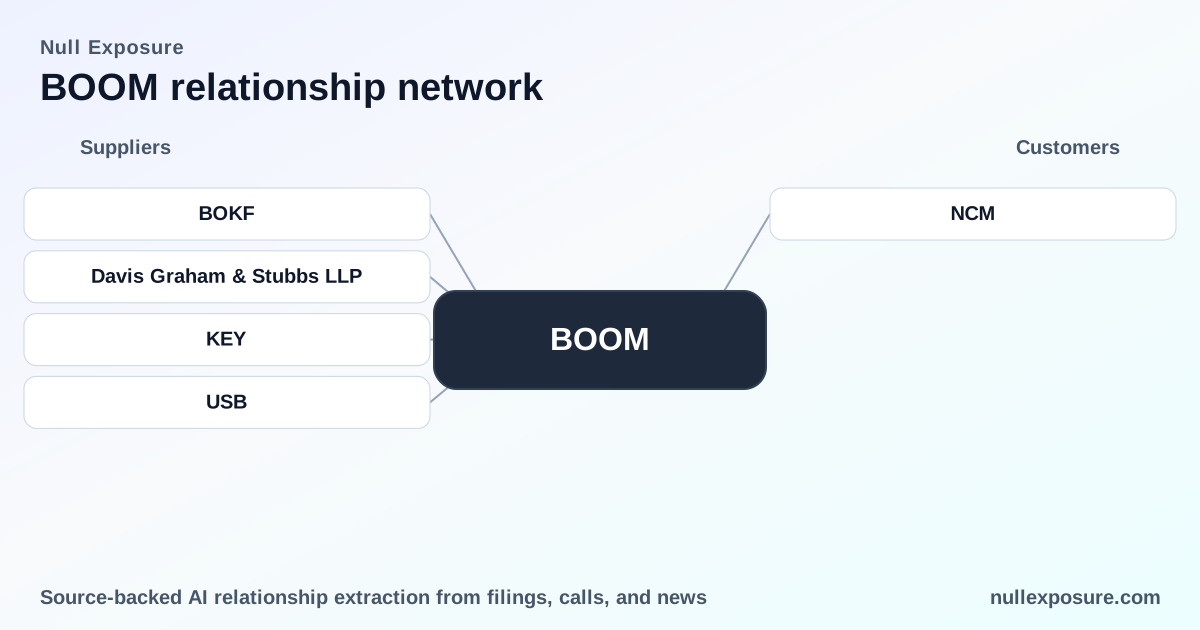
BOOM: Customer relationships that define DMC Global’s revenue risk and strategic footprint
DMC Global (ticker: BOOM) manufactures and sells technical equipment and engineered products across the energy, industrial and infrastructure markets, monetizing through direct product sales, specialty manufacturing and aftermarket support across distinct operating segments. Revenue flows are concentrated in manufacturing-intensive contracts with short payment terms and global distribution, and these structural features drive working-capital intensity and customer concentration risk that investors should price into valuation and liquidity assessments. For a quick access point to ongoing coverage and datasets tied to these customer linkages, visit https://nullexposure.com/.
Why customer links matter for BOOM right now
DMC’s operating model is manufacturing-led, globally distributed, and dependent on a handful of large industrial buyers. That combination produces predictable margins on long product lifecycles but elevated exposure to timing of orders and a small number of counterparties, which amplifies both revenue volatility and receivables risk.
HOOD / Robinhood Ventures Fund I — retail distribution link
Robinhood’s closed-end vehicle Robinhood Ventures Fund I (ticker RVI) lists Boom among a concentrated portfolio of private companies that the fund will expose to retail clients via an expected IPO allocation. According to a Sahm Capital news release in March 2026, retail investors can request RVI shares through Robinhood at an expected $25 per share, with RVI’s portfolio including Boom alongside other private-tech names. This relationship is investor‑side exposure rather than an operating customer contract, but it increases retail visibility and potential secondary-market interest in BOOM equity. (Sahm Capital, March 2026)
NCM — Newcrest Mining engagement through DynaEnergetics (entry 1)
Newcrest Mining engaged DynaEnergetics to develop a blasting-initiating system capable of operating in the extreme conditions of its Lihir mine, demonstrating DMC’s role as a direct supplier of mission-critical mining equipment. A report on IM‑Mining dated August 7, 2020, recounts that Newcrest approached DynaEnergetics for this development work, underlining DMC’s participation in high-specification mining projects. (IM‑Mining, August 2020)
Newcrest Mining — duplicate entry confirming the supplier relationship (entry 2)
A separate entry of the same IM‑Mining item reaffirms that DynaEnergetics supplied engineering and products tailored to Newcrest’s Lihir operations, illustrating repeatable engagement with a major mining operator for specialized equipment. The IM‑Mining coverage documents the project context and the supplier-client interaction. (IM‑Mining, August 2020)
How operating constraints shape customer risk and cash flow
DMC’s customer and contract profile generates a set of constraints investors must fold into forecasts and scenario analysis:
- Short-term payment terms and working-capital pressure. Company disclosures indicate payment terms generally require collections within 30 to 90 days, which makes order timing and receivable management central to free‑cash‑flow outcomes. This short-cycle posture increases sensitivity to demand shocks.
- Global sales footprint with U.S. manufacturing anchor. Evidence shows manufacturing, fabrication and distribution networks in the U.S. through Arcadia Products, while DynaEnergetics and NobelClad operate through an international network. The business is therefore exposed to cross-border logistics, FX and regional demand variability.
- Concentration of revenue at the segment level. A company disclosure notes that one DynaEnergetics customer accounted for approximately 23% of consolidated net sales in the year ended December 31, 2024, a clear materiality signal that concentrates downside risk if a large buyer reduces orders.
- Manufacturing and engineered-products posture. DynaEnergetics is explicitly a design-and-manufacture operation focused on perforating systems and related hardware for oil & gas, indicating capital-intensive production and long product development cycles that favor expertise and scale but raise fixed-cost leverage.
Those constraints together create a profile where order depth, a small number of large buyers, and short receivable cycles dominate mid‑term financial performance.
What these relationships mean for financials and valuation
DMC reports trailing revenue of roughly $586 million with negative reported EPS and modest operating margins in the most recent filings, which aligns with a firm in capital-intensive niche manufacturing with episodic demand. The Newcrest engagement demonstrates DMC’s ability to sell high‑value engineered solutions to major miners, while inclusion in Robinhood’s RVI fund increases investor awareness and potential liquidity for BOOM equity.
From a risk-adjusted valuation standpoint, the principal issues are:
- Customer concentration risk (the 23% DynaEnergetics customer) that can drive step changes in revenue if a single counterparty reduces procurement.
- Working-capital and cash-conversion timing driven by 30–90 day payment terms and manufacturing lead times.
- Global operational exposure across regions where oil & gas and mining capital spending are cyclical and correlated with commodity cycles.
Practical signals investors should track
Monitor these items to update conviction on BOOM’s revenue sustainability and liquidity:
- Order updates and backlog disclosures from DynaEnergetics and Arcadia Products.
- Receivables days and cash conversion trends relative to reported 30–90 day payment terms.
- Any public statements or contract awards involving major miners (e.g., Newcrest) or oilfield service companies.
- Secondary-market interest driven by retail‑facing vehicles that list Boom in concentrated portfolios.
A concise checklist:
- Watch quarterly commentary on major customer exposure and any replacement or renewal of the ~23% account.
- Reconcile receivables aging against cash flow from operations.
- Track project milestones on high‑spec engagements such as the Lihir mine contract cited in coverage.
Bottom line: concentrated customers, specialized products, and operational leverage
DMC Global’s customer profile is a double-edged sword: specialized contracts with large industrial buyers support premium pricing and repeatable aftermarket sales, but the company’s exposure to a small number of material customers and short payment terms amplifies downside risk during demand inflections. The Newcrest engagement validates product-market fit in mining, while Robinhood’s inclusion of BOOM in a retail‑accessible fund increases investor attention without changing the underlying operating economics.
For continuing surveillance of customer dynamics and to integrate these relationship signals into valuation work, see ongoing coverage and models at https://nullexposure.com/.