Bowhead Specialty Holdings: Distribution relationships and what they mean for investors
Bowhead Specialty Holdings underwrites commercial specialty P&C risks and monetizes through underwriting spreads, ceding fees under MGA arrangements, and investment income on a disciplined capital base. The company writes niche casualty, professional liability and healthcare liability business through a managing general agency (BSUI), issues paper through partner carriers, and re-insures economically into its captive insurance subsidiary (BICI) to deploy capital efficiently. For investors and operators evaluating customer relationships, the distribution network and the contractual mechanics of the MGA arrangements are the operational levers that drive both growth and margin.
For a quick deep-dive into how Bowhead’s customer relationships are described in public filings, visit https://nullexposure.com/ for structured analysis and primary-document access.
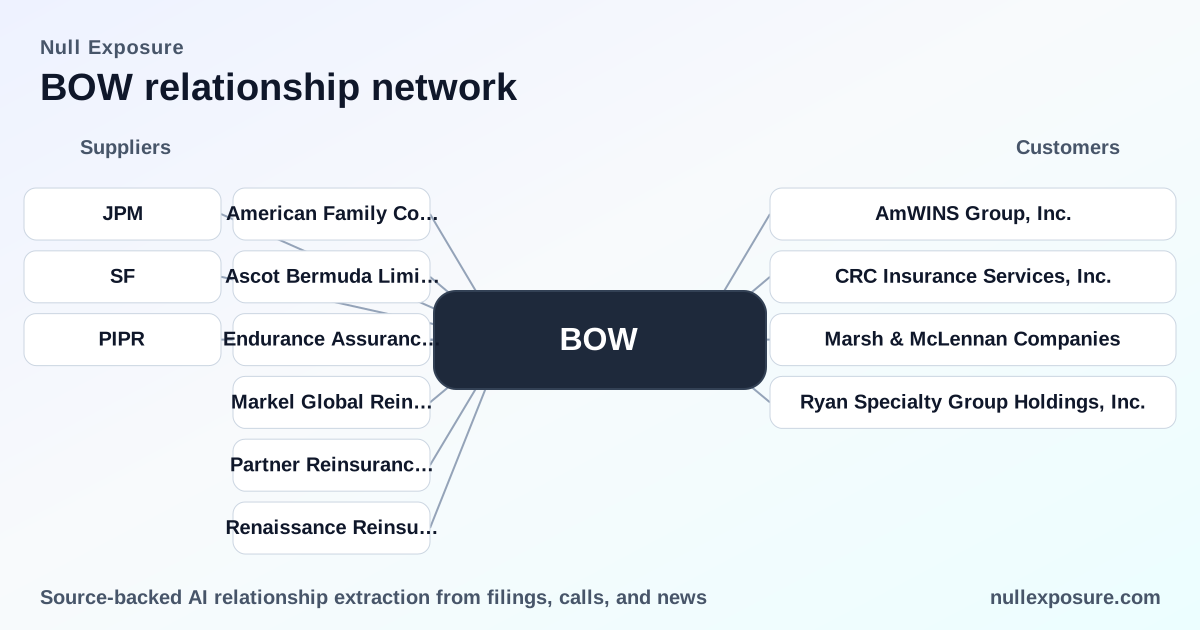
Distribution is concentrated in major broker channels — the list
Bowhead discloses a small set of brokers that together represent a meaningful share of placement activity. The FY2024 Form 10‑K lists four broker partners with material percentages of gross written premium across recent years; the disclosure frames Bowhead as dependent on a handful of distribution relationships to scale specialty lines rapidly and compliantly.
AmWINS Group, Inc.
AmWINS is identified among the brokers making up more than 10% of Bowhead’s gross written premium in the FY2024 10‑K, and Bowhead notes that policies are issued on American Family (AmFam) paper through BSUI with a ceding fee, then reinsured 100% to Bowhead Insurance Company, Inc. This arrangement is described as a mutually beneficial partnership that enabled rapid, capital-efficient growth. According to Bowhead’s FY2024 Form 10‑K, the AmWINS channel is a key distribution artery and integral to the BSUI / AmFam issuing-carrier structure.
CRC Insurance Services, Inc.
CRC Insurance Services is shown in the FY2024 10‑K with year-over-year percentage shares (8.8%, 9.7%, 11.3%), indicating an increasing role in placement activity. The filing links broker demand to Bowhead’s strategic partnership with AmFam to capture favorable pricing environments and specialized business flows. Bowhead’s disclosure in FY2024 positions CRC as a growing placement partner through which Bowhead channels specialty risks.
Marsh & McLennan Companies
Marsh & McLennan Companies is listed with shares of gross written premium across the recent periods (13.4%, 14.6%, 15.5%) in the FY2024 10‑K, making it one of Bowhead’s largest broker relationships by disclosed percentage. The filing associates Marsh’s share with the company’s broader strategy of using established broker networks to access complex specialty lines where Bowhead competes on tailored underwriting and service.
Ryan Specialty Group Holdings, Inc.
Ryan Specialty Group is the single largest named broker in the filing, with disclosed shares (22.5%, 26.3%, 27.9%) in FY2024, indicating it is a primary conduit for Bowhead’s growth in specialty lines. Bowhead’s FY2024 10‑K places Ryan at the center of its broker distribution mix and cites the partnership with AmFam and MGAs as the mechanism by which these placements are written and reinsured back into Bowhead’s balance sheet.
What the contract mechanics and constraints tell investors
Bowhead’s public disclosures include several company-level operational signals that shape the economics and risks of these broker relationships:
- Contracting posture (usage-based / MGA economics): BSUI is entitled to commission and provides accounting, claims handling and other services under MGA Agreements, with commissions adjusted to equal actual costs monthly. This indicates a usage-based, cost-pass-through component to the economic relationship between the MGA and issuing carriers, aligning BSUI compensation with activity and expense levels.
- Geographic concentration (U.S.-centric): The company states operations and all revenue derive from U.S. policyholders, and Bowhead writes both admitted and non-admitted (E&S) business across all 50 states and D.C., with selected offshore exposures handled via U.S. brokers. This is a domestic-market business model with limited foreign underwriting exposure.
- Customer concentration (immaterial single-customer risk): Bowhead reports no single customer accounting for 10% or more of total revenues for 2024, 2023, and 2022, signaling revenue diversification across brokers and policyholders despite large broker shares disclosed.
- Relationship role mix: Bowhead functions both as a buyer of distribution (purchasing broker access to specialty risks) and as a service provider through BSUI under the MGA Agreements (providing policy issuance, claims administration and regulatory support).
- Operating segment focus: Management reports a single operating and reportable segment focused on specialty services, indicating consolidated decision-making and capital allocation across underwriting lines.
These signals collectively imply a business that is distribution-dependent but structurally diversified at the customer level, with contract mechanics that transfer a portion of cost variability back to the MGA/carrier economics.
Why these relationships matter for valuation and operational risk
- Concentration of placements in a few brokers (Ryan, Marsh) creates optionality but also exposure to placement shifts; while no single broker meets the technical 10% revenue threshold as a “customer,” the disclosed percentages show that changes in broker behavior can materially affect growth rates and premium mix.
- MGA and issuing-carrier architecture (AmFam / BSUI / BICI) is a capital-efficient lever. The ceding fee and 100% reinsurance back to BICI let Bowhead scale written premium while controlling statutory and capital outcomes, improving return-on-capital when underwriting margins hold.
- U.S.-only footprint reduces geopolitical or FX complexity but concentrates regulatory risk and catastrophe aggregation domestically—an important consideration for portfolio stress testing.
- Usage-based commission adjustments align cost with activity and reduce fixed-cost leverage in the MGA. This stabilizes margin volatility but can compress economics if placement intensity or loss-adjustment costs rise.
Bottom line for investors and operators
Bowhead has built a distribution-forward specialty platform that leverages a small group of large brokers to scale targeted underwriting. The FY2024 disclosures show Ryan Specialty, Marsh & McLennan, CRC, and AmWINS as the principal placement channels, with an issuing-carrier / MGA / captive reinsurance construct that drives capital efficiency and underwriting leverage. Key risk vectors for next-stage valuation are broker placement concentration, the sustainability of MGA issuance economics, and the resilience of domestic specialty pricing.
For further primary-document review and relationship mapping, explore analysis at https://nullexposure.com/.
If you would like a focused briefing on how changes in broker placement patterns would impact Bowhead’s projected premium growth and capital strain, I can prepare a scenario analysis.