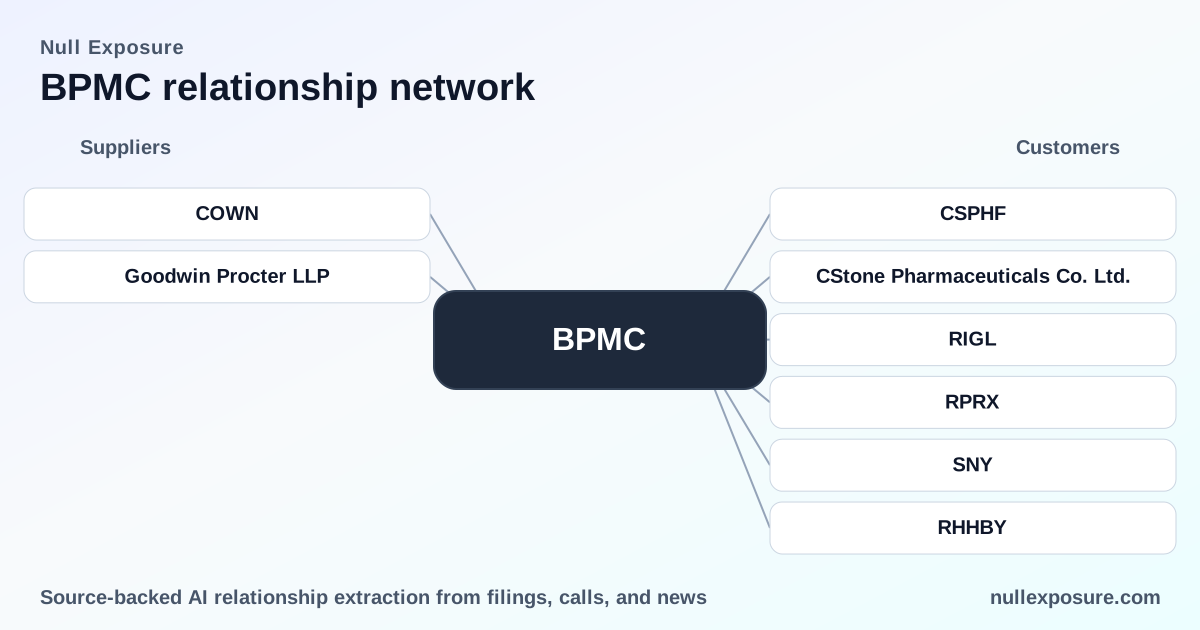
Blueprint Medicines (BPMC) customer relationships — partner footprint and what it signals for investors
Blueprint Medicines operated as a small-cap specialty biopharma that monetized discovery and development through a hybrid commercial model: in-house commercialization for select products, out‑licensing and regional marketing agreements that generate royalties, and structured financing transactions that monetize future royalties and milestones. The company’s value realization has come as a mix of license fees, milestone payments and royalty streams, culminating in a strategic acquisition that folded its product economics into a larger platform. For deeper company intelligence, see https://nullexposure.com/.
Why partners are the revenue engine here
Blueprint’s commercial outcomes historically depended on third‑party partners to expand geographic reach and to share commercialization risk. License agreements and regional distribution deals produced recurring royalties, while strategic financings transferred downside risk and advanced near‑term liquidity. These relationships collectively determined revenue concentration, time to market in major geographies, and the firm’s bargaining posture with larger pharma suitors.
Customer and partner list — who’s on the record
Below I cover every relationship captured in the results feed and provide a concise, investor‑oriented takeaway for each.
CStone Pharmaceuticals (CSPHF)
CStone holds Greater China commercialization rights for several Blueprint oncology drugs and has been responsible for marketing in China under a tiered royalty arrangement — Blueprint receives percentage royalties on China sales. This relationship was first reported when CStone secured exclusive Greater China rights in 2018 and is noted again in later company communications describing ongoing royalty payments. (See Caixin, June 6, 2018; GlobeNewswire press release, June 2, 2025.)
Rigel Pharmaceuticals (RIGL)
Rigel acquired U.S. commercial rights to Gavreto (pralsetinib) from Blueprint in a deal that included a $15 million payment, shifting U.S. commercialization responsibility while preserving monetization for Blueprint in other forms. This transaction was disclosed in coverage of Blueprint’s post‑Roche rights rebalancing and subsequent asset reassignments. (See FiercePharma, reporting on the Rigel deal, FY2024; TradingView/Zacks commentary, FY2026.)
Sanofi (SNY)
Sanofi completed a strategic acquisition that included Blueprint’s portfolio, integrating Blueprint products into its global rare‑disease and immunology strategy and capturing the downstream revenue streams from those assets. Sanofi’s own reporting highlights that acquired products contributed to revenue growth in Q4 2025 following the transaction. (See GlobeNewswire press release on the acquisition, June 2, 2025; Ad‑hoc‑News coverage, FY2026.)
Royalty Pharma plc (RPRX)
Royalty Pharma provided structured financing to Blueprint in 2022, including a $175 million upfront element under the financing agreement, and has been involved in transactions concerning ex‑U.S. royalty interests that were later restructured or ended as product rights shifted. That financing was a notable liquidity event for Blueprint and affected the company’s royalty economics. (See BizJournal coverage of the 2022 strategic financing; PR Newswire, JP Morgan presentation excerpt, FY2024.)
Roche (ROG / RHHBY)
Roche was a global co‑development partner for Gavreto outside Greater China but terminated the global collaboration in early 2023; the termination triggered reallocation of rights and subsequent downstream deals. Historically Roche’s involvement validated the asset but its exit materially changed Blueprint’s commercialization pathway. (See Sixth Street press note on the co‑development arrangement, FY2022; PR Newswire disclosure on Roche’s termination, Feb 2023 / FY2024.)
Sixth Street
Sixth Street participated alongside Royalty Pharma in a transformational 2022 financing package designed to provide Blueprint with up to $1.25 billion of strategic capital, a structure that blended non‑dilutive financing with partnership economics. This financing materially altered Blueprint’s capital structure and monetization timing. (See Sixth Street announcement and BizJournal reporting on the 2022 financing, FY2022.)
What these relationships collectively reveal about the operating model
- Contracting posture: Blueprint pursued an aggressive externalization strategy — licensing product rights regionally and signing co‑development and royalty monetization deals rather than attempting full global commercial build‑outs across all assets. That posture preserved capital and accelerated cash realization through license fees, milestones and royalties.
- Revenue concentration and criticality: A meaningful portion of Blueprint’s near‑term revenues and prospects depended on a handful of assets (notably Gavreto) and a small set of counterparties for distribution and financing. The Roche termination and subsequent reassignments to Rigel and others illustrate how a single partner decision could materially re‑shape revenue pathways.
- Counterparty maturity and market validation: Partners ranged from large, blue‑chip pharma (Roche, Sanofi) to regional commercial specialists (CStone) and financial buyers (Royalty Pharma, Sixth Street). That mix provided both market validation and immediate liquidity but also created layered claims on future royalties.
- Operational criticality: For markets like Greater China, regional partners such as CStone were essential for launch and scale, with tiered royalties converting local sales into recurring revenue for Blueprint; conversely, U.S. commercialization could be transferred entirely, as with the Rigel deal.
- Maturity of relationships: The record spans long‑standing regional deals (CStone, 2018) through financing and restructuring events in 2022–2024 and culminating in Sanofi’s acquisition (2025), showing a progression from licensing and co‑development to full corporate exit.
Note: the relationship feed does not list additional explicit constraints on contractual terms beyond the transaction descriptions; the above signals are company‑level inferences based on the documented partner activity.
Investment implications — risks and upside
- Upside: Strategic partners and financiers de‑risked late‑stage commercialization for Blueprint and provided liquidity; the Sanofi acquisition crystallized value for shareholders and validated the portfolio. Partnership monetization translated into both near‑term cash and long‑term royalty optionality, important for investors evaluating realized value versus pipeline expectations.
- Risk: Reliance on a small set of counterparties creates execution risk if a partner changes strategy (Roche’s termination is the case study). Royalty monetizations and structured financings transfer upside to buyers in exchange for liquidity, reducing free cash exposure to long‑tail market growth.
- Catalysts to watch: Post‑acquisition integration by Sanofi, ongoing royalty performance in Greater China under CStone, and any residual contingent payments tied to prior financings will drive realized economics.
Bottom line and next steps
Blueprint’s model was a partner‑centric commercialization and monetization strategy: regional licensees generated royalties, co‑development partners validated assets, and financial sponsors provided capital. These relationships successfully converted pipeline value into cash and ultimately a strategic exit. For a consolidated view of partner transactions and source documents, visit https://nullexposure.com/.
For direct access to curated partnership intelligence and to monitor how counterparties convert into realized revenue streams, visit https://nullexposure.com/.