Brookfield Property Partners (BPYPN) — Retail Relationships That Drive Value and Risk
Brookfield Property Partners (traded via its preferred BPYPN) operates and monetizes as a global real estate owner-operator and developer: it collects rental income, operates shopping centers and mixed-use assets, pursues opportunistic acquisitions and restructurings, and realizes value through asset management and disposals. With approximately $88 billion in total assets and a diversified platform that includes development and public-private projects, BPYPN’s investor case is driven by steady property cash flows plus upside from retail restructurings and strategic partnerships with fellow mall operators.
If you want a concise feed of counterparty exposures and press events that matter to holders of BPYPN, Nillexposure aggregates relationship signals that illuminate how Brookfield’s landlord, buyer and developer roles interact with retail distress and large-scale projects. Learn more at https://nullexposure.com/.
How these customer relationships map to Brookfield’s operating model
Brookfield functions simultaneously as a landlord, distressed-asset acquirer, and development partner. That mixed posture produces three operating characteristics investors should internalize:
- Contracting posture — active and opportunistic. Brookfield both enforces leases as a large mall landlord and negotiates workouts or equity positions when tenants restructure. That dual posture creates optionality: it either preserves rental income or converts tenant distress into ownership or control.
- Concentration and criticality — retail anchors matter. Large tenants and anchor chains (department stores, national retailers) are systemically important to mall-level cash flow; Brookfield’s direct relationships with those tenants therefore have outsized impact on same-center performance.
- Maturity and scale — institutional, transactional capability. The firm’s balance-sheet scale and development experience enable participation in large public-private projects and consortium bids, which diversify income beyond pure leasing.
Company financials underline this mixed profile: Revenue TTM ~$7.15bn and EBITDA ~$3.10bn, yet recent profit margin pressures (ProfitMargin -5.05%) reflect transitional costs and capital redeployment into opportunistic plays. No explicit constraints were flagged in the relationship feed for BPYPN.
The relationships — concise, sourced takeaways
Below are every customer relationship pulled from the feed, rendered as plain-English takeaways with source references.
Alex and Ani LLC — landlord exposure through rent arrears (FY2021)
Brookfield is listed among the largest unsecured creditors to Alex and Ani after the jewelry retailer filed Chapter 11, noted as owed more than $3 million in rent. This is a direct example of Brookfield’s landlord exposure to single-tenant distress. (Mirror Spectator, court filing reported June 9, 2021: https://mirrorspectator.com/2021/06/10/jewelry-retailer-alex-and-ani-files-for-bankruptcy/)
JCPenney — joint buyer in a distressed acquisition (FY2020)
Brookfield partnered with Simon Property Group to execute an acquisition strategy for JCPenney out of bankruptcy, participating in an approximately $800 million deal tied to a $1.75 billion OpCo asset purchase, converting tenant distress into ownership of operating retail assets. This transaction exemplifies Brookfield’s playbook of turning anchor-tenant disruption into asset-level control. (CommercialSearch reporting on the JCPenney deal, FY2020: https://www.commercialsearch.com/news/mall-giants-said-to-strike-800m-deal-for-j-c-penney/)
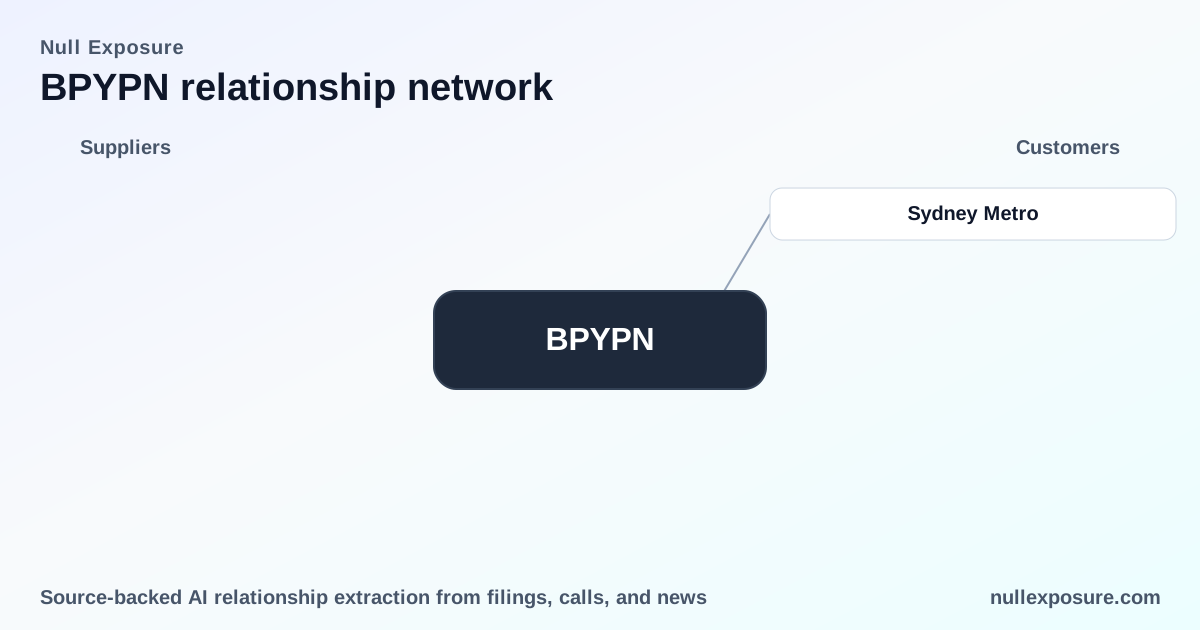
Sydney Metro — shortlisted development partner for a major precinct (FY2022)
Brookfield was named within a Brookfield-led consortium shortlisted for the Hunter Street station precinct in Sydney CBD, demonstrating the firm’s role as a development partner on large-scale, transit-oriented projects in international markets. This underscores Brookfield’s mixed developer/owner profile beyond pure retail tenancy. (RailwayPro coverage of shortlisted consortia, FY2022: https://www.railwaypro.com/wp/two-consortia-shortlisted-for-sydney-hunter-street-station/)
Forever 21 Inc. — landlord as potential equity participant during turnaround talks (FY2019)
Reports indicate that Forever 21’s leadership approached its largest landlords, including Brookfield, to consider taking equity stakes or other forms of support while navigating a turnaround, illustrating Brookfield’s willingness to convert landlord leverage into equity or hybrid arrangements when strategic. (WorldFootwear summary citing Bloomberg reporting, FY2019: https://www.worldfootwear.com/news/forever-21-is-exploring-options/3972.html)
What these relationships imply for BPYPN investors
Collectively, these items reveal a consistent Brookfield strategy: monetize landlord positions through active asset management, and selectively convert tenant stress into ownership or development upside. The mix of secured rent claims (Alex and Ani), transaction-level acquisitions (JCPenney), development bidding (Sydney Metro), and turnaround equity discussions (Forever 21) demonstrates the breadth of Brookfield’s counterparty interactions.
Key implications:
- Earnings resilience is balanced with transactional volatility. Rental income provides base cash flow, but acquisitions and restructurings create episodic capital deployment and valuation repricing that affect profitability and leverage.
- Counterparty risk is concentrated in retail anchors. Large tenants and department-store chains generate outsized cash-flow risk at specific assets; Brookfield’s direct involvement in restructurings both mitigates and transforms that risk into new asset exposures.
- Strategic partnerships matter. Co-investments and consortium roles (e.g., with Simon Property Group or public entities) reduce single-party execution risk and enable Brookfield to pursue large-scale projects it could not execute alone.
Risk profile and monitoring checklist for operators and investors
Evaluate BPYPN exposure by tracking:
- Anchor tenant restructurings and the outcome (rental cure vs. OpCo conversion).
- Material unsecured creditor positions or rent-roll concentrations at major retail assets.
- Development contract awards and the firm’s execution cadence on staged projects.
- Capital redeployments following opportunistic purchases that may compress near-term margins.
For a continuous feed of counterparty and relationship signals that feed these monitoring tasks, Nillexposure provides structured outputs tailored to investor due diligence — explore more at https://nullexposure.com/.
Bottom line
Brookfield’s customer relationships are not passive lease contracts; they reflect an active, opportunistic operator that converts tenant distress into asset-level optionality while pursuing development scale. For BPYPN investors, that means stable underlying rents augmented by episodic but meaningful upside (and execution risk) from restructurings and development deals. The four relationships cataloged here — Alex and Ani, JCPenney, Sydney Metro, and Forever 21 — collectively illustrate the full spectrum of Brookfield’s landlord, acquirer, and developer roles and should be tracked as leading indicators of cash-flow continuity and capital redeployment.