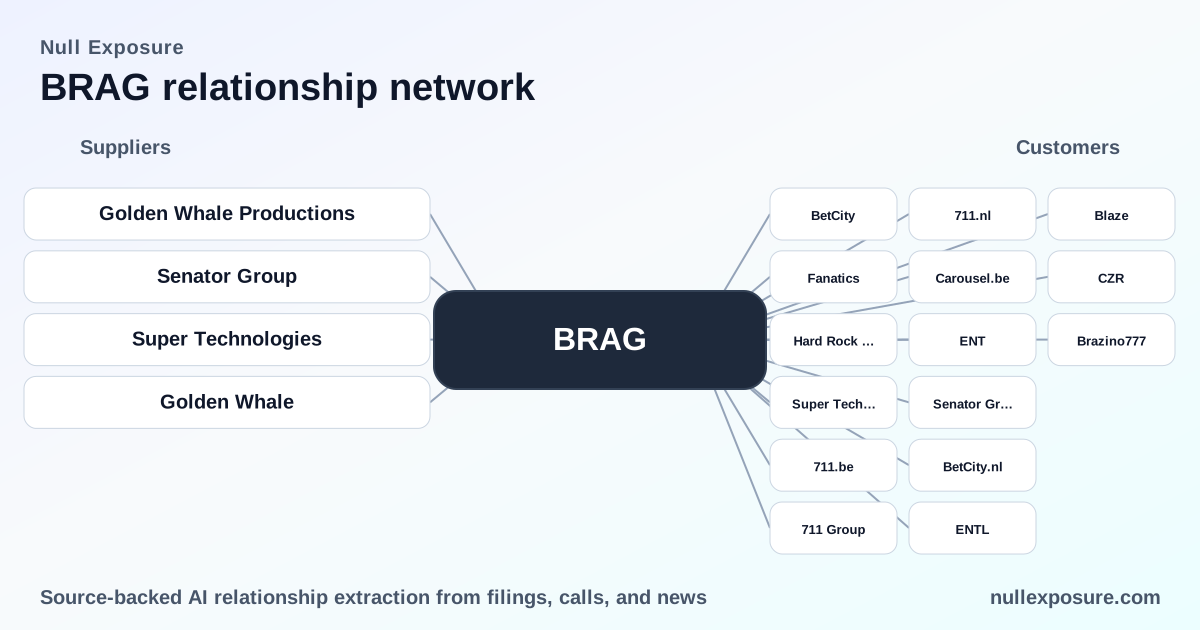
Bragg Gaming Group (BRAG): Customer Relationships and What They Mean for Revenue Durability
Bragg Gaming Group operates as a B2B iGaming content and technology supplier that monetizes through a mix of platform fees (PAM), content licensing and exclusivity deals, and turnkey managed services for regulated operators. The company’s commercial model blends multi-year platform agreements with bespoke content deals for Tier‑1 operators, plus targeted rollouts in new regulated markets to drive recurring revenues and margin improvement. For a concise view of Bragg’s partner footprint and commercial risks, read on — or visit https://nullexposure.com/ for a consolidated breakdown of partner exposures and renewal schedules.
What the partner map tells investors in one sentence
Bragg’s commercial book mixes multi-year PAM extensions with marquee content deals, signaling a business that relies on both platform stickiness and continuous content distribution to Tier‑1 and mid‑market operators; that duality supports recurring cash flow but concentrates execution risk in a handful of regional relationships.
Major client relationships and what each implies for BRAG
-
BetCity — Management disclosed on the 2025 Q3 earnings call that BetCity in the Netherlands is expected to migrate off Bragg’s PAM in H1 2026, representing a near‑term churn event materially relevant to Dutch revenue. According to Bragg’s 2025 Q3 earnings call (brag-2025q3-earnings-call, 2025Q3).
-
BetCity.nl — Bragg announced a short extension specific to BetCity.nl that keeps the operator on Bragg’s PAM and content stack only through May 31, 2026, indicating a temporary bridge arrangement rather than a long-term renewal. See the company’s 6‑K disclosure referencing the PAM extension (stocktitan / Bragg 6‑K, FY2026).
-
Entain Plc (ENT / ENTL / Entain) — Bragg publicly extended its Player Account Management agreement with Entain for BetCity.nl, underscoring a continued commercial link to one of the industry’s largest operators and reinforcing content and platform credibility. The extension was announced in a Jan 9 press release and accompanying filings (financialcontent / BizWire press release, FY2026).
-
711 Group / 711.nl / 711.be / Carousel.be — Bragg agreed a three‑year extension with 711 Group to continue providing PAM and content to 711.nl and power the launch of 711.be in Belgium, demonstrating multi‑year contract value in Benelux. GamingIntelligence and related press coverage documented the contract extension (gamingintelligence.com, FY2025/FY2026).
-
Senator Group — Bragg secured a four‑year turnkey extension with Senator Group in Croatia to supply PAM, proprietary/exclusive content, Fuze engagement tools, and managed services, which highlights Bragg’s turnkey market execution capability. The extension was disclosed in a company press release and covered by The Globe and Mail and other outlets (theglobeandmail.com / press release, FY2026).
-
Super Technologies / Superbet — Bragg announced a strategic partnership naming Super Technologies as a preferred content delivery partner and confirmed support for the Superbet brand’s entry into Greece, indicating geographic expansion via white‑label and partner-led launches. This partnership was reported across Business Wire, Investing.com and StockTitan (stocktitan.net; investing.com; markets/news releases, FY2026).
-
SuomiVeto — Bragg signed a PAM platform and turnkey solution agreement with SuomiVeto to support entry into Finland’s regulated market, with an expected go‑live on July 1, 2027, showing Bragg’s pipeline in newly regulated jurisdictions. Reported in coverage of Bragg’s FY2026 announcements (casino.org / FY2026).
-
Hard Rock Digital — Management referenced bespoke content agreements with Hard Rock Digital during the 2025 Q2 earnings commentary as evidence that Bragg is a preferred bespoke content partner for Tier‑1 operators, reinforcing the company’s position in the U.S. content market. See Bragg’s 2025 Q2 earnings call transcript (brag-2025q2-earnings-call, 2025Q2).
-
Caesars / Caesars Entertainment / CZR — Bragg noted bespoke content arrangements with Caesars as part of its Tier‑1 proof points and also reported launches of exclusive content with Caesars in U.S. states like West Virginia, supporting U.S. market expansion. Refer to the 2025 Q2 earnings call and later press coverage (brag-2025q2-earnings-call; gurufocus coverage, FY2026).
-
Fanatics / Fanatics Casino — Bragg launched its online casino games with Fanatics Casino across New Jersey, Pennsylvania and Michigan and announced a tri‑state rollout, which underlines its penetration strategy for U.S. retail/online hybrids. This activity was disclosed in the 2025 Q2 earnings call and press items (brag-2025q2-earnings-call; simplywall.st reporting, FY2026).
-
Bet365 — Bragg extended its content rollout in Ontario following a launch with Bet365, pointing to continued partnerships with large international operators in regulated Canadian provinces. Reported in investor news summaries and market coverage (simplywall.st, FY2026).
-
BetMGM — Bragg continued U.S. expansion with a content launch on BetMGM in Pennsylvania, reinforcing commercial traction with major U.S. platforms. See market press summaries (simplywall.st, FY2026).
-
Blaze — Bragg went live with proprietary and exclusive content on the Blaze platform in Brazil, reflecting content monetization in Latin American markets. Announced in a December 2025 press release covered by FinancialContent (markets.financialcontent.com, FY2025).
-
BetRivers / Rush Street Interactive (RSI) — Bragg rolled out new content to Pennsylvania via Rush Street Interactive’s BetRivers, signaling continued U.S. state‑level distribution partnerships. Captured in company press mentions and simplywall summaries (simplywall.st, FY2026).
-
Wynnbet / WYNN — Bragg extended content rollouts following a launch with Wynnbet in New Jersey, indicating incremental U.S. operator distribution. Documented in investor summaries (simplywall.st, FY2026).
-
Brazino777 — Bragg announced a partnership with Brazino777 for content distribution, indicative of selective, higher‑margin distribution agreements outside the largest operators. Reported in investor news feeds (intellectia.ai / FY2026).
-
Carousel.be — As part of the 711 Group extension, Bragg will continue serving Carousel.be in Belgium, emphasizing local brand support through PAM and content agreements (gamingintelligence.com, FY2025/FY2026).
-
Super Technologies (multiple filings) — Multiple press releases and 6‑K filings confirm Bragg’s designation as Super Technologies’ preferred content delivery partner across strategic markets, reinforcing the company’s role as a global content aggregator and integrator. See StockTitan and company 6‑K filings (stocktitan.net; Bragg 6‑K filings, FY2026).
Contracting posture, concentration and service criticality (company‑level signals)
-
Contracting posture: The mix of multi‑year extensions (3–4 years) and short bridge extensions (e.g., BetCity.nl through May 2026) shows Bragg executes both large, long‑term platform deals and tactical short‑term renewals to manage churn. Those structures support recurring revenues while allowing the company to re‑price or renegotiate at renewal events.
-
Concentration: Bragg’s revenue profile tilts toward contracts with Tier‑1 operators (Entain, Caesars, BetMGM, Bet365) alongside regional operators (711 Group, Senator), creating revenue concentration risk tied to a relatively small number of high‑value partners.
-
Criticality: Multiple press releases and contract extensions position Bragg’s PAM and turnkey services as mission‑critical to operators’ market entries and content strategies, which supports retention but raises execution risk if platform migrations occur.
-
Maturity and growth channels: Bragg is actively leveraging regulated market launches (Ontario, Greece, Finland, Brazil) and bespoke content deals to expand addressable markets, signaling a growth strategy built on geographic diversification and deeper operator integrations.
Risk and opportunity — the investor takeaway
-
Risk: Short‑term extensions and an explicit migration by BetCity constitute clear near‑term churn risk in the Netherlands with EBITDA impact if not offset by new deals or expansions. Analyst commentary has already reflected this risk in recent coverage. See market commentary and research notes (intellectia.ai / analyst downgrade coverage, FY2026).
-
Opportunity: Multi‑year extensions with 711 Group and Senator, plus Tier‑1 bespoke content deals, provide a runway for recurring platform revenue and higher‑margin exclusive content licensing. Partnerships with Super Technologies and supporting Superbet’s Greece launch illustrate scalable go‑to‑market leverage into new regulated markets.
For a consolidated, actionable view of these partner exposures — renewal dates, contract terms, and revenue sensitivity — visit https://nullexposure.com/ to see how these relationships map to Bragg’s near‑term cash flow and valuation drivers.
If you want a focused briefing on a subset of relationships (Netherlands exposure, U.S. Tier‑1 rollouts, or turnkey services), I can prepare a short investor memo that quantifies revenue sensitivity and likely EBITDA impact under plausible churn and replacement scenarios.