BellRing Brands (BRBR): Retail concentration is the investment thesis — and the chief risk
BellRing Brands manufactures and sells ready‑to‑drink protein shakes and powders and monetizes through high‑volume wholesale relationships with national retailers and club channels; roughly $2.32 billion of trailing revenue is earned by selling branded nutrition products into a small set of very large purchasers, with retail promotions and large‑format events driving short‑term consumption spikes and recurring shelf placements providing the bulk of revenue. For platform-level counterparty intelligence and ongoing monitoring of these retail relationships, visit https://nullexposure.com/.
Why the customer map matters: scale, leverage, and single‑buyer sensitivity
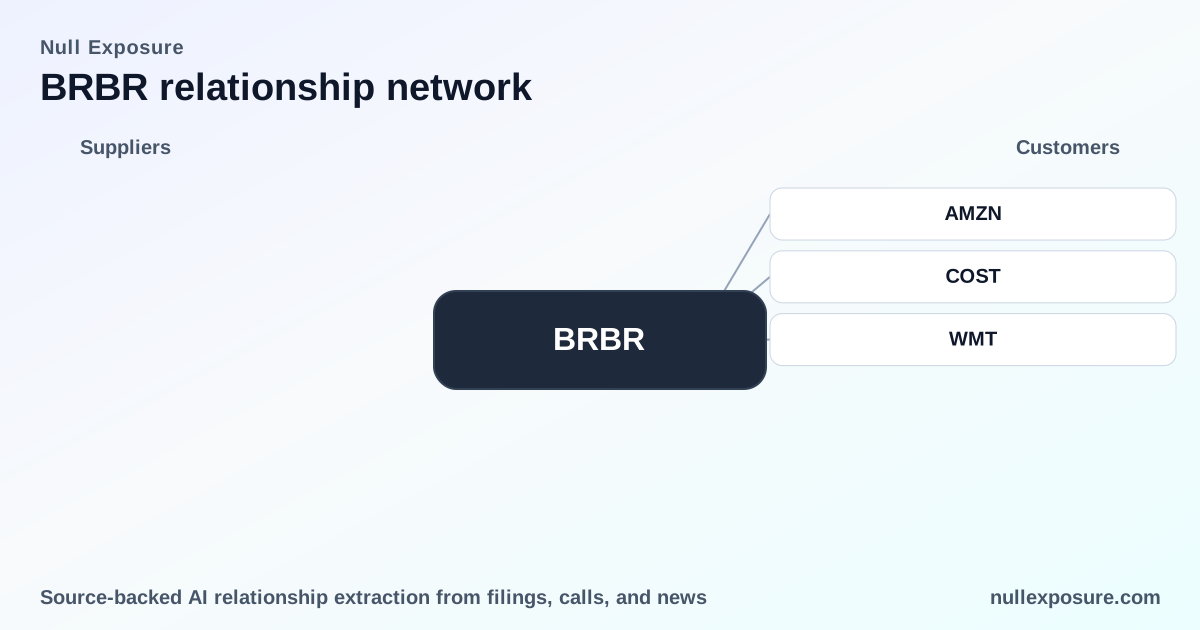
BellRing’s business model is built on distribution into club stores, FDM and online retailers where a handful of large buyers determine volume, promotional cadence, and shelf economics. According to BellRing’s FY2025 10‑K, Walmart (including Sam’s Club), Costco and Amazon together accounted for approximately 74.0% of net sales for the year ended September 30, 2025. The company reported one customer alone accounted for 34.3% of net sales in FY2025, underlining high revenue concentration and outsized counterparty risk. These are company‑level signals: the customer base is large‑enterprise focused, heavily U.S.‑centric (88.1% of net sales in FY2025), and the active relationships are tied directly to BellRing’s core product set (RTD shakes and powders).
Every major customer relationship disclosed
Amazon (FY2025 10‑K)
Amazon is listed among BellRing’s three largest customers and contributes to the collective ~74% share of net sales reported for FY2025; this reflects broad online wholesale distribution rather than a single direct‑to‑consumer channel. According to BellRing’s FY2025 10‑K, Amazon is one of the principal large customers driving the company’s net sales concentration.
Costco (FY2025 10‑K)
Costco is named in BellRing’s FY2025 10‑K as one of the three largest customers that, together with Walmart and Amazon, accounted for approximately 74.0% of net sales for the year ended September 30, 2025. The Costco channel contributes via bulk club placements and member events that scale volume.
Costco (FY2026 news sentiment)
Bullish analyst commentary in 2026 flagged a successful Costco member event as a driver of strong recent consumption trends for BellRing’s Premier brand, supporting a positive Q4 outlook. A 2026 report on Simply Wall St highlighted Costco‑led promotional success that supported near‑term demand.
Walmart (FY2025 10‑K)
Walmart and its affiliates (including Sam’s Club) are explicitly identified in BellRing’s FY2025 10‑K as one of the company’s largest customers and a principal contributor to the ~74% top‑customer concentration; Walmart appears as the single largest buyer in the company’s customer mix.
WMT (FY2025 10‑K)
The filing also lists WMT (the ticker reference to Walmart) in the same top‑customer disclosure for FY2025, reinforcing that Walmart/Sam’s Club constitutes a material, high‑share relationship for BellRing’s wholesale distribution.
(Each relationship summary above is drawn from BellRing Brands’ FY2025 10‑K and the cited 2026 market coverage on Simply Wall St.)
Operating model and counterparty constraints — what investors must understand
-
Concentration and criticality: BellRing’s revenue profile is highly concentrated; the top three retailers account for roughly three quarters of sales and one buyer accounts for just over a third. This structure generates scale but creates acute single‑buyer exposure that directly influences negotiating leverage, working capital needs, and demand volatility.
-
Contracting posture: The company operates as a seller of packaged nutrition products into very large enterprise buyers. That dynamic creates vendor economics dominated by slotting fees, promotional funding, and inventory cadence controlled by buyers rather than the supplier.
-
Geographic focus and growth runway: BellRing is predominantly domestic: U.S. sales represented 88.1% of net sales in FY2025, with international sales near 11.9%; international operations are smaller but steadily present across multiple years.
-
Relationship maturity and role: The firm’s relationships are active and core to its product strategy — BellRing is a provider of ready‑to‑drink protein shakes and powders and sells these products through established retail channels rather than emerging direct‑to‑consumer models.
These constraints are company‑level signals drawn from BellRing’s public disclosures and characterize how revenue is sourced and how dependency on a small set of large counterparties shapes strategic options.
Financial context that frames customer risk
BellRing reported approximately $2.32 billion in trailing revenue and $339.5 million of EBITDA; operating margin sits at 14.6% and net profit margin at 7.89%. The firm’s return on equity is high, reflecting operating leverage and capital structure dynamics. Those financials amplify the practical consequences of customer concentration: a large, single‑buyer disruption would reverberate through margins and working capital. Analysts’ consensus target price sits near $26.07, with most ratings in the Buy/Strong Buy range, reflecting confidence in the brand and route‑to‑market even given concentration risk.
Investment implications and monitoring checklist
-
Primary thesis: BellRing leverages national retail scale and club event promotion to monetize branded nutrition products; that model delivers attractive margins but concentrates commercial risk in a few enterprise buyers. Investors are compensated for concentration only if the company preserves shelf placement and promotional share with its largest accounts.
-
Key risks to monitor: renewal terms and promotional funding arrangements with the top buyer that accounts for ~34.3% of sales; inventory and payment terms negotiated with Walmart/Costco/Amazon; any shift in club or big‑box promotional strategy; and international expansion metrics as a diversification vector.
-
Near‑term catalysts: follow Costco member events, promotional cadence at Walmart/Sam’s Club, and Amazon online assortment changes — each can materially swing quarterly demand.
For continual monitoring of BellRing’s counterparty relationships and to access curated signals on customer concentration, visit https://nullexposure.com/.
Bottom line
BellRing’s operating model is straightforward: manufacture branded nutritional products and sell them at scale into a concentrated set of large retail and club customers. That concentration underpins both BellRing’s scale economics and its principal investment risk — the company’s commercial fate is tightly linked to a small number of enterprise buyers and the promotional strategies they deploy. Investors should value the firm’s strong operating margins and return metrics while actively tracking contract terms and buyer behavior for Walmart, Costco and Amazon as the critical drivers of near‑term revenue and margin performance.