Brady Corporation (BRC): Customer Relationships, Channels and Constraints that Drive Durable Revenue
Brady Corporation manufactures identification solutions and workplace safety products and monetizes through a mix of direct sales, distribution partnerships and digital channels, shipping physical goods and recognizing revenue at transfer of control. The business combines high-margin recurring consumables and hardware with channel-driven distribution, resulting in stable revenue per share and steady cash generation. For investors evaluating customer relationships, the most important signals are Brady’s broad distributor network, low single-customer concentration, and a mix of short invoice cycles with a measurable portfolio of multi-year warranty obligations. Learn more about the company and signals here: https://nullexposure.com/.
Quick investment thesis
Brady’s value proposition to customers is operational safety and traceability tied to branded consumables and labeling systems — a revenue mix that yields predictable recurring demand. Revenue diversification across geographies and channels, coupled with a distributor-heavy go-to-market posture, creates resilience and scale economics; this positions Brady as a compounder in industrial safety with margin expansion potential when execution drives cost efficiencies.
How Brady’s customer network actually looks
Brady sells through multiple channels and holds long-standing distributor relationships alongside direct accounts. The company’s published metrics show no single customer exceeds 10% of sales, reinforcing a low counterparty concentration that supports credit stability and predictable cash flow.
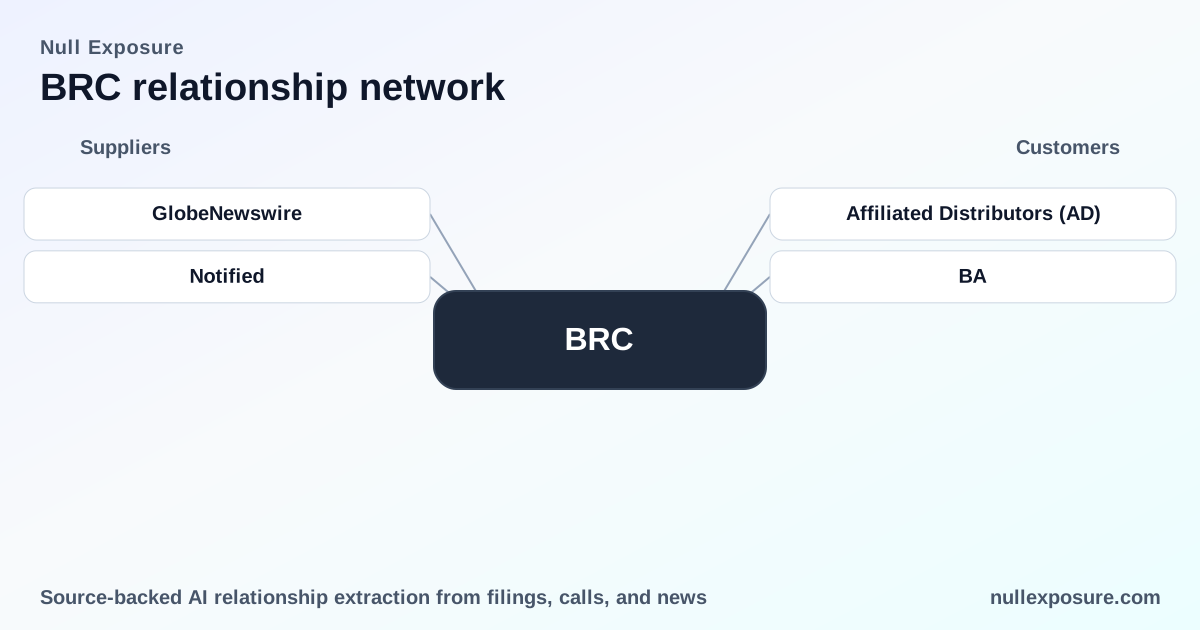
Affiliated Distributors (AD) — industrial distribution channel partner
Brady is identified as an AD Supplier within the Industrial Division, demonstrating a channel partnership that leverages AD’s member network to extend Brady’s reach into electrical and safety-focused buyers. According to an ADHQ report referencing this relationship (FY2019), the AD channel contributed to doubled sales growth for AD distributors using Brady e-content. (Source: ADHQ news about AD distributors, referenced FY2019).
BA (ticker BA) — Boeing-related program approval (press release reference)
Brady announced that its aerospace RFID tags and printing/encoding systems were approved for use on Boeing commercial airplane programs, a validation that opens access to aerospace OEM supply chains and certified parts lists. This approval was publicized in a Brady release covered by AviationPros on October 19, 2016. (Source: AviationPros press release, Oct 19, 2016).
Boeing Company — product qualification for aerospace applications
The same AviationPros release noted that Brady’s RFID solution was explicitly accepted for Boeing’s commercial programs, signaling product-level certification and engineering acceptance that underpin higher-bar, specification-driven sales channels. This approval positions Brady as an approved vendor for aerospace customers where qualification acts as a barrier to entry. (Source: AviationPros press release, Oct 19, 2016).
Operating model constraints and what they mean for investors
Brady’s contracts and operating footprint present a mix of characteristics that influence revenue durability, working capital and margin profile:
-
Contracting posture: Short invoice cycles with pockets of multi-year obligations. The company’s standard payment terms are net 30, and contracts with customers are typically shorter than one year for the majority of orders; at the same time, Brady reports warranty-related contract liabilities that represent unsatisfied obligations extending beyond one year as of July 31, 2025. This combination compresses receivable duration while retaining multi-year service or warranty exposure that requires provisioning. (Source: Brady annual filings, balance of contract liabilities as of July 31, 2025).
-
Channel concentration: Distributor-centric but broadly diversified. Brady maintains long-standing relationships with electrical, safety, industrial and other distributors and sells through distributor master supply agreements and purchase orders; that channel focus delivers scale and distribution efficiency while keeping individual customer concentration low. The company explicitly discloses a broad customer base with no customer representing 10%+ of net sales. (Source: Brady annual disclosures on customer concentration and distributor relationships).
-
Geographic reach: True global footprint with regional segmentation. Brady reports operations across North and South America, Asia, Europe, Australia, the Middle East and Africa — the company groups these operations into Americas & Asia and Europe & Australia segments. Investors should value growth and FX exposures region by region given revenue mix across developed and emerging markets. (Source: Brady segment disclosures in filings).
-
Relationship maturity and criticality: Mature distributor relationships and certified OEM approvals. The firm has long-standing, mature partnerships with distributors and has pursued product approvals for specification-driven customers such as aerospace OEMs; this combination raises switching costs in specific verticals while leaving commoditized product lines more price-competitive.
-
Materiality: Low customer concentration as a stabilizer. Company-level disclosures confirm that no single customer accounts for 10% or more of total net sales, which reduces counterparty revenue risk and supports predictable cash flows even if a large customer contract lapses. (Source: Brady investor filings).
Implications for investors and operators
- Revenue resilience: Distributor breadth and consumable-driven demand create recurring revenue streams and protect margins versus one-off capital sales. Expect steady revenue-per-share absent macro shocks.
- Working capital profile: Net-30 terms compress receivables but longer warranty liabilities create a deferred obligation; monitor cash conversion against warranty and service liability trends.
- Growth levers: Certification wins in verticals like aerospace (Boeing approvals) drive access to higher-value customers and can expand ASPs (average selling prices) where product approval creates scarcity value.
- Execution risks: Geographic expansion, FX management and maintaining pricing in commoditized segments remain operational levers; distributor relationships reduce selling cost but concentrate go-to-market dependency.
Key takeaway for diligence and next steps
Brady’s commercial model blends a low-concentration, distributor-led sales engine with targeted OEM certifications that create vertical defensibility. For buy-side diligence, prioritize channel revenue breakdowns, warranty liability trends, and the cadence of new vertical approvals (aerospace, medical, utilities). For operators, focus on improving digital lead capture in distribution channels and optimizing warranty lifecycle management.
If you want a structured view of Brady’s customer signals and constraints for modeling or competitive benchmarking, visit NullExposure for the full relationship intelligence and filings overview: https://nullexposure.com/.
Bold summary: BRC is a distributor-heavy, globally diversified manufacturer with mature channel relationships, low single-customer concentration, short invoice cycles, and selective long-term warranty obligations — a profile that supports stable cash generation and targeted growth via vertical certifications.