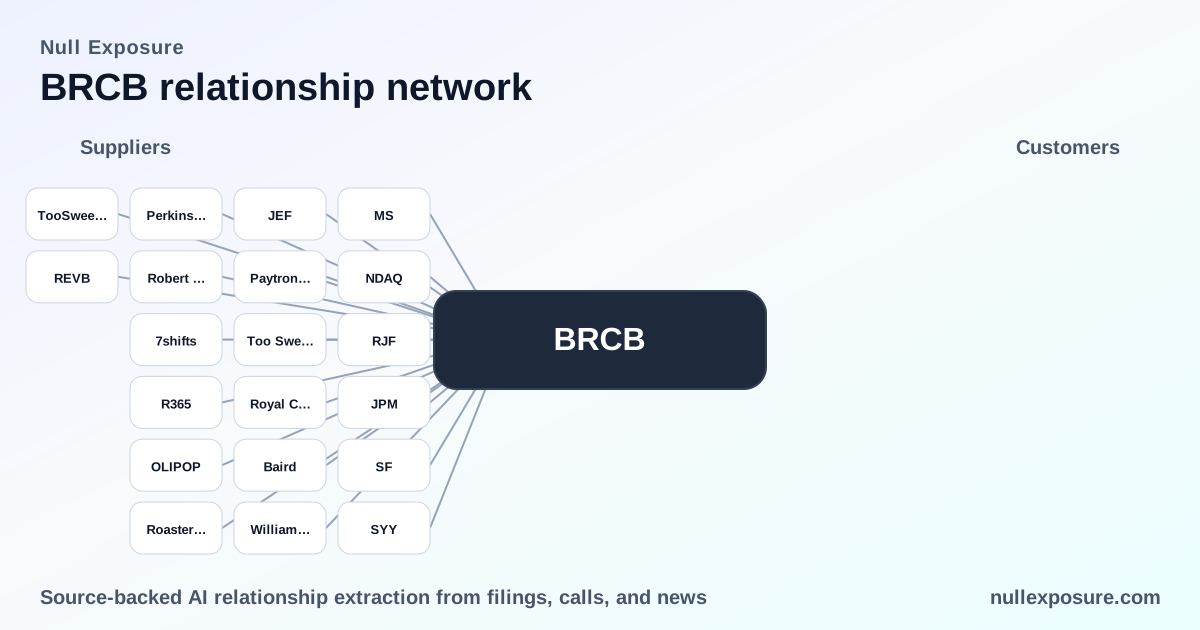
Black Rock Coffee Bar (BRCB) — Institutional Interest, Customer Relationships, and Strategic Signals
Black Rock Coffee Bar operates and monetizes a national chain of drive‑thru coffee bars, generating revenue from retail sales at company‑owned locations; the company’s economics today are defined by high gross margins on beverage sales, low operating margins at scale, and modest EBITDA relative to market capitalization. For investors and operators evaluating customer relationships, the most actionable signal in public reporting is targeted institutional interest that can influence float dynamics, secondary offering appetite, and valuation multiple compression or expansion. For a concise market update and relationship breakdown, visit https://nullexposure.com/.
How the business makes money — the economics that matter to buyers and partners
Black Rock Coffee Bar runs a straightforward retail operating model: company‑owned drive‑thru units produce the majority of revenues, so top‑line performance is tied directly to store throughput, location selection, and beverage margin execution. Latest trailing twelve‑month figures show Revenue of $200.3M and Gross Profit of $102.0M, with EBITDA around $13.1M and an operating margin near 3.3%, indicating the business converts sales to cash flow slowly relative to pure digital or franchised rollouts. Market capitalization stands near $205M, implying the market is pricing a combination of growth optionality and operating leverage into the equity.
- Concentration and ownership: insider ownership is modest at ~3.6%, while reported institutional ownership is listed at 122.8%, a figure that should be treated as a reporting anomaly or a sign of complex institutional positions requiring confirmation.
- Maturity and growth: quarterly revenue growth year‑over‑year is +25.3%, suggesting acceleration at the sales line even while net profitability remains constrained by expansion costs and operating scale.
Black Rock’s operating posture—owning and operating locations rather than relying on a pure franchise model—creates direct control over customer experience but concentrates capital expenditure and execution risk for the company.
Institutional interest recorded: Wellington Management
A May 2026 news item documents that Wellington Management expressed interest in purchasing up to $30 million of shares in Black Rock Coffee’s offering. This is a clear institutional read into demand dynamics for any public offering and can support secondary pricing or anchor demand for share issuance. (Source: eFanews, May 2, 2026 — https://www.efanews.eu/item/53591-coffee-is-good-for-the-nasdaq.html)
Implication: a $30M‑level institutional order would be material relative to current market cap and could tighten float and improve aftermarket stability if executed; it also signals that large asset managers are monitoring the name for yield and equity exposure to consumer discretionary, drive‑thru retail.
What every relationship in the public results tells investors
The relationship set in the public results is compact and focused; below is a plain‑English takeaway for the single reported relationship.
- Wellington Management — The asset manager expressed interest to buy as much as $30 million of shares in BRCB’s offering during FY2025 activity tracking; the communication was captured in a May 2026 media report. (eFanews, May 2026 — https://www.efanews.eu/item/53591-coffee-is-good-for-the-nasdaq.html)
This is the only relationship disclosed in the customer‑scope results, and it is recorded as demand interest rather than a completed block purchase, so investors should track subsequent filings or transaction notices for confirmation of any execution.
Constraints and company‑level signals that shape partnership risk
There were no explicit relationship‑level constraints reported in the provided relationship data. At the company level, observable operating characteristics create constraints that influence partner negotiations and market behavior:
- Contracting posture: owning and operating stores gives Black Rock direct retailer status with negotiating power over suppliers but also concentrates capital needs on the company balance sheet; partners should expect standard vendor agreements rather than franchise royalties.
- Concentration: revenue is retail‑driven and sensitive to same‑store traffic and site economics; institutional ownership metrics are anomalous and warrant due diligence before inferring shareholder stability.
- Criticality: for suppliers and vendors, Black Rock is a recurring retail customer but not a globally critical account; for investors, a sizable institutional anchor or block can be materially critical to share price stability.
- Maturity: the business reports positive revenue growth with constrained profitability—growth stage with operational leverage still to be realized, making timing of institutional capital injections and secondary supply especially consequential.
These signals inform how counterparties should price long‑term supplier contracts, how banks should underwrite working capital, and how investors should model dilution from potential equity offerings.
What investors and operators should watch next
- Confirmation of any Wellington purchase: published interest is significant only if executed; follow filings and trade prints for block coverage.
- Follow‑through on comp metrics and margin expansion: with gross profit healthy, the path to higher operating margins depends on leverage from unit volume and expense discipline.
- Ownership reconciliation: resolve the reported 122.8% institutional ownership statistic through proxy statements or 13F disclosures to understand true float and potential short interest.
For an actionable investor page and deeper relationship monitoring, visit https://nullexposure.com/.
Bottom line — a compact relationship footprint with outsized importance
Black Rock Coffee Bar’s public relationship footprint in the customer‑scope results is narrow but meaningful: institutional interest from a heavyweight like Wellington Management is a high‑leverage signal for a small‑cap retail operator, with potential to affect supply and secondary market behavior. Combine that with the company’s owner‑operated model, accelerating revenue, and modest EBITDA, and the risk/reward tradeoff centers on execution of store economics and whether institutional allocations convert from interest to committed capital.