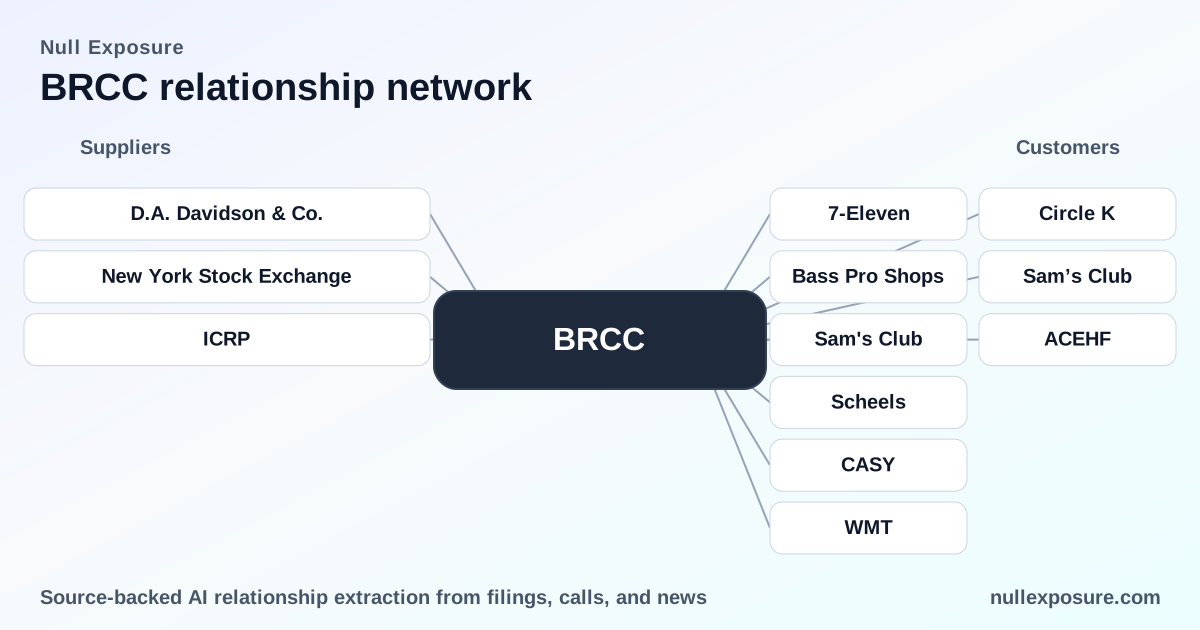
BRCC Customer Map: Who Sells Black Rifle Coffee and Why it Matters to Investors
BRC Inc. (BRCC) operates as a vertically oriented specialty coffee company that monetizes through three primary channels: a subscription-driven direct-to-consumer (DTC) Coffee Club, branded retail Outposts and merchandise, and a rapidly expanding Wholesale business supplying packaged coffee and ready-to-drink (RTD) beverages to large national and regional retailers. Revenue is increasingly concentrated in Wholesale (roughly $245.0M in 2024) while DTC remains a meaningful recurring base ($123.8M and ~190,400 active subscribers at year-end 2024), creating a hybrid model that blends sticky subscription economics with high-volume, lower-margin retail distribution. Learn more at https://nullexposure.com/.
Business model and operating constraints
BRCC’s go-to-market and contract posture combine elements of subscription retention and large-enterprise distribution. The Coffee Club is an established subscription product that drives repeat DTC revenue and customer lifetime value, while Wholesale relationships position BRCC for scale through national chains and convenience networks. According to the company’s FY2024 10‑K, the DTC channel “principally comprises revenue from our e-commerce websites and subscription services,” and the Coffee Club is explicitly subscription-based. Wholesale partnerships include food, drug and mass (FDM) retailers and convenience-store chains; the 10‑K lists Walmart and Sam’s Club as strategic entry points into mass retail.
Key operating signals investors should track:
- Concentration risk is high. BRCC discloses that a single Wholesale customer and affiliate represented 28% of consolidated net sales in 2024, signaling an elevated dependence on one large retail partner (company 10‑K, FY2024).
- Scale is driven by Wholesale. Wholesale generated $245.0M in 2024 compared with $123.8M from DTC, indicating the business is shifting resources toward distribution-led growth (company disclosures, FY2024).
- Contracting posture mixes subscription stability and reseller distribution. The Coffee Club provides recurring revenue, while many customers function as distributors/resellers for packaged and RTD products (10‑K, FY2024).
- Growth stage is ramping for Wholesale. Management describes distribution expansion as a priority, positioning Wholesale as the next lever for top-line acceleration (10‑K, FY2024).
Customer relationships — the full roster and what each means for BRCC
Below are all customer relationships mentioned in the available material, each summarized with its source.
Walmart / WMT
BRCC has an explicit partnership to enter the food, drug and mass retail channel through Walmart, which is cited as a major Wholesale partner helping scale national distribution. According to the FY2024 10‑K, the company expanded its Wholesale footprint “including entering the food, drug, and mass retail market through a partnership with Walmart.” (BRCC 10‑K, FY2024)
Sam’s Club
Sam’s Club is listed alongside Walmart as a Wholesale account for packaged coffee and RTD beverages, providing club-store reach and bulk sales channels that complement supermarket placement. The FY2024 10‑K includes Sam’s Club in the company’s Wholesale customer list. (BRCC 10‑K, FY2024)
7‑Eleven
7‑Eleven is named as a convenience-store channel partner for BRCC’s packaged coffee and RTD beverages, offering high-velocity point-of-sale exposure across urban and suburban sites. The FY2024 10‑K and subsequent news mentions include 7‑Eleven among convenience store partners. (BRCC 10‑K, FY2024; Intellectia news coverage, Mar 2026)
Casey’s General Store (CASY)
Casey’s appears in BRCC’s Wholesale roster as a convenience-store customer, representing regional convenience distribution and incremental RTD and single-serve sales. This relationship is cited in market commentary and the company’s Wholesale description. (Intellectia news coverage, Mar 2026)
Circle K
Circle K is identified as a convenience-store outlet for BRCC’s RTD and packaged products, strengthening the company’s footprint in high-traffic convenience retail. The company’s Wholesale channel listing includes Circle K. (Intellectia news coverage, Mar 2026)
Bass Pro Shops
Bass Pro Shops is mentioned as a specialty retail partner selling BRCC coffee, apparel, and gear, highlighting cross-category retail placements beyond grocery and convenience channels. The FY2024 10‑K lists Bass Pro Shops among specialty retailers. (BRCC 10‑K, FY2024)
Scheels
Scheels, another specialty retailer, carries BRCC coffee, apparel, and branded gear, providing exposure to outdoor/specialty consumers that align with the brand’s demographic. Scheels is called out in the FY2024 10‑K. (BRCC 10‑K, FY2024)
Ace Hardware (ACEHF)
Ace Hardware is listed among specialty retailers that stock BRCC coffee and branded merchandise, offering a nontraditional grocery outlet and reinforcing in-store diversification. The FY2024 10‑K references Ace Hardware in the specialty retailer category. (BRCC 10‑K, FY2024)
Department of the Interior (government contracts)
BRCC has at least some engagement with public-sector procurement: QuiverQuant lists an estimated government contracts figure tied to the Department of the Interior in 2024, indicating minor federal grant, loan, or purchase activity. The referenced entry shows an estimated quarterly amount awarded to BRCC from public contracts in early 2024. (QuiverQuant, May 2026)
Implications for investors and operators
- Concentration is the headline risk. A single Wholesale customer representing ~28% of sales in 2024 creates near-term revenue vulnerability if shelf placement, promotions, or contract terms change. This is a company-level material risk disclosed in the FY2024 10‑K.
- Wholesale is the growth engine but requires execution. The shift from DTC to Wholesale increases scale but lowers margin visibility; Wholesale delivered $245.0M in 2024 while DTC was $123.8M. Management will need to sustain retail shelf economics and promotional discipline to protect gross margins. (Company FY2024 disclosures)
- Subscription economics and brand loyalty are balancing forces. The Coffee Club’s ~190,400 active subscribers provide recurring revenue and a direct marketing channel that buffers Wholesale volatility. The subscription base also underpins cross-sell and higher-margin product push in DTC. (Company FY2024 disclosures)
- Operational complexity increases with reseller distribution. Managing relationships across FDM, club, convenience, and specialty retailers requires robust supply chain, trade promotion, and distributor coordination—areas investors should monitor through SG&A and fulfillment disclosures.
Mid-article note: For a deeper, consolidated view of BRCC’s customer exposure and how we surface counterparty concentration across public filings, visit https://nullexposure.com/.
Bottom line
BRCC’s revenue profile is now a two‑pillar construct: a recurring subscription DTC base that stabilizes cash flow, and a capital‑efficient Wholesale engine that scales revenue but concentrates counterparty risk. Investors should weigh the upside of broader retail distribution against the material single-customer exposure disclosed in the FY2024 10‑K, and track promotional cadence and shelf dynamics at Walmart, Sam’s Club and national convenience chains as early indicators of Wholesale stability.
Key takeaway: Wholesale expansion can accelerate top-line growth, but the 28% revenue concentration and the complexity of multi-channel retail execution are the primary corporate risks that determine whether incremental distribution translates into durable shareholder value.