BrilliA Inc (BRIA): Customer Map and Commercial Implications for Investors
BrilliA Inc. operates as a one-stop cross-border service and product partner for women's intimate apparel and athleisure brands, monetizing through turnkey services that span sourcing, design, prototyping, supply-chain coordination, quality control and commercial collaborations. The company generates revenue by supplying finished products to global brand customers and by structuring regional commercial partnerships through its subsidiary Bra Pro Limited. For investors, the growth story depends on scaling brand relationships while maintaining margin control in manufacturing and logistics. Learn more about our coverage at https://nullexposure.com/.
How BrilliA wins business and where the money comes from
BrilliA positions itself between global brand owners and independent manufacturing facilities, billing for services and supplied goods rather than selling a technology license. Revenue drivers are product sales to large branded customers and fees for end-to-end sourcing and quality control services, with incremental upside from brand collaborations and regional market entries (e.g., Japan). The company’s recent IPO and dividend declarations reflect an operational transition toward public-market discipline and shareholder returns (GlobeNewswire; Investing.com, 2024–2026).
Who BrilliA counts as customers and partners — a compact walkthrough
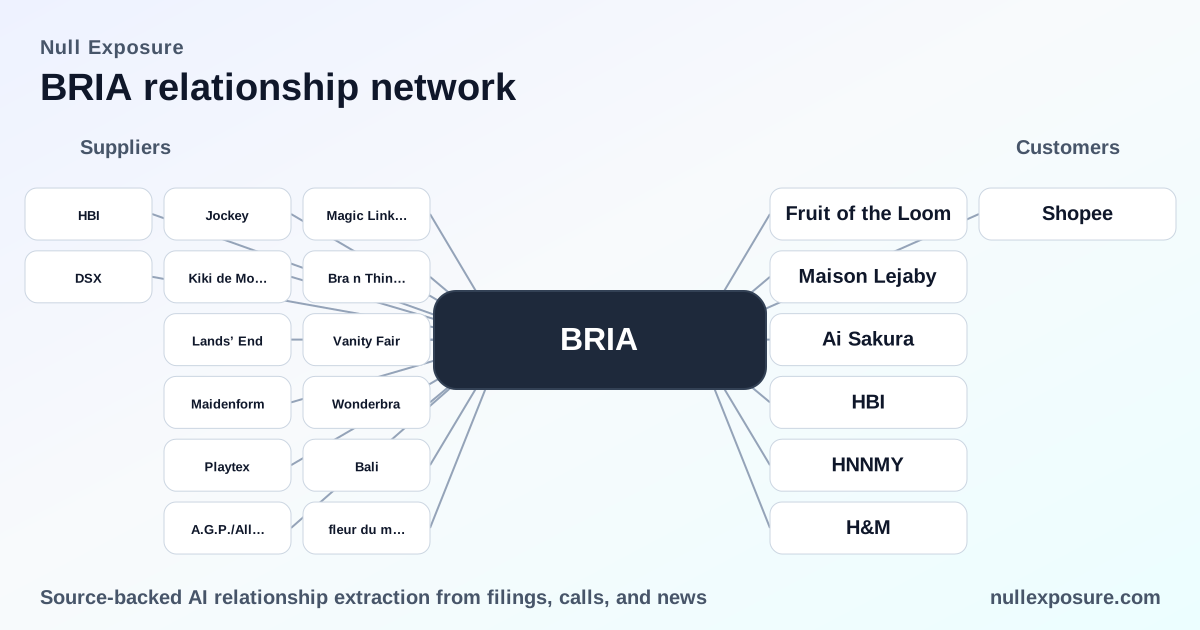
Below I cover every customer relationship surfaced in the results. Each entry is a plain-English summary followed by a concise source reference.
Shopee
BrilliA distributes product through e-commerce marketplaces and social channels, including Shopee as one of its online retail channels for consumer sales and marketplace exposure (FY2024). (See Simply Wall St coverage of BrilliA retail channels: https://simplywall.st/stocks/us/retail/nysemkt-bria/brillia)
Fruit of the Loom
BrilliA manages sales and customer relationships with Fruit of the Loom as a large international client, handling sourcing, quality control and supply-chain tasks for intimate apparel delivered under the Fruit of the Loom brand (mentioned across FY2024–FY2025 press coverage). (Investor news and company releases: https://www.investing.com/news/company-news/brillia-declares-0133-per-share-cash-dividend-payable-september-30-93CH-4222780; https://www.globenewswire.com/news-release/2024/11/29/2989215/0/en/BrilliA-Inc-Announces-Closing-of-Initial-Public-Offering.html)
Hanes Brands Inc. (HBI)
Hanes Brands is listed repeatedly as a major international client for which BrilliA provides sourcing, prototyping and supply-chain management services; BrilliA cites Hanes alongside other global customers as part of its commercial footprint (FY2024–FY2025). (Company announcements and market coverage: https://finance.yahoo.com/news/brillia-inc-announces-closing-initial-162600871.html; https://www.investing.com/news/company-news/brillia-declares-0133-per-share-cash-dividend-payable-september-30-93CH-4222780)
H&M
BrilliA reports H&M among its major clients, with relationships described in IPO and subsequent releases as part of the company’s global sales and customer-management scope for intimate apparel (FY2024–FY2025). (Press releases and filings: https://www.globenewswire.com/news-release/2024/11/29/2989215/0/en/BrilliA-Inc-Announces-Closing-of-Initial-Public-Offering.html; https://finance.yahoo.com/news/brillia-inc-announces-pricing-initial-014500326.html)
Maison Lejaby
BrilliA, through subsidiary Bra Pro Limited, entered a formal partnership to supply intimate apparel products aligned with Maison Lejaby’s requirements — an arrangement that anticipates product value up to €10 million and includes bras, panties, bodysuits, sleepwear and swimwear (FY2024–FY2025). This is a strategic higher-end European relationship that signals BrilliA’s capability to service luxury and premium brands. (Partnership announcement and commercial terms: https://www.stocktitan.net/news/BRIA/; https://www.globenewswire.com/news-release/2025/02/14/3026649/0/en/BrilliA-Establishes-Cooperation-Framework-with-Top-French-Luxury-Brand-and-Lands-European-Introduction-for-In-House-DIANA-Brand.html)
Ai Sakura (Japan expansion)
BrilliA’s subsidiary Bra Pro Limited announced a commercial collaboration with Tokyo-based Ai Sakura to expand into Japan’s higher-margin athleisure market, demonstrating a strategic channel and regional growth play beyond pure intimate apparel (FY2026). This transaction highlights BrilliA’s shift into performance and athleisure segments where margins and retail pricing power are typically stronger. (Japan market expansion release: https://www.stocktitan.net/news/BRIA/brilli-a-expands-into-japan-s-athleisure-8gccvz02g1at.html)
Operating model constraints and company-level signals
No explicit constraints were listed in the relationship feed; however, the relationship data implies several company-level operating characteristics investors must weigh:
- Contracting posture: BrilliA operates as a vendor and service integrator rather than licensing technology, which means contracts are transactional and execution-focused, emphasizing quality control, logistics commitments and supply reliability.
- Concentration and diversification: While BrilliA lists several major global clients (Hanes, H&M, Fruit of the Loom) and a roster of more than 30 intimate apparel brands, revenue risk concentrates around large brands and a small number of high-value partnerships; diversification into European luxury (Maison Lejaby) and Japanese athleisure (Ai Sakura) reduces single-market exposure.
- Criticality to customers: BrilliA provides mission-critical supply-chain and quality assurance services for customers that outsource manufacturing oversight; that operational criticality supports stickiness but requires adherence to strict delivery and quality KPIs.
- Stage and maturity: The firm recently completed an IPO and has begun public reporting and dividend payments, indicating a transition from private growth operations to public-market accountability, which changes capital allocation, disclosure expectations and margin pressure.
Investment implications: where to focus due diligence
- Revenue quality: Confirm the revenue mix between long-term commercial supply agreements and one-off product runs; major-brand concentration can amplify volatility if a contract lapses.
- Margin durability: Manufacturing and logistics inflation compresses margins; the premium athleisure and luxury partnerships are the clearest path to margin expansion.
- Operational execution: Quality control failures or logistic disruptions would be immediately consequential given BrilliA’s role as an integrator for brand clients.
- Governance and ownership: High insider ownership (data shows significant insider percentage) aligns management with shareholders but can reduce free float and institutional engagement; monitor insider selling patterns and board independence.
Visit https://nullexposure.com/ if you want a structured briefing and access to our relationship analytics and alerting for BRIA.
Bottom line
BrilliA’s commercial model is execution-heavy and customer-driven: the company sells a combination of finished goods and integrated sourcing-to-delivery services to major brands while pursuing higher-margin brand partnerships and regional rollouts. The dual opportunities are scale in global retail channels and margin expansion through premium partnerships; the primary risks are customer concentration and operational execution in manufacturing and logistics. Investors should prioritize contract terms, revenue concentration, and proof of durable margin improvement when evaluating BRIA.