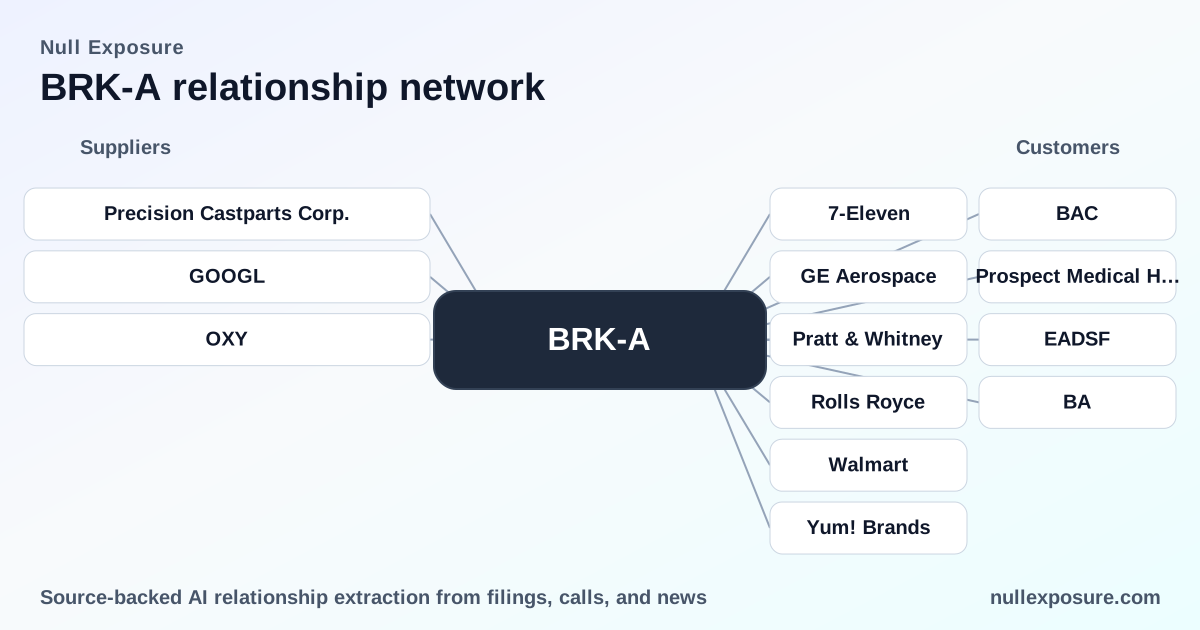
Berkshire Hathaway (BRK‑A): How its customer relationships shape valuation and risk
Berkshire Hathaway monetizes through a diversified portfolio of wholly owned operating businesses and equity holdings: it underwrites insurance premiums and invests float, controls industrial manufacturers and distributors, operates regulated utilities and railroads, and owns retail and service businesses that generate recurring cash flow. Value for investors derives from stable insurance float, high-margin industrial cash flows, and concentrated distribution relationships that drive predictable revenue, while risk is concentrated in a handful of large commercial customers and U.S. geographic exposure. Explore the full company profile at https://nullexposure.com/ for the underlying filings and mapped relationships.
Why customer relationships matter for a conglomerate investor
Berkshire is effectively a holding company that profits when its operating subsidiaries maintain durable, high-margin customer channels and predictable contract terms. Large, long-term contracts in energy and infrastructure, deep reseller and distributor networks for manufacturing and retail brands, and concentrated accounts in wholesale distribution are core drivers of free cash flow stability. Conversely, revenue concentration with a small number of major customers — and heavy U.S. revenue weighting — creates idiosyncratic counterparty risk that investors must price.
Operating model signals investors should read into
- Contracting posture: Evidence shows a mix of long‑term contracts (notably in independent power projects and regulated utilities) alongside transactional reseller and wholesale distribution arrangements; this hybrid posture provides both predictable base revenues and cyclical upside. According to Berkshire's disclosures, independent power projects sell power under long‑term contracts, while U.S. utilities supply retail customers with regulated margins.
- Concentration and criticality: McLane’s top customers (Walmart, 7‑Eleven, Yum!) generate a sizable share of its revenues, signaling potential concentration risk in the wholesale distribution segment. Separately, BNSF and utility assets are critical infrastructure businesses whose revenues and margins are less cyclically volatile.
- Counterparty mix and maturity: Berkshire’s book includes relationships with individual retail insurance buyers (GEICO), small businesses (BH Direct commercial lines), and very large enterprises (IMC customers in aerospace and automotive), indicating a multi‑tier customer base across maturity stages and bargaining power.
- Geographic exposure: North America is the dominant revenue source (about 86% of sales, service and leasing revenues in 2024), concentrating macro and regulatory risk in the U.S. market.
- Go‑to‑market roles: Subsidiaries operate as resellers, distributors, manufacturers and service providers — with distribution channels (McLane, Pilot, dealer networks) particularly important for consumer and retail-facing brands.
Customer relationships: company-by-company detail
7‑Eleven
McLane identified 7‑Eleven as a major customer, accounting for roughly 13.2% of McLane’s revenues in 2024, highlighting a meaningful dependency of Berkshire’s wholesale channel on convenience-store chains. According to Berkshire Hathaway’s 2024 Form 10‑K, McLane’s customer mix lists 7‑Eleven among its top accounts.
Walmart
Walmart represented approximately 17.3% of McLane’s revenues in 2024, making it McLane’s largest single account and a material concentration for Berkshire’s distribution economics. This figure is disclosed in Berkshire Hathaway’s 2024 Form 10‑K.
Yum! Brands
Yum! Brands accounted for about 12.5% of McLane’s revenues in 2024, reinforcing that quick‑service restaurant chains are a core end market for Berkshire’s wholesale distribution business. This is noted in Berkshire Hathaway’s 2024 Form 10‑K.
GE Aerospace
PCC (Precision Castparts Company) lists GE Aerospace among significant customers as an engine‑manufacturer supplier, positioning Berkshire as a supplier into major aerospace OEM supply chains. The relationship is described in Berkshire Hathaway’s 2024 Form 10‑K discussion of PCC customers.
Pratt & Whitney
Pratt & Whitney is named with GE and Rolls‑Royce as a significant customer of PCC, indicating exposure to major aircraft‑engine OEM demand and aftermarket cycles. This appears in the 2024 Form 10‑K.
Rolls‑Royce
Rolls‑Royce is listed alongside other engine manufacturers as a PCC customer, which places Berkshire in the multi‑vendor engine supply ecosystem serving global airframers. See Berkshire Hathaway’s 2024 Form 10‑K.
Airbus
Airbus is cited as an OEM customer for PCC, confirming direct exposure to airframe production volumes and long procurement cycles. This is included in the 2024 Form 10‑K.
Boeing
Boeing is identified as a major OEM customer of PCC, tying Berkshire’s industrial segment performance to large commercial aircraft production and aftermarket demand. This is documented in the 2024 Form 10‑K.
BA (duplicate Boeing entry)
Berkshire’s disclosures include a duplicate listing for BA (Boeing), reflecting the same PCC customer set; the duplicate reinforces Boeing’s prominence in the aerospace customer roster reported in the 2024 Form 10‑K.
Bank of America (BAC)
Contemporary news coverage recalled Berkshire’s capital support to Bank of America — historically a $5 billion infusion in 2011 — and recent reporting discusses Berkshire leadership decisions regarding BAC exposure. A Globe and Mail report (March 2026) and associated news summaries referenced this Bank of America link in the context of Warren Buffett’s dealings.
Prospect Medical Holdings Inc.
Berkshire’s insurance affiliates objected to Prospect Medical’s bankruptcy exit plan, arguing that the plan infringes on carrier rights under insurance contracts and nonbankruptcy law, signaling active claims‑management and contract enforcement behavior by Berkshire’s insurance units. Bloomberg Law reported on the carriers’ objection in March 2026.
What investors should infer from these relationships
- Revenue concentration risk is real in McLane: three customers alone (Walmart, 7‑Eleven, Yum!) accounted for the bulk of McLane’s disclosed major customers, signaling bargaining leverage and potential downside if large accounts reprice or shift supply.
- Industrial exposure ties Berkshire to aerospace cycles: PCC’s customer list (Boeing, Airbus, GE Aerospace, Rolls‑Royce, Pratt & Whitney) means Berkshire’s manufacturing cash flows are sensitive to commercial aerospace demand and supply‑chain normalization.
- Insurance operations span retail and commercial markets: GEICO’s business model targets individual auto policies while BH Direct addresses small business commercial lines, providing diversification across counterparty types and claims profiles.
- Regulated and infrastructure assets are margins anchors: BNSF and U.S. regulated utilities provide durable, lower‑volatility earnings that stabilize conglomerate free cash flow.
- Geographic concentration compresses diversification benefits: With roughly 86% of sales attributable to the U.S., economic, regulatory, and weather‑related shocks in North America will disproportionately affect consolidated results.
Investment implications and final takeaways
- Positive: Diversified operating roles and strong distribution networks underpin recurring cash flow and provide multiple pathways to redeploy float into high‑return businesses.
- Negative: Customer concentration in wholesale distribution and aerospace cyclicality create idiosyncratic risk premiums that should be reflected in valuation, especially given Berkshire’s substantial U.S. exposure.
- Actionable signal: Monitor McLane account retention/contract renewals and backlogs at PCC to gauge short‑term revenue risk; track regulatory outcomes and utility rate cases for BNSF and BHE to assess earnings durability.
For deeper mapping of these relationships and the primary sources cited in filings and contemporaneous reporting, see the full company profile at https://nullexposure.com/.
Boldly factoring these customer dynamics into your model will sharpen estimates of Berkshire’s operating leverage and downside scenarios.