Berkshire Hathaway (BRK‑B): Customer Relationships that Drive Scale and Resilience
Berkshire Hathaway operates as a diversified holding company that monetizes through three core engines: insurance underwriting and investment float, cash‑generating operating subsidiaries (railroads, utilities, manufacturing and retail), and long‑term ownership of public equities. The firm collects premiums and investment income, sells products and services across dozens of industries, and leases equipment and real estate under both fixed and variable structures. For deeper company signals and relationship mapping visit https://nullexposure.com/.
Why customers matter for Berkshire’s valuation and risk profile
Berkshire’s revenue and free cash flow depend less on single product cycles and more on the contracting patterns and counterparty mix across its operating businesses. The public filings and news in this review show a clear tilt toward:
- Long‑term, contracted revenue streams (rail, utility, power purchase and equipment leasing) that underpin predictable cash flows.
- Large enterprise counterparties in manufacturing and distribution channels, alongside mass‑market retail exposures via GEICO and branded consumer businesses.
- A North American revenue concentration, with substantial global insurance reach for certain lines.
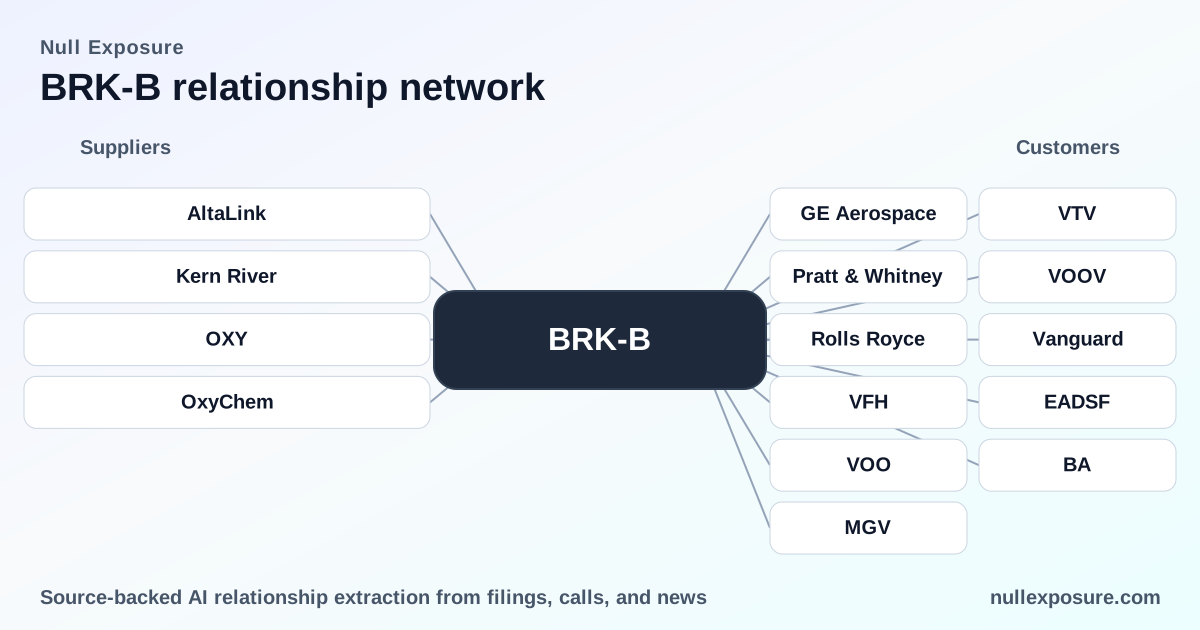
Below I summarize every named customer or counterparty found in the records and what each relationship implies for investors and operators.
What the reported relationships are and why they matter
GE Aerospace
Precision Castparts Company (PCC), a Berkshire subsidiary, lists GE Aerospace as a significant customer in FY2024; this reflects PCC’s role as a supplier into engine manufacturers and the strategic importance of aerospace OEM relationships for Berkshire’s manufacturing segment. According to Berkshire Hathaway’s 2024 Form 10‑K (brk‑b‑2024‑12‑31, FY2024).
Pratt & Whitney
PCC identifies Pratt & Whitney among its key engine‑supplier customers in FY2024, reinforcing PCC’s exposure to global aero engine supply chains and the defense/commercial aerospace demand cycle. (Berkshire Hathaway 2024 Form 10‑K, FY2024.)
Rolls Royce
Rolls Royce is named as another engine‑supplier customer for PCC in the 2024 filing, indicating PCC’s diversified OEM customer base across U.S. and international engine makers. (Berkshire Hathaway 2024 Form 10‑K, FY2024.)
Airbus
Airbus appears in PCC’s customer list for FY2024, representing direct OEM exposure to major airframe manufacturers and the corresponding sensitivity to aircraft production rates. (Berkshire Hathaway 2024 Form 10‑K, FY2024.)
Boeing
Boeing is listed by PCC as a significant OEM customer in the FY2024 filing, underscoring PCC’s material revenue linkage to the world’s largest commercial airframe manufacturer. (Berkshire Hathaway 2024 Form 10‑K, FY2024.)
BA
The search results also include a duplicate listing labeled “BA” (inferred symbol BA) tied to the same PCC customer excerpt; this is the same Boeing relationship captured twice in the FY2024 10‑K. (Berkshire Hathaway 2024 Form 10‑K, FY2024.)
Microsoft Corporation (MSFT)
A May 2026 news summary attributes Microsoft’s acquisition of Activision Blizzard to a transaction involving Berkshire and other investors; this reflects occasional secondary market or private equity‑style dispositions where Berkshire participates as an investor or co‑seller. (SimplyWallSt summary, May 2026.)
VOOV (Vanguard S&P 500 Value ETF)
VOOV is cited in a 2024‑era investment writeup as one of several ETFs that hold Berkshire shares, indicating passive institutional ownership that supports liquidity and price discovery for BRK‑B. (The Globe and Mail / Motley Fool summary, March 2026 referencing FY2024 data.)
MGV (Vanguard Mega Cap Value ETF)
MGV is listed among ETFs holding Berkshire in the same March 2026 fund roundup, showing Berkshire’s inclusion in multiple value‑oriented ETF sleeves and the consequential passive flows. (The Globe and Mail / Motley Fool, March 2026.)
VOO (Vanguard S&P 500 ETF)
VOO is identified as a holding vehicle for Berkshire stock in the market commentary, confirming BRK‑B’s presence in core S&P 500‑linked ETFs and index demand channels. (The Globe and Mail / Motley Fool, March 2026.)
Vanguard Financials ETF (VFH)
VFH is documented as an ETF with material exposure to Berkshire, highlighting sector ETF ownership concentration and financial‑sector indexers’ contribution to BRK‑B share ownership. (The Globe and Mail / Motley Fool, March 2026.)
Vanguard Mega Cap Value ETF (duplicate MGV entry)
The entry for Vanguard Mega Cap Value ETF appears twice in the source list; it reiterates the fund’s position in BRK‑B across March 2026 commentary. (The Globe and Mail / Motley Fool, March 2026.)
Vanguard S&P 500 Value ETF (duplicate VOOV)
A second VOOV listing duplicates the ETF holding callout from the March 2026 piece and confirms multiple mentions of value ETF ownership. (The Globe and Mail / Motley Fool, March 2026.)
Vanguard S&P 500 ETF (duplicate VOO)
A second VOO listing duplicates the S&P 500 ETF reference and reinforces index ownership as a stable demand source for BRK‑B. (The Globe and Mail / Motley Fool, March 2026.)
Vanguard Value ETF (VTV)
VTV is referenced among ETFs that include Berkshire stock, signaling another dimension of passive value exposure supporting BRK‑B share liquidity. (The Globe and Mail / Motley Fool, March 2026.)
Vanguard (the company)
The broader Vanguard organization is named as an institutional holder and issuer of ETFs that own Berkshire, indicating large institutional custody and index distribution channels behind BRK‑B equity ownership. (The Globe and Mail / Motley Fool, March 2026.)
GIC Real Estate, Inc.
A SimplyWallSt note from May 2026 reports GIC Real Estate as a buyer with Oak Street in a transaction that included STORE Capital, previously held by Berkshire and others, illustrating Berkshire’s occasional portfolio exits in real estate investments. (SimplyWallSt summary, May 2026.)
Oak Street Real Estate Capital, LLC
Oak Street partnered with GIC Real Estate to acquire STORE Capital from Berkshire and co‑sellers, reflecting completed real estate dispositions involving Berkshire stakes. (SimplyWallSt summary, May 2026.)
Operating‑model constraints and what they signal for investors
The filings produce company‑level signals about how Berkshire runs its businesses:
- Contracting posture: Berkshire generates a meaningful share of revenue from long‑term contracts (railcar leases, power purchase arrangements and utility contracts) alongside significant usage‑based variable lease revenues—evidence comes from the operating lease and unsatisfied performance obligation disclosures in the FY2024 Form 10‑K. These attributes translate to predictable baseline cash flows with incremental upside from usage variability.
- Counterparty mix: The business combines large enterprise counterparties (manufacturing OEMs, global energy and utility customers) with individual retail customers through GEICO, producing a balanced risk profile between concentrated commercial accounts and high‑volume retail exposures.
- Geography: North America is dominant for sales, service and leasing revenues, while insurance operations retain global underwriting reach—this concentration focuses operational and regulatory risk in U.S. markets while preserving insurance diversification worldwide.
- Role diversity: Berkshire acts as service provider, distributor, reseller and seller across subsidiaries—this breadth reduces single‑mode risk but increases operational complexity for management.
For more granular relationship mapping and signal extraction, explore the full platform: https://nullexposure.com/.
Key takeaways for investors and operators
- Berkshire’s cash flows are anchored by durable, long‑term contracts (rail, utilities, equipment leases) with embedded variable revenue lines that boost upside.
- Large OEM customers (aerospace names) create industrial exposure that tracks aircraft cycles; passive ETF ownership supplies stable equity demand.
- Geographic concentration in North America concentrates macro and regulatory risk domestically even as insurance operations retain global exposures.
If you evaluate counterparties, allocate diligence to Berkshire’s subsidiary contracts (lease terms, renewal practices, and OEM supply agreements) because those details drive near‑term cash flow volatility and long‑term resilience. For ongoing monitoring and to map these relationships programmatically, visit https://nullexposure.com/.