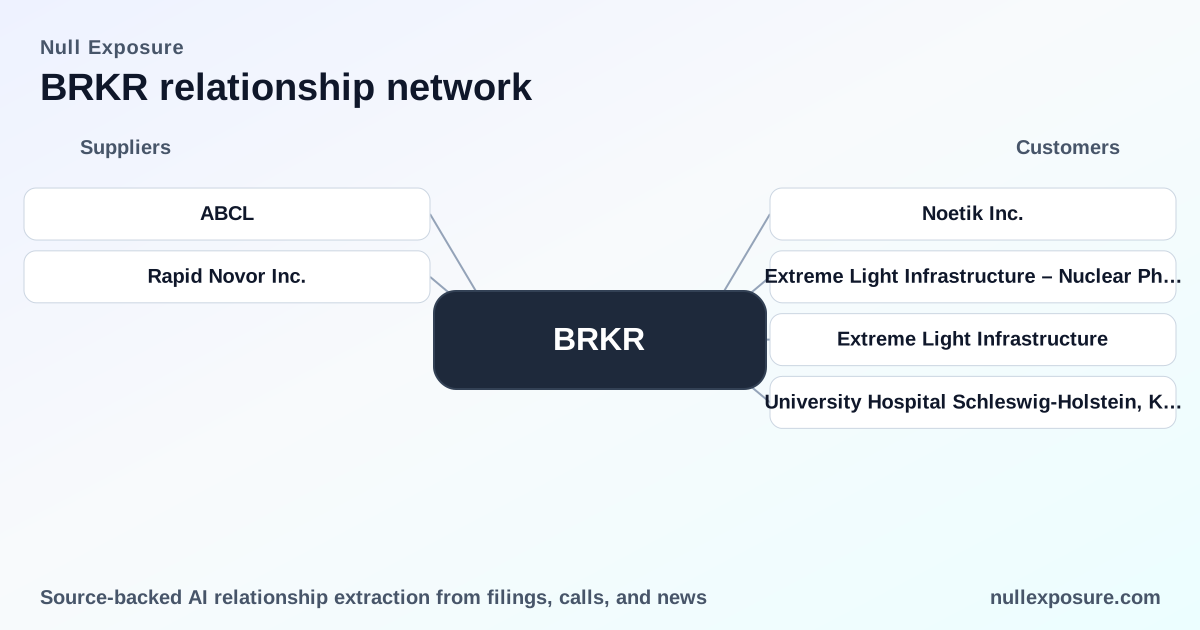
Bruker (BRKR): Customer relationships that underpin recurring science revenue
Bruker monetizes by selling and servicing high‑end scientific instruments and by capturing recurring consumables and service revenue tied to multi‑year reagent and rental arrangements; the business combines one‑time system sales with high‑margin, recurring streams from assays, maintenance and long‑term customer commitments. With global direct and indirect sales coverage, institutional and government accounts alongside pharma and academic labs drive both steady consumables demand and episodic large project wins that lift near‑term top line. For a deeper view on how customer wins translate to revenue and operational risk, visit https://nullexposure.com/.
How Bruker’s commercial model converts instruments into recurring cash flow
Bruker sells complex analytical and diagnostic instrumentation and then locks in recurring economics through reagent agreements, service contracts, and multi‑year rentals. Multi‑year reagent and rental contracts provide predictable lifetime value from each installed instrument, while the company also leverages distributors and value‑added resellers to reach diverse end markets. Bruker reported Revenue TTM of $3.436B and a market capitalization near $5.54B, underscoring a mid‑cap industrial scale where recurring consumables materially supplement capital equipment sales.
Key operating characteristics:
- Contracting posture: Evidence points to long‑term customer commitments that convert installed base into recurring reagent and service revenue through multi‑year minimum purchase agreements.
- Customer concentration: No single customer accounted for more than 10% of revenue through 2024, which is a meaningful diversification signal.
- Channel mix and roles: Bruker acts as manufacturer and seller, while also using third‑party distributors, resellers and value‑added partners; it also receives customer advances backed by bank guarantees, indicating advanced ordering and customer deposit risk management.
- Global reach but regional exposure: Direct sales forces cover North America, Europe, China, Japan and broader APAC; reported regional revenue lines show material exposure to the United States, Europe (including Germany) and China.
A concise catalog of reported customer relationships
Below I list every relationship flagged in the available coverage and summarize the business relevance in plain English.
Noetik Inc.
Noetik expanded its collaboration with Bruker to image thousands more patients using the CosMx whole transcriptome assay to train tissue‑based models, reflecting adoption of Bruker’s spatial biology consumables and platform in AI‑led translational research (StockTitan news, March 9, 2026).
TCRT (Alaunos Therapeutics study)
Alaunos reported that body composition in preclinical work was measured using a Bruker Minispec LF90II body composition analyzer, demonstrating Bruker’s role as a supplier of validated preclinical instrumentation used in drug development workflows (Yahoo Finance, May 4, 2026).
AXDX (Accelerate Diagnostics)
Accelerate Diagnostics referenced an automated platform designed for use with Bruker’s MALDI Biotyper CA System, highlighting integration of Bruker diagnostics into clinical microbiology automation to reduce diagnostic turnaround times (AXDX earnings call transcript, Q3 2024).
Extreme Light Infrastructure (research programs)
Bruker’s research instruments business booked more than $40 million in orders to supply enabling technology for the Extreme Light Infrastructure project, representing a strategic large order for high‑end research infrastructure that will translate to revenue mostly in late 2026 (Bruker earnings commentary reported on InsiderMonkey, March 2026).
Extreme Light Infrastructure – Nuclear Physics (ELI‑NP)
Bruker’s majority‑owned RI Research Instruments secured approximately €35 million of orders for the ELI‑NP project in Romania, indicating a discrete, sizable project sale that establishes a new revenue stream within advanced scientific infrastructure (SimplyWall report, March 2026).
University Hospital Schleswig‑Holstein, Kiel (UKSH)
UKSH is deploying Bruker’s CellScape platform to develop translational predictive and prognostic spatial‑omics panels and AI‑informed signatures for solid tumors, signaling hospital and clinical research uptake of Bruker spatial‑omics solutions (StockTitan news, March 9, 2026).
Hitachi High‑Tech
ElitechGroup (a Bruker company) and Hitachi High‑Tech collaborated on the MyGenius PRO platform; Hitachi High‑Tech will market the system in Japan as the LABOSPECT GA‑5 with Bruker molecular diagnostic assays included, demonstrating channel partnerships and localized regulatory commercialization in Japan (FT Markets / Business Wire announcement, May 2, 2026).
What these relationships say about risk and opportunity
- Recurring revenue engine is real: Multiple customer citations reference assays, analyzers and platform deployments—this confirms that Bruker extracts recurring economics from consumables and software tied to instruments.
- Large project wins lift volatility but are manageable: Orders like the €35M ELI‑NP and $40M ELI research bookings create step‑function revenue additions; such projects are material to quarterly flows but do not invalidate the company’s stated diversification (no customer >10% of revenue).
- High criticality customers are mission‑driven: Government, academic and large research infrastructure programs (ELI, UKSH) represent high‑value accounts that prioritize precision and long procurement cycles—this drives long sales cycles but durable revenue once installed.
- Channel and geographic breadth reduces single‑point risk: Direct sales in North America, Europe, China and Japan, combined with distributors and resellers, support global demand and localized regulatory commercialization (e.g., Hitachi High‑Tech in Japan).
Investment implications and points to watch
- Growth levers: Expansion of spatial‑omics (CellScape, CosMx), diagnostic integrations (MALDI Biotyper CA), and major research infrastructure projects are primary top‑line drivers.
- Stability levers: Long‑term reagent agreements and service contracts provide recurring, higher‑margin cash flows that improve lifetime customer economics.
- Risk vectors: Dependence on multi‑year capital projects creates revenue timing risk; customer advances and bank guarantees indicate some exposure to delivery and warranty obligations.
- Scale: Bruker’s Revenue TTM of $3.436B and elevated institutional ownership imply stewardship of a complex business that oscillates between capital sales and consumable annuities.
For investors modeling Bruker, the interplay between one‑time instrument sales and the recurring consumables/services book is the central valuation lever. If you want more structured tracking of customer trajectories and order flow, see additional research and tools at https://nullexposure.com/.
Bruker’s customer citations show a company that is simultaneously an OEM, channel partner and service provider to high‑value scientific and clinical customers—this combination underpins durable recurring revenue but requires monitoring of large project cadence and regional regulatory commercialization.