Direxion Daily BRKB Bull 2X Shares (BRKU): Who’s Trading It and What That Reveals
BRKU is a leveraged exchange-traded product that monetizes through its expense structure and trading activity, with liquidity provision and creation/redemption flows driving daily volume and fee capture. As a 2x long exposure vehicle on BRK.B, its economics depend on active market-making, institutional positioning, and short-interest dynamics rather than long-term buy-and-hold investor income. Understanding which firms hold or trade BRKU provides direct insight into the product’s liquidity profile, counterparty reliance, and sensitivity to intraday trading flows.
If you want a consolidated view of customer-level signals and how they influence product dynamics, visit https://nullexposure.com/ for additional coverage and dataset-backed commentary.
What the current investor roster tells a research-driven operator
BRKU’s investor list in recent filings and market alerts is dominated by trading firms and smaller fiduciary positions rather than large passive allocators. That composition is typical for leveraged ETFs, where market makers and proprietary trading desks provide the bulk of daily liquidity and act as primary counterparties for creation/redemption activity. The presence and trading patterns of those counterparties directly affect spreads, rebalancing costs, and the product’s ability to track its leveraged objective.
Relationship roster — who’s on the tape (and what they did)
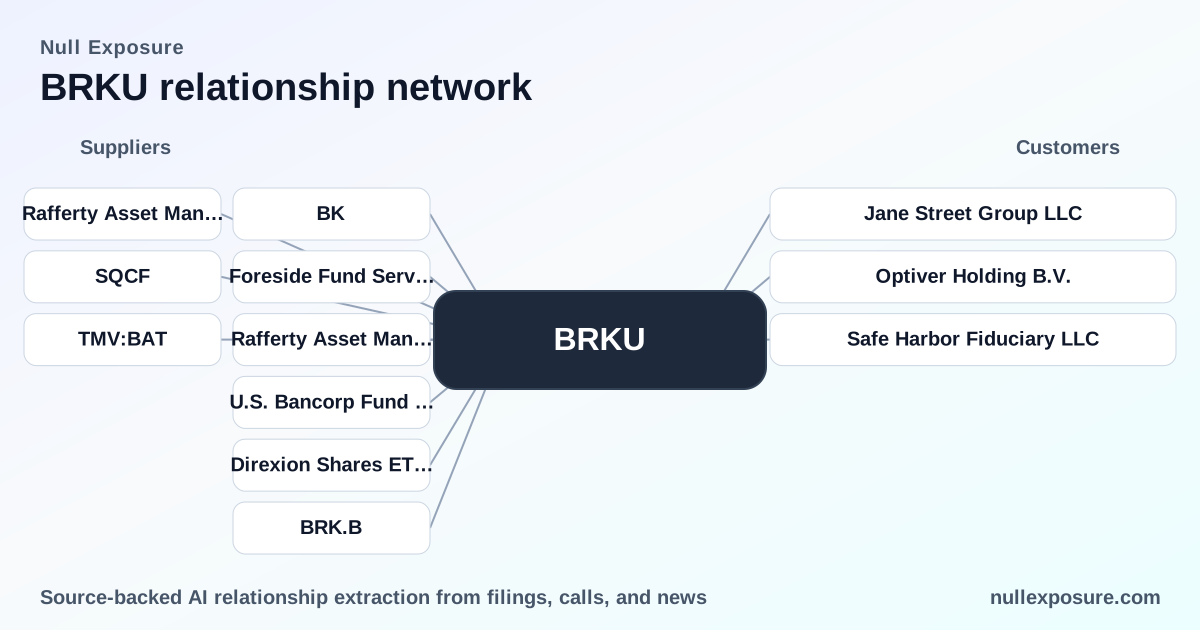
Jane Street Group LLC
Jane Street raised its holdings in Direxion Daily BRKB Bull 2X Shares by 350.5% in the first quarter of FY2026, indicating a substantial increase in participation from a major liquidity provider. According to a MarketBeat instant alert (Feb. 25, 2026), this move signals heightened activity from a global market maker that routinely supplies two-sided liquidity in leveraged products. (Source: MarketBeat instant alert, Feb 25, 2026 — https://www.marketbeat.com/instant-alerts/direxion-daily-brkb-bull-2x-shares-nasdaqbrku-short-interest-down-846-in-february-2026-02-25/)
Optiver Holding B.V.
Optiver purchased a new stake in BRKU during the third quarter valued at approximately $139,000, representing an entry by another principal trading and market-making firm. MarketBeat captured this as a new position established in Q3 FY2026, which underscores continued interest from algorithmic liquidity providers. (Source: MarketBeat instant alert, Feb 25, 2026 — https://www.marketbeat.com/instant-alerts/direxion-daily-brkb-bull-2x-shares-nasdaqbrku-short-interest-down-846-in-february-2026-02-25/)
Safe Harbor Fiduciary LLC
Safe Harbor Fiduciary added a new position in BRKU in the fourth quarter worth about $25,000, reflecting a modest allocation by a smaller fiduciary/advisory firm rather than a large institutional holder. MarketBeat’s reporting lists this as a Q4 purchase, suggesting some demand from fee-based managers or niche advisors alongside the larger trading houses. (Source: MarketBeat instant alert, Feb 25, 2026 — https://www.marketbeat.com/instant-alerts/direxion-daily-brkb-bull-2x-shares-nasdaqbrku-short-interest-down-846-in-february-2026-02-25/)
Operating-model constraints and company-level signals
No formal constraint excerpts were provided in the customer data; however, the observable relationship mix and product type imply several company-level characteristics that investors and operators should treat as structural:
-
Contracting posture — short-horizon, transactional: BRKU’s counterparties operate on intraday and short-horizon timeframes. Contracts and operational relationships are therefore transactional and highly responsive to market volatility and spread dynamics rather than long-term custody agreements.
-
Concentration — dispersed among trading firms, not concentrated holders: The identified positions are modest and operated by multiple firms, indicating low concentration among buy-and-hold investors. This reduces single-counterparty counterparty risk but increases dependence on professional market makers for liquidity.
-
Criticality — market-making counterparties are critical to daily functioning: While no single holder dominates, market makers (represented here by Jane Street and Optiver) are critical for spread management and creation/redemption efficiency; interruptions in their activity would materially widen spreads and impair intraday liquidity.
-
Maturity — product-level maturity with active trading strategies: Leveraged ETFs are a mature product class with well-understood operational processes; the presence of established liquidity providers is a signal of normal market functioning rather than early-stage distribution risk.
-
Operational complexity — derivatives and rebalancing exposure: The leveraged structure implies daily rebalancing costs and derivative counterparty relationships; these are implicit company-level constraints that affect tracking error and require robust risk management.
If you want to map these counterparty behaviors into exposure models or monitor changes in real time, more granular position data is available at https://nullexposure.com/.
Investment implications — what investors should watch
-
Liquidity is provider-driven. The enlarged stake by a major market maker like Jane Street is a positive for intraday bid/ask tightness and creation/redemption responsiveness, but liquidity quality depends on continued participation by these firms.
-
Concentration risk is operational rather than ownership-based. Even with relatively small classical holdings, the product’s health depends on a handful of professional counterparties performing market-making duties.
-
Short-interest and trading flows matter more than long-term allocations. MarketBeat’s headline on the same coverage noted a meaningful shift in short-interest metrics in February 2026, which feeds directly into leveraged ETF dynamics and short-term volatility.
-
Small fiduciary positions reflect limited buy-and-hold demand. Positions like Safe Harbor’s $25,000 allocation illustrate that BRKU attracts tactical or niche usages rather than strategic asset-allocation commitments.
Key near-term indicators to monitor:
- Changes in reported holdings by market-making firms.
- Short-interest movements and intraday volume spikes.
- Bid/ask spread trends and creation/redemption activity reported by the issuer.
Bottom line
BRKU functions as a short-horizon trading vehicle whose liquidity and tracking performance are directly shaped by a small ecosystem of market makers and trading firms. The recent activity — a large increase from Jane Street, a new stake from Optiver, and minor fiduciary interest — confirms that the product’s operational health hinges on active professional counterparties rather than large passive holders. For research teams and operators, the priority is to track counterparty participation, spread behavior, and short-interest flows, not only headline AUM.
For deeper counterparty maps and ongoing updates on BRKU relationships, explore the full coverage at https://nullexposure.com/.