Barnwell Industries (BRN): Customer Relationships, Commercial Posture, and What Investors Should Know
Barnwell Industries operates as a small independent oil and natural gas producer that monetizes through near-term sales of hydrocarbons in Canada and the U.S., complemented by a secondary land investment business in Hawaii. Revenue is driven by commodity sales under predominantly short-term contracts and indexed-price arrangements; this operating posture delivers immediate cash flow exposure to market prices but concentrates counterparty and price risk. For deeper commercial diligence, see coverage at https://nullexposure.com/ (link).
Investment thesis — what the commercial footprint implies for returns
Barnwell’s business model is straightforward: it develops and produces oil, natural gas and natural gas liquids, then sells production largely under short-term, indexed contracts to a small set of purchasers. With trailing revenue of roughly $12.5 million and negative EBITDA, the company is a capital- and commodity-sensitive operator whose equity value is tightly linked to near-term commodity realizations and the stability of a small counterparty group. Key investor takeaway: this is a cash-flow play with elevated counterparty and commodity risk, not a long-duration, contract-backed revenue stream.
How Barnwell actually sells product — contracting posture and commercial constraints
Company disclosures and recent reporting make the commercial posture explicit. Barnwell sells the large majority of its oil, natural gas and natural gas liquids production under short-term contracts indexed to market prices, and recognizes revenue at the point of delivery when title passes to the purchaser. The company also disclosed an amendment in February 2025 that fixed pricing on a defined portion of Canadian gas for a six-month window while leaving remaining volumes to spot pricing. These facts establish a business model that is:
- Short-term and market-priced: Contracts are predominantly short-term and indexed, with selective fixed-price arrangements for limited volumes.
- Concentrated by counterparty: The company reports selling Canadian production to two primary oil purchasers, one natural gas purchaser, and one NGL purchaser, which concentrates settlement and credit exposure.
- Geographically North American: Production is derived from Alberta in Canada and from Oklahoma and Texas in the U.S., while land investments remain in Hawaii.
- Seller and active in core product: Sales of hydrocarbons are Barnwell’s core revenue engine; the land investment segment is an ancillary business line.
These are company-level commercial signals drawn from Barnwell’s filings and public reporting across FY2023–FY2025.
Financial context that matters for customer risk
Barnwell’s scale and capital structure amplify the importance of customer relationships. Key metrics from the most recent disclosures:
- Revenue (TTM): $12.5M
- EBITDA (TTM): - $2.68M
- Market capitalization: ~$16.2M
- Profitability: negative EPS and negative operating margins
- Ownership: insiders control ~54% of shares; institutions hold roughly 25%
High insider ownership and small market cap imply that loss of a single purchaser or a prolonged collapse in commodity realizations would have an outsized operational and valuation impact. The short-term contracting model preserves price upside but does not offer downside protection through long-term offtake commitments.
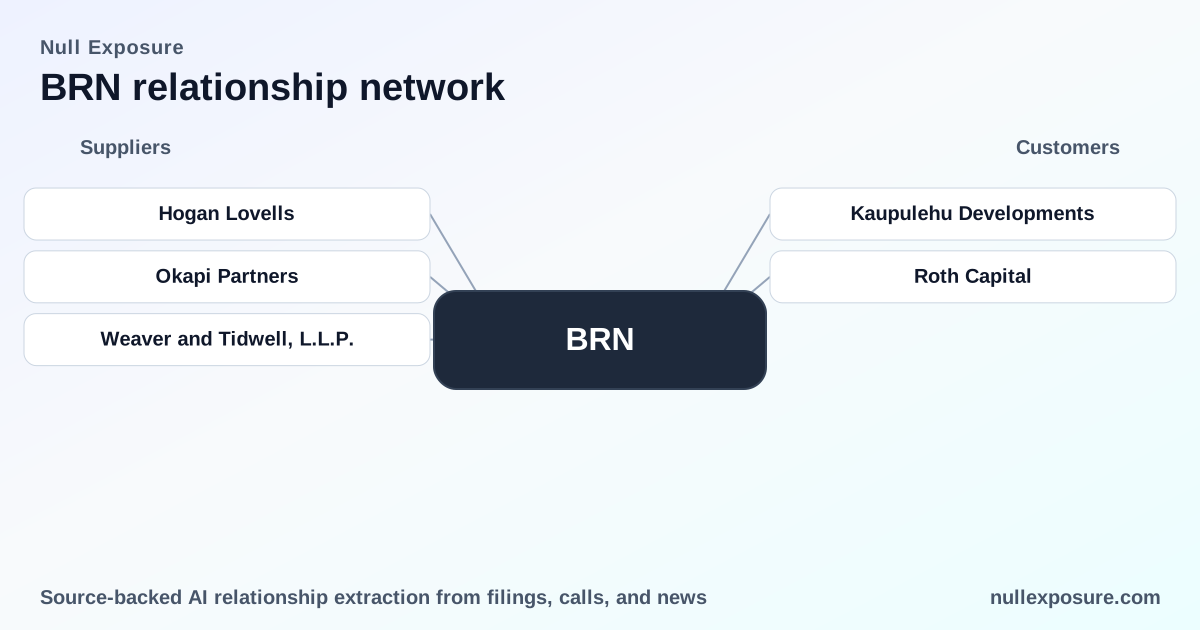
Customer relationships: Kaupulehu Developments and Roth Capital
Barnwell’s public relationship mentions in recent news are limited in number but material to evaluate commercial tactics and cash events.
Kaupulehu Developments
Kaupulehu executed an agreement in November 2025 to surrender remaining rights for Increment II for $2.0 million, of which Barnwell received $70,000 at the time of the report. This is a one-off land-rights settlement that touches Barnwell’s Hawaiian land investment activity rather than its core Canadian hydrocarbons sales. Source: StockTitan reporting of Barnwell’s FY2025 results referencing the November 2025 agreement (reported March 2026).
Roth Capital
Barnwell announced a $50 million sales agreement reported in March 2026 as a named commercial transaction with Roth Capital. The public notice frames this as a capital-marketing step; given Barnwell’s reported scale, the headline figure likely represents an arrangement for sales capacity or financing rather than immediate recurring cashflow. Source: Reuters coverage syndicated via TradingView (March 2026).
Interpreting these relationships in the context of Barnwell’s model
- The Kaupulehu item is a land-investment cash event, not a core commodity offtake, and therefore is non-recurring relative to production revenue streams. That aligns with Barnwell’s separate Land Investment segment and does not materially change its hydrocarbon counterparty concentration.
- The Roth Capital mention — framed as a $50 million sales agreement — is significant in headline terms but requires scrutiny: Barnwell’s trailing revenue and capitalization are small, so the structure, tenor, and collateral profile of any large sales or capital arrangement determine whether it changes credit risk or simply expands marketing capacity. Reported details to date are limited to the March 2026 notice.
Operational risk profile for buyers of Barnwell exposure
- Price exposure is immediate. Short-term, indexed contracts and spot sales leave Barnwell exposed to commodity cycles on a cash-basis. The February 2025 fixed-price amendment covering limited volumes demonstrates tactical use of short-term hedging but not a systemic hedge program.
- Counterparty concentration is real. Multiple excerpts confirm a small number of purchasers account for the majority of Canadian volumes; losing one would materially impact realized prices and cash receipts.
- Geographic concentration in Alberta, Oklahoma and Texas means regional price differentials and access to takeaway capacity affect realizations.
- Corporate scale compounds risk. With negative EBITDA and modest market cap, Barnwell lacks the balance-sheet depth of larger independents; working-capital swings tied to commodity payments are consequential.
What investors and partners should require in diligence
- Contract-level detail on the Roth Capital arrangement: scope, recourse, collateral, and revenue recognition timing.
- Counterparty credit lines and payment history for the primary oil, gas, and NGL purchasers.
- Clear mapping of production volumes to fixed vs. spot pricing windows for FY2026 and FY2027.
For a concise commercial risk brief and ongoing customer-relationship monitoring, visit https://nullexposure.com/ for tools and reports tailored to investor diligence.
Final read — positioning Barnwell for investors
Barnwell is a classical small-scale hydrocarbon producer with cash flows tied tightly to short-term markets and a small set of counterparties. The recent Kaupulehu cash settlement and the Roth Capital sales announcement are relevant but do not, on their face, eliminate the company’s exposure to commodity price swings and counterparty concentration. Investors should treat ownership as a high-beta commodity exposure with event-driven upside from tactical sales arrangements, but also with elevated operational and credit concentration risk.