Barinthus (BRNS): Customer Concentration and the Oxford License — What investors need to price
Barinthus Biotherapeutics develops T‑cell immunotherapies and today monetizes primarily through intellectual‑property licensing, not product sales. In FY2024 a single license relationship produced the entirety of reported revenue, and subsequent period reporting shows that license inflows were highly lumpy — a structural feature investors must price into valuation, cash‑flow forecasts, and partner negotiations. For a focused look at customer concentration and commercial risk, visit https://nullexposure.com/.
How Barinthus’s revenue model actually works
Barinthus is a clinical‑stage biopharma: its core activity is advancing novel T‑cell immunotherapeutics from research into clinical development and, ultimately, commercialization. Current monetization is dominated by licensing and collaboration receipts rather than recurring product sales, reflecting the company’s pre‑commercial stage and dependency on milestone or upfront license payments to fund operations.
- Contracting posture: the business is operating from a licensing/collaboration posture rather than a commercial sales posture; revenue is delivered in episodic license payments tied to partner agreements or milestone triggers.
- Concentration and criticality: a single partner accounted for the entire reported revenue base in FY2024, making that relationship both concentrated and operationally critical to near‑term cash flow.
- Maturity: absence of product sales and the post‑2024 drop to zero reported revenue indicate the company remains pre‑revenue from commercialization and relies on one‑off or periodic partner payments.
The Oxford University Innovation relationship: the accounting fact
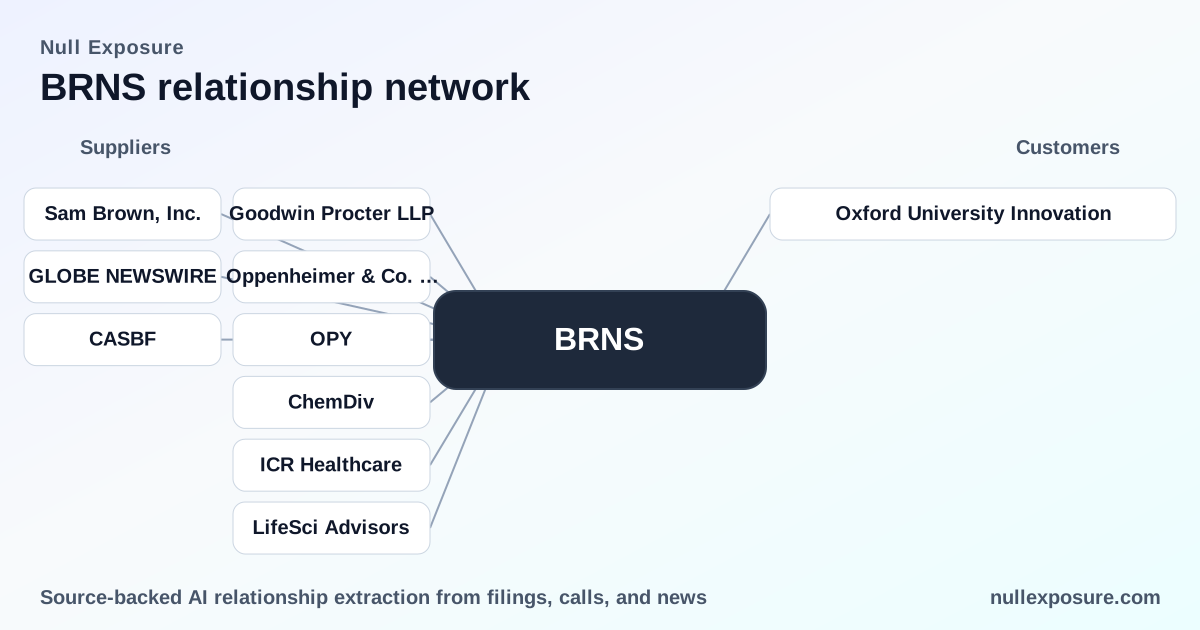
Oxford University Innovation (OUI) was reported in Barinthus’s FY2024 filings as the only licensee representing 10% or more of revenue — 100% of reported revenue in both 2023 and 2024. According to Barinthus’s FY2024 10‑K, Oxford University Innovation accounted for all material license revenue disclosed for that year. This single‑counterparty concentration is explicit in the filing and is a central commercial fact investors must evaluate (FY2024 10‑K).
What the subsequent reporting shows about payment volatility
TradingView’s coverage of the company’s post‑2025 results reported a sharp swing: revenue fell to $0 million in 2025 from $15.0 million in 2024, with the 2024 receipts identified as coming from OUI license payments. That movement confirms the license‑driven and episodic nature of cash receipts and demonstrates material volatility between reporting periods (TradingView news report on FY2025 results, published 2026).
Relationship-level summaries (each listed relationship)
- Oxford University Innovation — The FY2024 10‑K discloses Oxford University Innovation as the sole licensee accounting for 100% of Barinthus’s revenue in FY2024, establishing a clear concentration of licensing receipts with a UK research commercialization partner (Barinthus 2024 10‑K filing).
- OUI (TradingView report) — A TradingView news article covering Barinthus’s post‑2025 results states revenue was $0 million in 2025 versus $15.0 million in 2024, with the 2024 number attributed to OUI license payments, highlighting the one‑off or milestone nature of the receipts (TradingView, coverage of FY2025 results, 2026).
What these relationships imply for investors and operators
- High counterparty concentration creates execution and cash‑flow risk. When a single licensee provides the entirety of revenue, any delay, non‑renewal, or one‑time structuring of payments can produce abrupt revenue collapses — which is exactly what the 2024→2025 movement documents.
- Revenue is lumpy and milestone‑driven, not recurring. The 2024 license receipts represent episodic monetization rather than an annuity; forecasts should model sparse, event‑driven inflows rather than smooth growth curves.
- Commercial maturity is limited. With product revenue at zero in 2025 and negative operating metrics elsewhere, Barinthus is a development‑stage company relying on external license receipts and financing to fund R&D.
- Payer and buyer dynamics affect long‑term value. Company disclosures emphasize the importance of government payors and third‑party payors for eventual product adoption and reimbursement, and healthcare providers will be primary buyers and prescribers upon approval. These are company‑level constraints that affect future commercialization economics and market access, independent of current licensing income.
How to think about contracting posture, concentration, and criticality in practice
- Contracting posture: license‑first — the company’s commercial relationships are built around IP transfer and collaboration terms, not product distribution networks. This makes negotiation leverage, milestone structuring, and termination protections central to value capture.
- Concentration: single‑partner dependence — with OUI as the 100% revenue source for reporting periods, investor focus should be on contract duration, renewal terms, and the contingency structure of payments.
- Criticality: near‑term cash runway depends on partner receipts — absent product sales, partner payments and capital markets financing are the primary sources sustaining operations.
- Maturity: pre‑commercial — the company’s financial profile and the FY2025 zero‑revenue outcome show commercialization and payer engagement remain future stages rather than present sources of cash.
Tactical investor checklist
- Confirm the OUI agreement terms beyond financials: upfront versus milestone composition, payment timing, exclusivity, and termination clauses. These materially change the predictability of future inflows.
- Model scenarios with zero license receipts for multiple periods as a base case and a structured milestone inflow as an upside case.
- Monitor clinical progress and regulatory timelines that could convert license or milestone structures into recurring revenue opportunities via partnerships or eventual product sales.
- Evaluate payer‑engagement plans: because government and third‑party payors drive eventual product uptake, a commercialization plan without explicit payer strategy materially weakens long‑term forecasts.
Bottom line
Barinthus’s near‑term economics are governed by a single, material licensing relationship with Oxford University Innovation and the episodic nature of those payments. Investors and operators must treat revenue as non‑recurring until the company demonstrates repeatable partner agreements or transitions to product sales, and they should factor payer dynamics and buyer behavior into any long‑term commercialization thesis. For continued monitoring and relationship‑level intelligence, visit https://nullexposure.com/.
Key takeaway: the business is development‑stage and license‑driven; customer concentration and payment volatility are the primary commercial risks that determine valuation, financing needs, and the timetable to sustainable revenue.