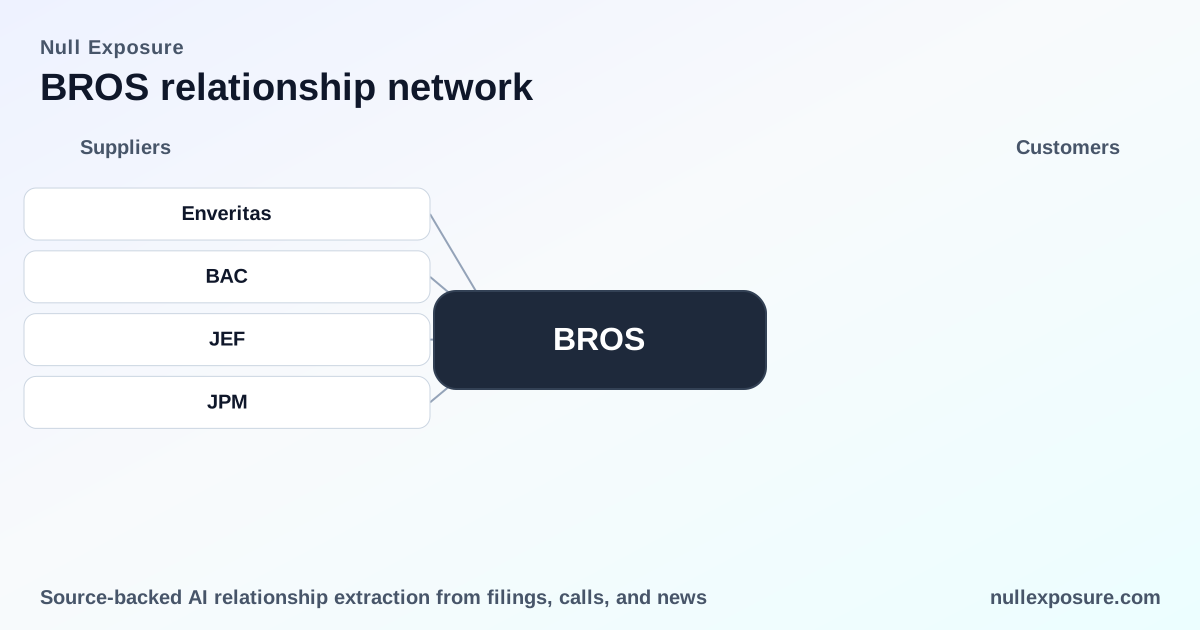
Dutch Bros (BROS): Retail partners widen distribution — what investors should know
Dutch Bros operates and franchises drive-through and walk-up coffee shops and monetizes through retail beverage sales at company-operated shops, franchise fees and royalties, and expanding branded consumer-packaged goods (CPG) sold through retail and online channels. The business combines a high-frequency, loyalty-driven retail base with an emerging wholesale and retail grocery distribution strategy that can scale brand reach without equivalent shop-level capital intensity. For a concise take and ongoing coverage, see https://nullexposure.com/.
The business model in one sentence (and why partnerships matter)
Dutch Bros is fundamentally a retail-first coffee operator: the core revenue engine is shop-level sales, augmented by franchise revenue and a nascent at-home CPG channel that distributes canned and packaged beverages through mass retailers and e-commerce. That distribution extension is strategically important because it leverages brand equity and Dutch Rewards loyalty to capture incremental spend from existing customers and new buyers at much lower marginal cost than opening new shops.
The operating posture: what the filings tell investors
Company disclosures through FY2025 make four operating- and commercial-level signals clear:
- Geographic concentration is domestic. All segment revenue is earned in the United States and, as of December 31, 2025, the company operated 1,136 shops across 25 U.S. states (811 company-operated, 325 franchised). This is a capex- and regulatory environment confined to North America, so retail partners are chosen with U.S. distribution scale in mind.
- Customer acquisition and retention are loyalty-driven. In 2025 roughly 72% of transactions were attributable to Dutch Rewards members, highlighting a tight direct-to-consumer revenue loop that retailers and CPG partners can amplify.
- Primary revenue recognition is point-of-sale retail. Retail sales from company-operated shops are recognized at the time of sale — the company remains first-and-foremost a shop-led retail operator, not a packaged-goods manufacturer.
- Core product orientation remains beverages and light food. The company emphasizes hot, iced, and blended beverages as its core offering, which frames how grocery and e-commerce partners position the at-home assortment.
These are company-level signals drawn from the firm’s FY2025 disclosures and should be treated as structural constraints on scaling strategy and partner selection.
Why the retail and e-commerce push is material
Expanding into grocery shelves and Amazon delivers three strategic benefits: incremental revenue without brick-and-mortar capex; brand trial among non-shop customers; and cross-sell opportunities back into the Dutch Rewards ecosystem. Given Dutch Bros’ $1.64 billion revenue TTM and $284.6 million EBITDA, off-premise channels can improve top-line leverage while preserving shop-level margins — but they also introduce new supply-chain and retail-margin dynamics that differ from point-of-sale coffee sales.
For more background on how brand distribution can change customer economics, visit https://nullexposure.com/.
Channel-by-channel: the partners you should know
Albertsons
Albertsons will carry Dutch Bros’ at-home assortment in select stores nationwide, giving the brand presence in a large, national grocery network that reaches suburban and value-oriented shoppers. A Sahm Capital report (Feb 10, 2026) noted the roll-out into Albertsons locations as part of the company’s FY2026 distribution expansion.
Amazon
Dutch Bros’ at-home products are available through Amazon, unlocking national e-commerce reach and convenient replenishment for loyalty members and new consumers who prefer online purchase and delivery. A Sahm Capital piece (Feb 10, 2026) specifically cited Amazon as a current channel for the at-home assortment.
H.E.B
H.E.B — a major regional grocer in Texas — is stocking Dutch Bros’ products in select stores, which provides regional depth in a large state market and a test bed for in-store consumer response. The Sahm Capital report (Feb 10, 2026) referenced H.E.B alongside national retailers in the FY2026 expansion announcement.
Walmart
Walmart shelves will carry the at-home assortment in select locations, delivering scale in value and mass channels where repeat, large-format purchases can magnify trial and frequency. A Sahm Capital news item from Feb 10, 2026 reported Dutch Bros’ availability in Walmart as part of the nationwide retail push.
(Each of the four partner items above derives from the same Sahm Capital coverage of Dutch Bros’ FY2026 CPG expansion, which specifically lists Amazon, Walmart, H.E.B., and Albertsons as distribution points.)
What these relationships imply about concentration, criticality and maturity
- Concentration: The company’s economic footprint remains U.S.-centric with shop operations across 25 states; retail partners are therefore tactical extensions rather than international market entries. This keeps channel risk concentrated in domestic retail performance and U.S. consumer trends.
- Criticality: Grocery and e-commerce partners are strategically valuable but not existential; the core cash engine remains company-operated shop sales and franchise revenues. Retail partners are important for brand scaling and margin diversification, not for replacing shop-level economics.
- Maturity: The CPG channel is nascent — FY2026 rollout language indicates early-stage distribution rather than a fully mature retail program. Expect iterative assortment, selective store footprints, and promotional testing before national parity with shop revenue.
These are company-level operational characteristics supported by the FY2025 disclosures and the FY2026 press coverage of retail rollouts.
Risks and upside for investors
- Upside: Broader retail placement and Amazon distribution create a high-leverage avenue to monetize brand equity beyond shop traffic, potentially improving revenue per customer and brand stickiness if cross-channel promotions feed Dutch Rewards sign-ups.
- Risks: Retail margins and trade promotion expense will compress gross margins relative to direct shop sales; supply-chain scaling and inventory management with partners like Walmart and Albertsons introduces execution risk; and domestic concentration exposes the firm to U.S. macro and consumer-spend cycles.
- Operational nuance: The 72% rewards transaction ratio signals high loyalty and recurring purchase behavior, which de-risks growth to an extent — retailers benefit from that loyalty if cross-channel linking is well-executed, but the company remains responsible for converting CPG buyers into repeat shop customers.
Bottom line and investor action
Dutch Bros is extending a shop-led, loyalty-rich model into grocery and e-commerce to scale brand monetization with lower incremental capex. The partnerships with Amazon, Walmart, H.E.B., and Albertsons are early-stage but meaningful distribution milestones that reduce unit economics pressure from shop openings and create new revenue channels. Monitor execution metrics — distribution velocity, promotional lift, and cross-channel loyalty conversion — to judge whether this becomes a durable profit driver.
For a structured view of partner exposures and a regular feed of relationship signals, visit https://nullexposure.com/.