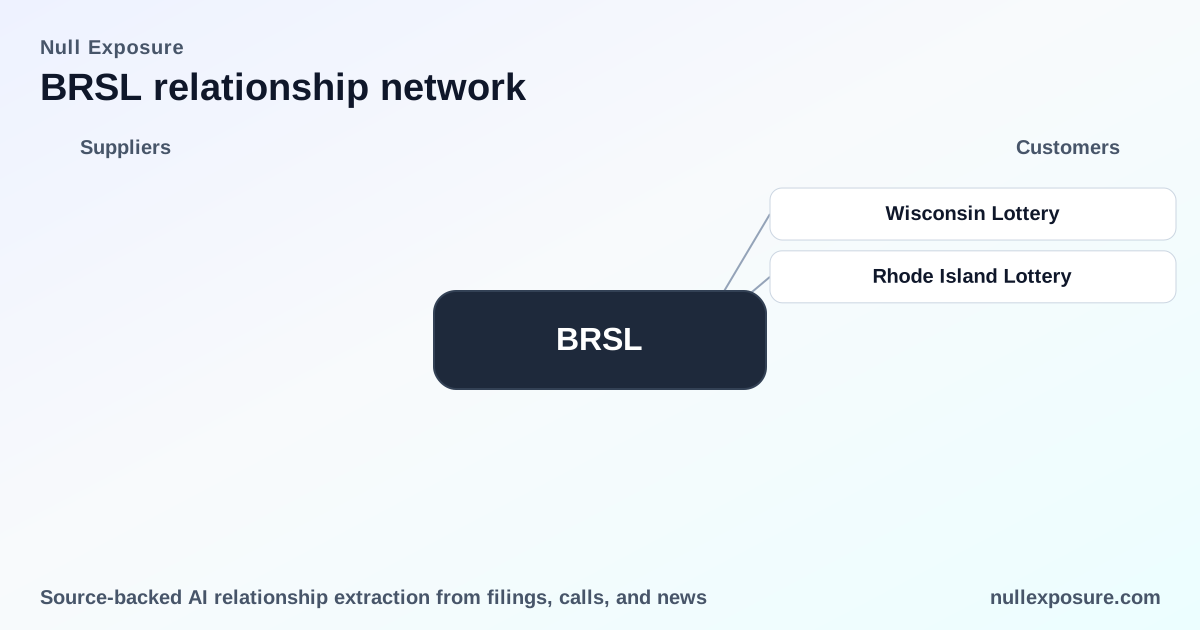
Brightstar Lottery (BRSL): Customer relationships that define the new, post‑sale operating model
Brightstar Lottery PLC runs, modernizes, and operates state lottery systems and retail/digital lottery platforms, monetizing through long‑term contracts, platform licensing (OMNIA™), systems integration, and recurring operational services. After the July 2025 divestiture of its Gaming & Digital business, Brightstar’s economics increasingly hinge on state lottery customers, multi‑year agreements, and the rollout cadence of its OMNIA platform — a profile that supports recurring revenue and high operating margins but concentrates commercial risk in a small set of public sector counterparties. For a concise monitor of customer signals and implications for valuation, see Null Exposure’s research gateway: https://nullexposure.com/.
Why customers drive valuation: a compact operating-model read
Brightstar’s business model is contract‑centric and scale‑dependent: the company sells integrated retail and digital solutions, then captures multi‑year maintenance, transaction processing, and revenue‑share or service fees. That contracting posture produces predictable recurring revenue when state lotteries commit to OMNIA deployments, and operational leverage visible in Brightstar’s strong operating margin (reported operating margin TTM 26.2%). At the same time, customer concentration in state lotteries creates concentration risk: each major contract meaningfully affects near‑term revenue visibility and long‑run growth prospects. Brightstar’s market cap ($2.28B), TTM revenue ($2.51B), and EBITDA ($882M) frame a compact, profitable core business that is nevertheless sensitive to the timing of customer implementations and renewals.
- Company‑level signal: there are no explicit operational constraints reported in the relationship scope that would limit Brightstar’s customer activity; public reporting and news coverage show normal contract wins and ongoing fulfillment.
- Key commercial vector: OMNIA™ rollouts are the primary lever for new revenue and cross‑sell; state lottery adoption and multi‑year contract terms are the primary drivers of backlog and visibility.
Explore further company intelligence and customer tracking: https://nullexposure.com/.
Customer relationships in the public record
Wisconsin Lottery — large OMNIA win and an eight‑year contract
Brightstar’s subsidiary signed an eight‑year, long‑term contract with the Wisconsin Lottery to modernize retail and digital solutions using its OMNIA™ platform, positioning the company to materially enhance sales and retail modernization in that state (Intellectia, March 9, 2026: https://intellectia.ai/news/stock/brightstar-signs-longterm-contract-with-wisconsin-lottery). Earlier reporting also documents Wisconsin’s selection of Brightstar for OMNIA rollout, establishing that the relationship transitioned from selection to a multi‑year implementation (iGamingFuture, FY2025 reporting: https://igamingfuture.com/igt-lottery-rebrands-as-brightstar-ahead-of-gaming-sale/).
Source citations: Intellectia (March 9, 2026) and iGamingFuture (FY2025).
Rhode Island Lottery — ongoing fulfillment after a security incident
Reporting on a 2024 systems breach noted that Brightstar continues to fulfill its contractual obligations to the Rhode Island Lottery, indicating the company retained operational responsibility and contractual continuity through remediation and customer engagement (Rhode Island Current, FY2025 reporting: https://rhodeislandcurrent.com/briefs/r-i-lottery-tech-suppliers-systems-were-breached-in-2024-thousands-were-impacted/). This underscores Brightstar’s role as a mission‑critical supplier whose operational continuity is material to state lottery functioning.
Source citation: Rhode Island Current (news brief, FY2025).
Apollo Global Management — buyer in the July 2025 divestiture that reshaped Brightstar
The sale of the former Gaming & Digital business to an Apollo‑owned holding company completed on July 1, 2025, and represents the major corporate transaction that refocused Brightstar on lottery operations; press coverage cited a $4 billion transaction and a capital return to IGT shareholders as part of the deal structure (StreetInsider, July 2025: https://www.streetinsider.com/Corporate+News/International+Game+Tech+(IGT)+Completes+Sale+of+Gaming+&+Digital+Business,+Announces+$1.1B+Capital+Return+to+Shareholders/25003089.html). Additional analyst coverage referenced the same restructuring as the material corporate event reshaping the company’s customer and product focus (Investing.com/Argus, FY2026 reporting).
Source citations: StreetInsider (July 2025) and Investing.com/Argus (FY2026).
What investors should take from each relationship
- Wisconsin Lottery: This is a near‑term revenue and backlog catalyst. An eight‑year contract written around OMNIA delivers predictable recurring services and implementation revenue and strengthens Brightstar’s referenceability for other U.S. states. (Intellectia, March 2026; iGamingFuture, FY2025.)
- Rhode Island Lottery: Continued fulfillment through a security incident demonstrates Brightstar’s operational centrality and the reputational and operational risk inherent to running state lottery systems. Incidents like these can attract regulatory scrutiny and incremental contractual obligations. (Rhode Island Current, FY2025.)
- Apollo Global Management: The 2025 sale to Apollo crystallized Brightstar’s customer focus and reduced product complexity by carving out Gaming & Digital; this structural simplification improves margin comparability but concentrates growth dependence on the lottery segment. (StreetInsider, July 2025; Investing.com/Argus, FY2026.)
Risk and opportunity — what moves the multiple
Brightstar’s valuation is sensitive to contract cadence and execution. Upside catalysts include accelerated OMNIA rollouts and new state awards that compound recurring service revenue and extend contractual duration. Downside risks include security incidents, contract renewals that price downward, and the concentration effects of a customer base dominated by a relatively small number of state lotteries.
- Operational leverage is real: strong operating margins and EBITDA suggest the company converts new contract wins into meaningful profit.
- Concentration risk is material: each large state contract like Wisconsin meaningfully impacts revenue and should be tracked as a discrete event.
- Reputational and regulatory exposure arises from any security failures or delivery issues given Brightstar’s mission‑critical role.
Bottom line and monitoring checklist
Brightstar is a contract‑heavy, high‑margin lottery operator whose next 12–24 months will be defined by OMNIA deployments and the execution of long‑term state contracts. Investors should watch (1) official contract announcements and effective start dates, (2) rollout progress and implementation milestones for OMNIA, and (3) any further post‑sale structural changes tied to the Apollo transaction and residual obligations.
For direct access to ongoing customer tracking and to integrate these relationship signals into portfolio workflow, visit Null Exposure’s research portal: https://nullexposure.com/.