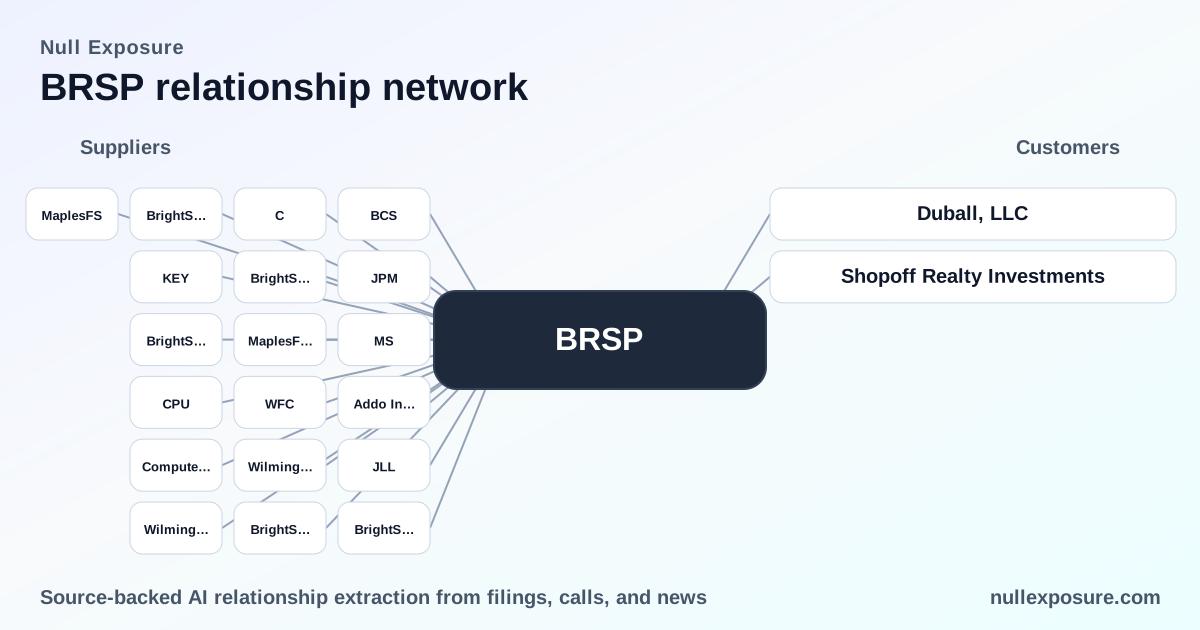
BrightSpire Capital (BRSP) — Customer relationships that move capital and property
BrightSpire Capital (NYSE: BRSP) operates as a CRE credit REIT that originates, acquires, finances and manages a U.S.-focused portfolio of first mortgage loans and net-leased properties. The company monetizes through interest income on senior mortgage lending, capital gains and fee income from asset sales and portfolio management, and stable cash flows from long-term net leases where tenants carry operating expenses. For investors, BRSP’s economics are driven by its CRE lending book as the core product, supplemented by opportunistic sales of real estate assets and the yield spread between loan originations and funding costs. Visit https://nullexposure.com/ for a concise marketplace view of counterparties and exposure mapping.
What the customer relationships reveal about BRSP’s operating posture
BrightSpire’s public activity shows a dual business model: loan originations and portfolio turnover through property sales. The company acts as lender, seller (through subsidiaries), and servicer of CRE assets; its contracts skew long-term for net-leased assets and transactional for mortgage lending. The firm’s geographic footprint is concentrated in the United States and the balance sheet carries material unfunded lending commitments — management reported $106.3 million of gross unfunded lending commitments at December 31, 2024 — indicating an active pipeline and ongoing credit deployment capacity.
Key company-level signals:
- Contracting posture: Long-term net leases for property cash flow; commercial mortgage loans structured as senior, first-lien positions.
- Geographic concentration: Predominantly U.S. exposure, implying domestic market and regulatory sensitivity.
- Role complexity: BRSP functions as lender, asset manager/service provider, and occasional seller through subsidiaries.
- Product focus and maturity: CRE debt investments (first mortgage loans) are the core, with net-leased property holdings as a complementary, income-stable segment.
- Balance-sheet optionality: Unfunded commitments above $100M denote active lending pipelines and potential capital deployment needs.
Customer relationships: explicit deal-level activity investors should track
Below I summarize the public customer interactions that reflect BRSP’s market activity and counterparty network. Each item is drawn from the cited news or press release.
Pearl Realty Management LLC — Paragon Building sale
BrightSpire sold the Paragon Building to Pearl Realty Management LLC for $28 million, a transaction that reduces real estate inventory while crystallizing proceeds and reallocating capital toward core lending or other assets. This deal was reported by MarketScreener on May 2, 2026. (MarketScreener, May 2, 2026)
Duball, LLC — 1201 Connecticut Ave NW disposition
An affiliate of Duball, LLC acquired 1201 Connecticut Avenue NW from a BrightSpire subsidiary in a sale where JLL acted for the seller; the transaction underscores BRSP’s strategy of monetizing non-core assets through brokered dispositions. JLL’s deal announcement and a YieldPro report provide the market context, with reporting clustered in 2024–2026 (JLL press release, March 2026; YieldPro, Aug 2024).
Shopoff Realty Investments — senior mortgage financing (Cierra Apartments)
BrightSpire’s finance arm provided a senior loan of approximately $17.815 million for the Cierra Apartments project refinance in Whittier, California, showing BRSP’s active role as lender on small-to-mid-sized multifamily transactions. The refinancing was brokered by JLL Capital Markets and documented in press coverage dated December 2, 2025 (Shopoff/SahmCapital coverage, Dec 2, 2025; StockTitan briefing, March 2026).
(Where relationships repeat in the public feed, the facts confirm a pattern: BRSP both extends senior mortgage credit and periodically converts property equity through sales via brokered channels.)
Why these relationships matter to an investor or operator
These counterparties and transactions illustrate three practical dynamics of BRSP’s business model:
- Capital recycling: Sales to buyers like Duball and Pearl free up liquidity and reduce operating complexity, allowing redeployment into higher-yielding mortgage loans or to shore up liquidity.
- Credit origination engine: Loans to sponsors such as Shopoff demonstrate BRSP’s role as a direct CRE lender, which creates interest income but exposes the company to underwriting risk and concentration in localized markets.
- Execution through brokers: Repeated use of intermediaries (JLL) signals BRSP’s reliance on market distribution channels to execute sales and syndicate debt — a predictable execution posture that supports disposition timing and price discovery.
Risks and constraints that shape valuation and counterparty exposure
Investors should weigh a set of company-level constraints that are explicit in regulatory and corporate disclosures:
- Long-term net leases drive stable cash flows but concentrate tenant credit risk and hybrid operating obligations (insurance, taxes, capex pass-throughs).
- U.S.-centric geography creates single-market exposure; macro and regional CRE cycles will disproportionately affect performance.
- Core product concentration in CRE debt elevates sensitivity to credit cycles and interest-rate spread compression.
- Material unfunded commitments (>$100M) signal growth optionality but also potential capital funding needs and underwriting risk accumulation.
- Multiple operational roles (lender, servicer, seller) create complexity in governance and execution, requiring robust asset management to preserve NAV.
Key takeaway: BRSP’s earnings profile is driven by the spread on originated CRE loans and selective gains on property sales; both lines are dependent on disciplined underwriting and the firm’s ability to execute dispositions at attractive prices.
Practical implications for due diligence
- Review recent loan-level underwriting and concentration by geography and sponsor to assess downside risk from tenants and local markets.
- Track auction and broker activity (JLL listings, property sale announcements) as forward indicators of portfolio rotation and realized gains/losses.
- Monitor unfunded commitment drawdown and liquidity sources, as these determine BRSP’s capacity to originate without diluting equity.
For a concise map of counterparties and exposure that complements this read, see our portal at https://nullexposure.com/ — the homepage provides a focused lens on counterparties and transaction history for BRSP and comparable CRE credit REITs.
Bottom line
BrightSpire’s public customer interactions reflect a deliberate strategy of combining first-mortgage lending with opportunistic asset sales to generate yield and liquidity. The named transactions with Pearl, Duball and Shopoff illustrate both sides of that model: loans that produce income today and sales that crystallize capital for redeployment. Investors should price BRSP by its credit underwriting quality, the health of U.S. CRE markets, and management’s discipline in converting inventory without compressing NAV.